

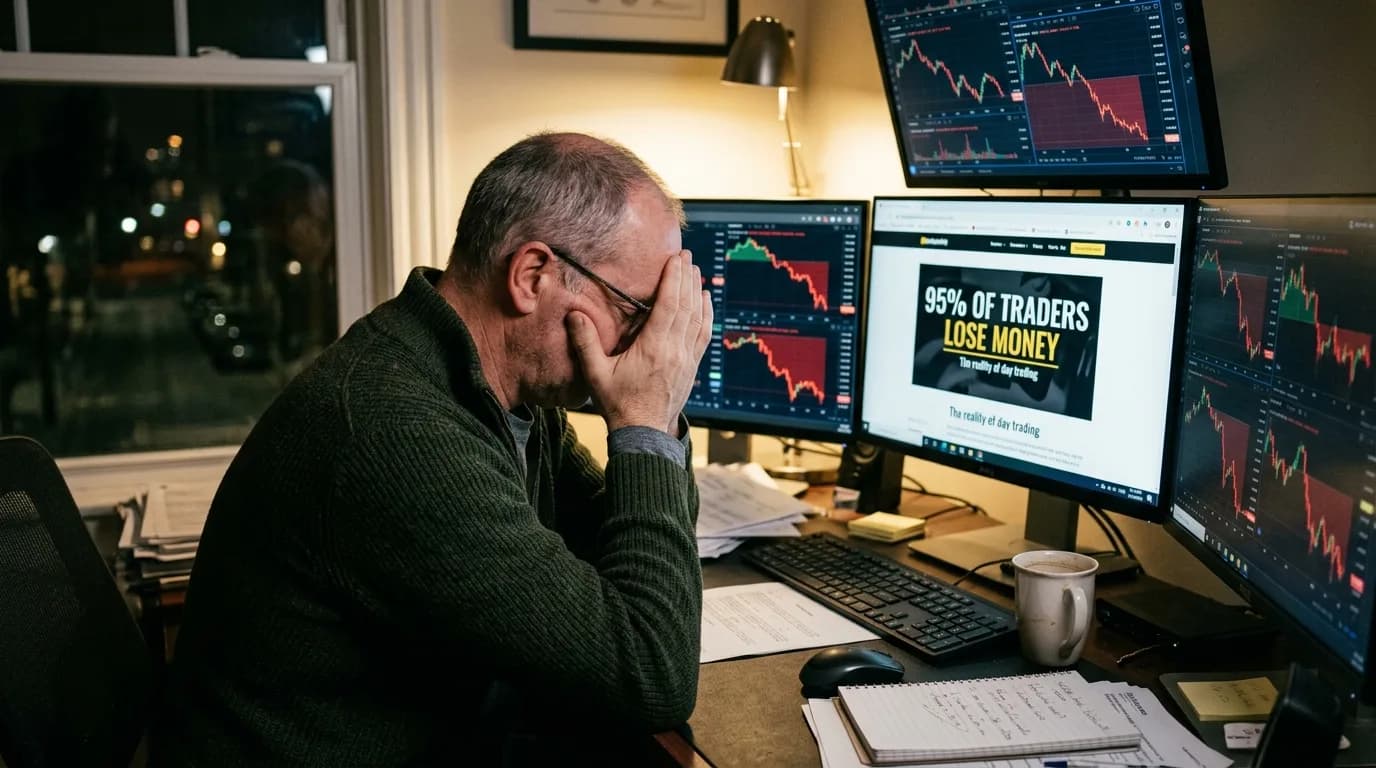
Why 95% of Traders Lose Money (And the 3 Things Winners Do Differently)
EU regulations now require brokers to disclose the percentage of retail accounts that lose money. The numbers are sobering: 70–80% of accounts at major brokers are unprofitable. In crypto futures — where 50x–125x leverage is available to anyone with $100 — the failure rate is likely higher. The “95% of traders lose” statistic may be an approximation, but the underlying reality is clear: the vast majority of retail traders destroy their capital. Understanding why is the first step toward being in the minority that doesn't.
The Data: What Broker Disclosures Show
| Broker Type | Loss Rate | Source |
|---|---|---|
| EU CFD brokers (avg) | 76% | ESMA disclosure requirements |
| US forex brokers | 72% | CFTC quarterly reports |
| Crypto futures (estimated) | 80–90% | Exchange data analysis |
| Day traders (academic study) | 97% | Barber et al. (2020), Taiwan Exchange |
The Taiwan study is particularly striking: of 350,000 day traders tracked over 15 years, only 1,000 (0.3%) were consistently profitable after fees. The vast majority lost money, and those who persisted longest lost the most because they had more time to accumulate losses.
The 3 Things Winners Do Differently
1. They Have a Systematic Edge (Not Intuition)
Losing traders make decisions based on feelings, news headlines, social media tips, or pattern recognition that hasn't been validated. Winning traders have tested, documented strategies with defined entry rules, exit rules, and position sizing. They know their strategy's win rate, average winner, average loser, and maximum drawdown — because they've backtested it across years of data.
The edge doesn't need to be large. A 55% win rate with 1.5:1 reward-to-risk is enough to build wealth over time. But you need to KNOW that your edge exists — not hope it does. Backtesting provides this knowledge.
2. They Manage Risk Ruthlessly
Winning traders risk 1–2% of capital per trade. Period. No exceptions for “sure things.” No doubling down on losers. No revenge trading after a loss. The math is simple: at 2% risk per trade, 10 consecutive losses costs 18% of capital. At 10% risk, 10 losses costs 65% — functionally unrecoverable.
Risk management also means knowing when NOT to trade. If the market doesn't match your strategy's conditions, winning traders sit on their hands. Losing traders force trades to satisfy the urge to be active.
3. They Track Data and Adapt
Winning traders treat their trading as a business with metrics. They track: win rate by market condition, average hold time for winners vs losers, performance by day of week/time of day, drawdown frequency and recovery time. This data reveals what's working and what isn't — enabling targeted improvements rather than random changes.
Losing traders change strategies after every losing streak, never accumulating enough data to know if any single approach works. They chase the next “perfect” strategy instead of perfecting one approach.
The Psychology Factor
Beyond systems and risk management, psychology separates the profitable minority from everyone else. Two cognitive biases cause the most damage:
Loss aversion: Research by Kahneman and Tversky shows that losses feel approximately 2.5 times more painful than equivalent gains feel pleasurable. In trading, this manifests as holding losers too long (hoping they'll recover) and cutting winners too short (locking in the good feeling). The result is exactly backwards from optimal — small wins and large losses. Profitable traders recognize this bias and enforce mechanical exits that override the instinct to hold or cut prematurely.
Recency bias: Traders disproportionately weight recent events. After three winning trades, confidence inflates and position sizes increase. After three losses, fear takes over and signals get skipped. Both reactions degrade the strategy's statistical edge. A strategy designed for consistent 2% risk per trade doesn't work when the trader varies between 1% and 5% based on recent results.
The most effective psychological defense is automation — or at minimum, pre-written rules that remove real-time decision-making. When entry, exit, and position size are determined before the trade, emotional interference is minimized.
The Role of Backtesting
Backtesting addresses all three failure modes simultaneously. It provides a systematic edge (you know your strategy's historical performance), enforces risk management (you can test different position sizes and stops), and generates data for analysis (every trade is recorded and categorized). Traders who backtest before deploying capital have a structural advantage over those who learn through live losses.
The uncomfortable truth: Most traders fail because they skip the boring work. Building a strategy, backtesting it across years of data, analyzing the results, refining the approach, testing again — it's tedious. But it's exactly what the profitable 5% do. They're not smarter or luckier. They're more disciplined about the process.
Start with backtesting, not live trading
Test your strategy ideas against historical data, refine based on results, and build confidence in your edge before risking real capital. Get started free →
FAQ
Is it true that 95% of traders lose money?
EU broker disclosures show 70–80% retail account loss rates. Crypto futures likely 80–90%. Academic studies show 97%+ of day traders are unprofitable. The exact number varies but the majority consistently lose.
What do profitable traders do differently?
Three things: (1) Systematic tested edge, not intuition. (2) Ruthless risk management — 1–2% per trade. (3) Data tracking and adaptation. They treat trading as a statistical business.
Can backtesting improve profitability?
Significantly. Avoids the #1 failure mode: discovering a strategy doesn't work after losing real money. Builds confidence during drawdowns through historical evidence.
Further Reading
About the Author
Financial data analyst focused on crypto derivatives and on-chain metrics. Expert in futures market microstructure and funding rate strategies.
FAQ
Is it true that 95% of traders lose money?▾
Broker disclosure data consistently shows 70-80% of retail CFD/forex accounts lose money (required by EU regulators). In crypto futures, the numbers are likely worse due to higher leverage. The '95%' figure comes from older studies and includes traders who quit after initial losses. The actual number of consistently unprofitable active traders is probably 75-85%.
What do profitable traders do differently?▾
Three consistent patterns emerge from research: (1) They have a systematic edge — tested rules, not gut feelings. (2) They manage risk ruthlessly — 1-2% per trade, never more. (3) They track performance data and adapt. Profitable traders treat trading as a statistical business, not an exciting activity. They're often described as 'boring' by peers because they follow rules mechanically.
Can backtesting improve my chances of profitability?▾
Significantly. Traders who backtest strategies before deploying capital avoid the most common failure mode: discovering a strategy doesn't work after losing real money. Backtesting also builds confidence in a system during drawdowns — when you've seen 100 historical drawdowns recover, you're less likely to panic and abandon the strategy during drawdown #101.
Further reading
Related articles
Comments (0)
Loading comments...