

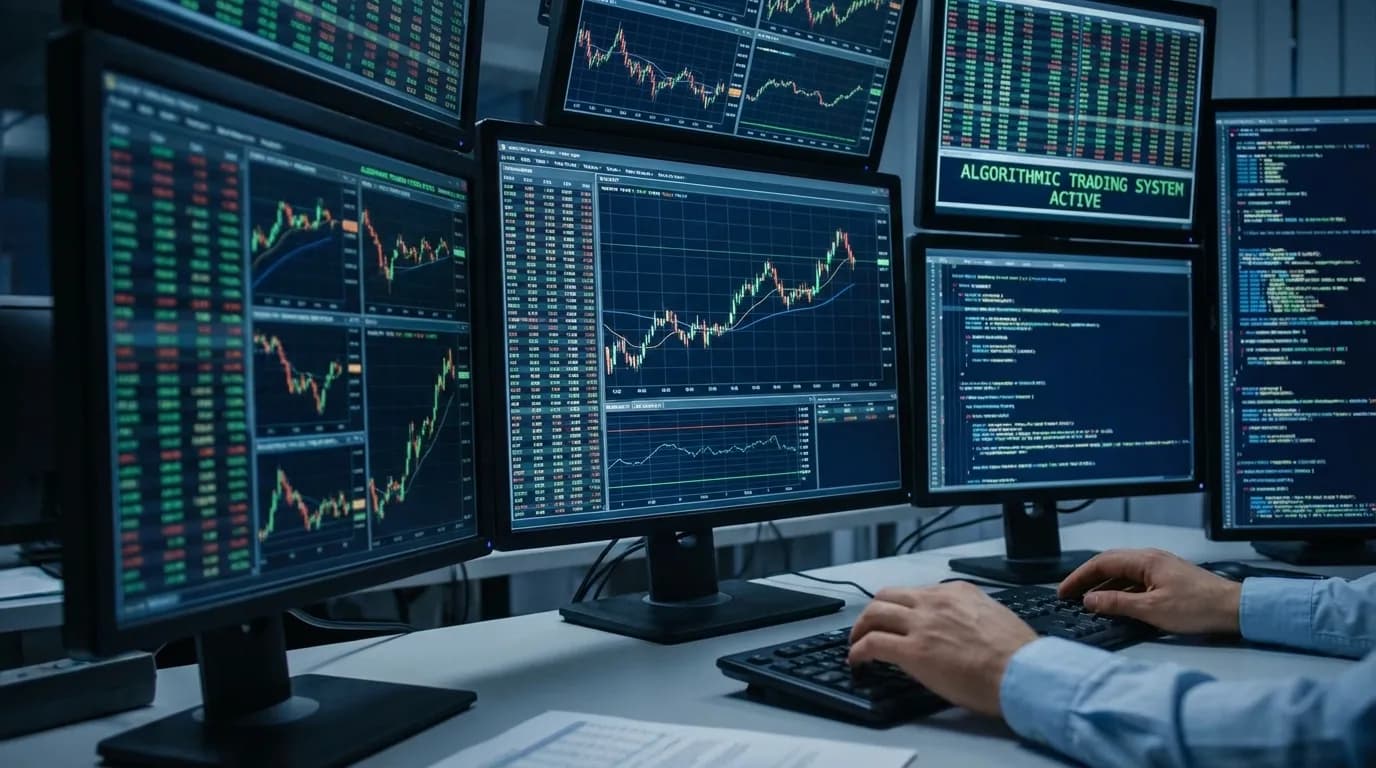
Algorithmic Trading Explained: How Machines Trade
Algorithmic trading is the practice of using computer programs to execute trading strategies based on predefined rules. Instead of manually watching charts and placing orders, an algorithm monitors market conditions and acts when its criteria are met — faster, more consistently, and without the emotional biases that plague human decision-making.
In cryptocurrency markets, where prices move around the clock and volatility can spike without warning, algorithmic approaches have become the dominant mode of professional trading. Estimates suggest that over 70% of crypto futures volume on major exchanges originates from automated systems. Understanding how algorithmic trading works is no longer optional for serious market participants — it is foundational.
From Idea to Algorithm
Every algorithmic strategy starts as a trading hypothesis. The process of turning that hypothesis into a working algorithm follows a structured pipeline:
- Hypothesis formulation — «When Bitcoin’s RSI drops below 30 and volume exceeds the 20-day average, a bounce is likely within 4 hours.»
- Formalization — translate the idea into precise rules: entry conditions, exit conditions, position sizing, and risk limits. Ambiguity must be eliminated — the algorithm cannot interpret «probably» or «feels overbought.»
- Backtesting — simulate the strategy against historical data to evaluate performance. This reveals whether the hypothesis has statistical merit or is merely an illusion of pattern recognition.
- Optimization — adjust parameters to improve risk-adjusted returns while guarding against overfitting. The goal is finding robust parameter zones, not a single optimal point.
- Paper trading — run the algorithm in real-time with simulated capital to verify that live market behavior matches backtest assumptions.
- Live deployment — execute with real capital, starting with small position sizes and gradually scaling up as confidence builds.
StratBase.ai focuses on steps 1 through 4, allowing traders to describe strategies in natural language and receive backtested results without writing code. The AI translates human concepts into formal strategy specifications that the Rust-based backtesting engine can execute across years of historical data in seconds.
Types of Algorithmic Strategies
| Strategy Type | Logic | Holding Period | Typical Instruments |
|---|---|---|---|
| Trend Following | Enter in the direction of established trends using moving averages, breakouts, or momentum indicators | Days to weeks | BTC, ETH, major alts |
| Mean Reversion | Bet on price returning to a statistical average after overextension | Hours to days | Range-bound pairs |
| Arbitrage | Exploit price differences between exchanges or related instruments | Seconds to minutes | Cross-exchange pairs |
| Market Making | Provide liquidity by quoting both buy and sell prices, profiting from the spread | Seconds | Low-liquidity altcoins |
| Sentiment-Based | Trade based on funding rates, open interest shifts, or social media signals | Hours to days | Perpetual futures |
Each strategy type carries different risk characteristics. Trend following strategies typically have lower win rates (30–45%) but large average winners. Mean reversion strategies have higher win rates (55–70%) but smaller payoffs per trade. Understanding these profiles helps set realistic expectations before backtesting.
Advantages of Algorithmic Trading
The benefits extend well beyond speed of execution:
- Emotional discipline — algorithms do not panic sell during flash crashes or FOMO into parabolic moves. They execute the rules, period. This alone is worth more than most indicators.
- Consistency — the same conditions always produce the same actions. No «I had a bad day» trades. No revenge trading after losses.
- Scalability — a single algorithm can monitor hundreds of instruments simultaneously, capturing opportunities across BTC, ETH, and dozens of altcoins that a human would miss.
- Quantifiable edge — backtesting provides statistical evidence of whether a strategy works, replacing guesswork with data. You can know your expected Sharpe ratio, drawdown, and win rate before risking a single dollar.
- 24/7 operation — critical in crypto where markets never close and significant moves often happen during off-hours in your timezone.
Common Pitfalls and How to Avoid Them
Algorithmic trading is not a guaranteed path to profits. The most frequent mistakes include:
- Overfitting — tuning parameters to perfectly match historical data produces strategies that fail in live markets. Use walk-forward testing and out-of-sample validation to detect overfitting. If performance degrades dramatically out-of-sample, the strategy is likely curve-fit.
- Ignoring transaction costs — a strategy that trades 50 times per day needs to overcome substantial fee drag. Always include realistic fee estimates (typically 0.04–0.1% per trade for futures) in backtests. A strategy with 0.2% average profit per trade loses its edge entirely at 0.1% fees per side.
- Survivorship bias — testing only on assets that still exist (e.g., current top-100 coins) inflates results. Many tokens that existed in 2021 have since been delisted.
- Curve fitting disguised as optimization — testing hundreds of parameter combinations and selecting the best one is not optimization; it is data mining. Limit parameter ranges and require consistent performance across ranges.
- Ignoring regime changes — a strategy optimized during a bull market may fail catastrophically in a bear market or sideways consolidation. Test across multiple market environments to ensure robustness.
The best algorithmic strategies are simple enough to explain in one sentence, robust enough to work across multiple instruments, and boring enough that they would never go viral on social media. Complexity is not a virtue — robustness is.
Getting Started Without Code
Historically, algorithmic trading required programming skills in Python, C++, or specialized languages like Pine Script. Modern no-code platforms have democratized access. On StratBase.ai, traders can describe a strategy concept to the AI assistant, which translates it into a formal specification with entry/exit conditions, indicators, and risk parameters. The Rust backtesting engine then simulates the strategy across historical data, delivering detailed performance metrics including Sharpe ratio, profit factor, maximum drawdown, and a full equity curve.
A typical workflow looks like this: tell the AI «I want to buy BTC when RSI crosses below 30 on the 4H chart with a 2% stop-loss and 4% take-profit.» The AI formalizes this into a complete strategy specification, and within seconds you have backtest results spanning years of market data. Iterate on the idea by adding filters, adjusting parameters, or trying different instruments.
This approach lets traders focus on the intellectual challenge — developing and validating trading hypotheses — rather than wrestling with code syntax. The barrier to algorithmic trading has never been lower, but the intellectual rigor required to build profitable strategies remains as high as ever.
Further Reading
About the Author
Financial data analyst focused on crypto derivatives and on-chain metrics. Expert in futures market microstructure and funding rate strategies.
FAQ
What is algorithmic trading?▾
Algorithmic trading uses computer programs to automatically execute trades based on predefined rules. The algorithm monitors market data, identifies trading signals according to its rules, and places orders without human intervention. Algorithms range from simple (buy when price crosses above moving average) to complex (machine learning models analyzing thousands of variables simultaneously).
How much of the market is algorithmic trading?▾
Estimates vary, but algorithmic trading accounts for 60-80% of US equity volume, 40-60% of forex volume, and growing percentages of crypto volume. High-frequency trading (a subset of algo trading) alone accounts for roughly 50% of US equity volume. The market is increasingly dominated by machines trading against machines.
Can retail traders do algorithmic trading?▾
Yes, with caveats. Retail traders can build and deploy simple algorithms using platforms like QuantConnect, Jesse, or 3Commas. However, retail algorithms can't compete with institutional HFT on speed. The retail advantage is in strategies that don't require microsecond execution: trend following, mean reversion on daily/4-hour timeframes, and event-driven strategies.
Comments (0)
Loading comments...