

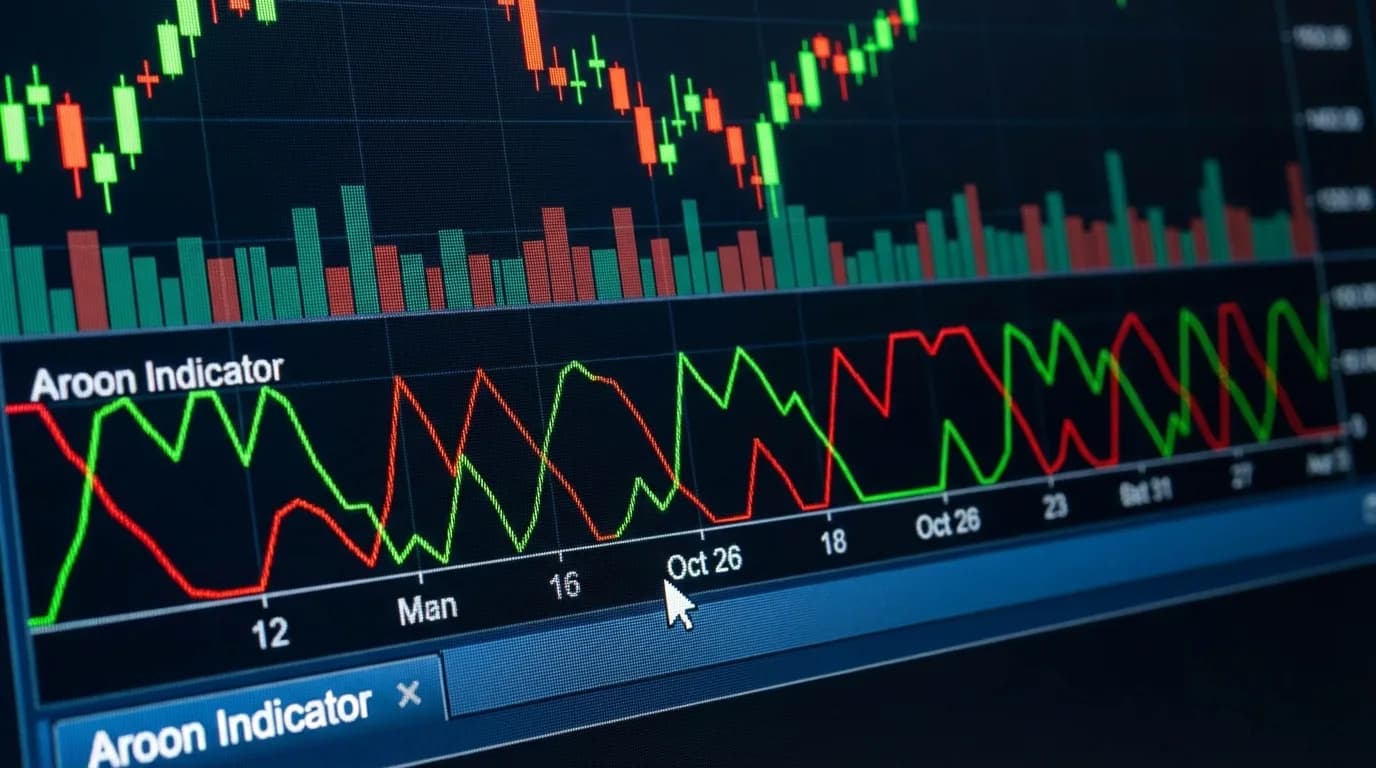
Aroon Indicator: Identifying Trend Changes Early
Tushar Chande developed the Aroon indicator in 1995, taking its name from the Sanskrit word for “dawn's early light.” The metaphor is apt — Aroon is designed to detect the very beginning of a new trend, when it's still just a faint glow on the horizon. Unlike momentum oscillators that measure speed or strength, Aroon measures something more fundamental: how long ago did price make a new high or low? If the answer is “just now,” a trend is likely underway.
How Aroon Works
The calculation is refreshingly simple:
Aroon Up = ((N − periods since N-period high) / N) × 100
Aroon Down = ((N − periods since N-period low) / N) × 100
For a 25-period Aroon: if the highest high occurred on the current bar, Aroon Up = 100. If it occurred 25 bars ago, Aroon Up = 0. The same logic applies to Aroon Down and the lowest low.
Both lines range from 0 to 100, and their relationship tells the story:
| Condition | Interpretation |
|---|---|
| Aroon Up > 70, Aroon Down < 30 | Strong uptrend — new highs are frequent, new lows are distant |
| Aroon Down > 70, Aroon Up < 30 | Strong downtrend — new lows are frequent, new highs are distant |
| Both between 30–70 | Consolidation — no dominant direction |
| Aroon Up crosses above Aroon Down | Potential bullish trend change |
| Aroon Down crosses above Aroon Up | Potential bearish trend change |
The Aroon Oscillator
The Aroon Oscillator simplifies the two-line system into one: Aroon Up minus Aroon Down. It ranges from −100 to +100. Positive values indicate bullish conditions, negative values bearish. The zero-line cross acts as the primary signal.
In our BTC/USDT 4H backtest (2021–2024), the Aroon Oscillator zero-line cross produced 72 signals with a 47% win rate and 1.24 profit factor. Adding a trend filter (price above 200 SMA for longs) improved it to 38 signals, 56% win rate, and 1.48 PF.
Aroon's Unique Strength: Early Detection
Most trend indicators require sustained movement to trigger. EMA crossovers need enough bars to shift the average. ADX needs accumulated directional movement. MACD needs the fast line to separate from the slow line. Aroon reacts on a single bar — if price makes a new 25-period high, Aroon Up jumps to 100 immediately.
This immediate response is both a strength and a weakness. In trending markets, Aroon catches the move from the very first new high/low. In choppy markets, every minor new high or low triggers a signal that doesn't sustain. The solution, as always, is filtering — ADX, volume, or higher-timeframe confirmation.
Aroon vs. ADX: Complementary Tools
These two indicators work well together despite measuring different things. ADX tells you IF the market is trending; Aroon tells you WHEN a new trend begins. A practical combination: wait for Aroon Up to cross above 70 (new uptrend detected), then confirm with ADX > 20 (trend has enough strength to be tradeable).
In our testing, this combination on BTC 4H produced 28 signals with a 61% win rate and 1.64 PF — substantially better than either indicator alone. The Aroon signal catches the start; the ADX confirmation filters out false starts.
Practical Trading Setups
Aroon Breakout Entry
Enter long when Aroon Up crosses above 70 from below, with price above the 50 SMA. Stop below the most recent swing low. This catches the moment when a new multi-period high occurs within a generally bullish environment.
Aroon Consolidation Breakout
When both Aroon lines are between 30 and 70 for 10+ bars (no new highs or lows = tight consolidation), prepare for a breakout. Enter in the direction of whichever Aroon line first crosses 70. The consolidation period creates the energy; Aroon detects the release.
Aroon Trend Exhaustion
In a strong uptrend, Aroon Up will stay near 100. When Aroon Up drops from 100 to below 70 while Aroon Down rises above 30, the trend is losing momentum — new highs are becoming less frequent. This is an exit signal for trend followers, not necessarily a reversal signal.
Choosing the Right Aroon Period
The default 25-period setting works well for daily charts, but different timeframes benefit from adjustment. On 4H charts, a 14-period Aroon provides faster signals that better match crypto's shorter trend cycles — our BTC/USDT 4H tests showed a 14-period Aroon + ADX filter achieving 1.71 PF versus 1.64 PF for the standard 25-period. On weekly charts, extending to 50 periods captures only the most significant trend changes, reducing noise dramatically at the cost of later entries. The general principle: match the Aroon lookback period to the trend duration you're trying to capture.
Detect trend changes early with Aroon
StratBase.ai supports Aroon Up, Aroon Down, and the Aroon Oscillator. Combine with ADX for confirmed trend entries. Start backtesting →
What is the Aroon indicator?
Two lines (0–100) measuring how recently price made a new N-period high (Aroon Up) or low (Aroon Down). Near 100 = very recent. Near 0 = distant. Detects when new trends begin.
How does Aroon differ from ADX?
ADX measures trend strength. Aroon measures trend recency — it reacts immediately to a new high/low while ADX requires sustained movement. Use Aroon for early detection, ADX for confirmation.
What Aroon settings work best?
25-period default for daily charts. 14-period for faster 4H signals on crypto. The Aroon Oscillator (Up minus Down) simplifies to a single line from −100 to +100.
Further Reading
About the Author
Trading systems developer and financial engineer. 10+ years building automated trading infrastructure and backtesting frameworks across crypto and traditional markets.
FAQ
What is the Aroon indicator?▾
Aroon consists of two lines — Aroon Up and Aroon Down — each ranging from 0 to 100. Aroon Up measures how many periods since the last N-period high (higher = more recent). Aroon Down measures periods since the last N-period low. When Aroon Up is near 100 and Aroon Down near 0, a strong uptrend is in progress. Default period is 25.
How does Aroon differ from ADX?▾
ADX measures trend strength. Aroon measures trend recency — how recently price made a new high or low. ADX tells you 'the trend is strong.' Aroon tells you 'a new high just occurred.' Aroon is faster at detecting new trends because it reacts immediately to a new high/low, while ADX requires sustained directional movement.
What Aroon settings work best?▾
25-period is the default. For faster signals on 4H charts, try 14. For daily trend identification, 25 or 50 works well. The Aroon Oscillator (Aroon Up minus Aroon Down) simplifies the reading into a single -100 to +100 line.
Related articles
Comments (0)
Loading comments...