

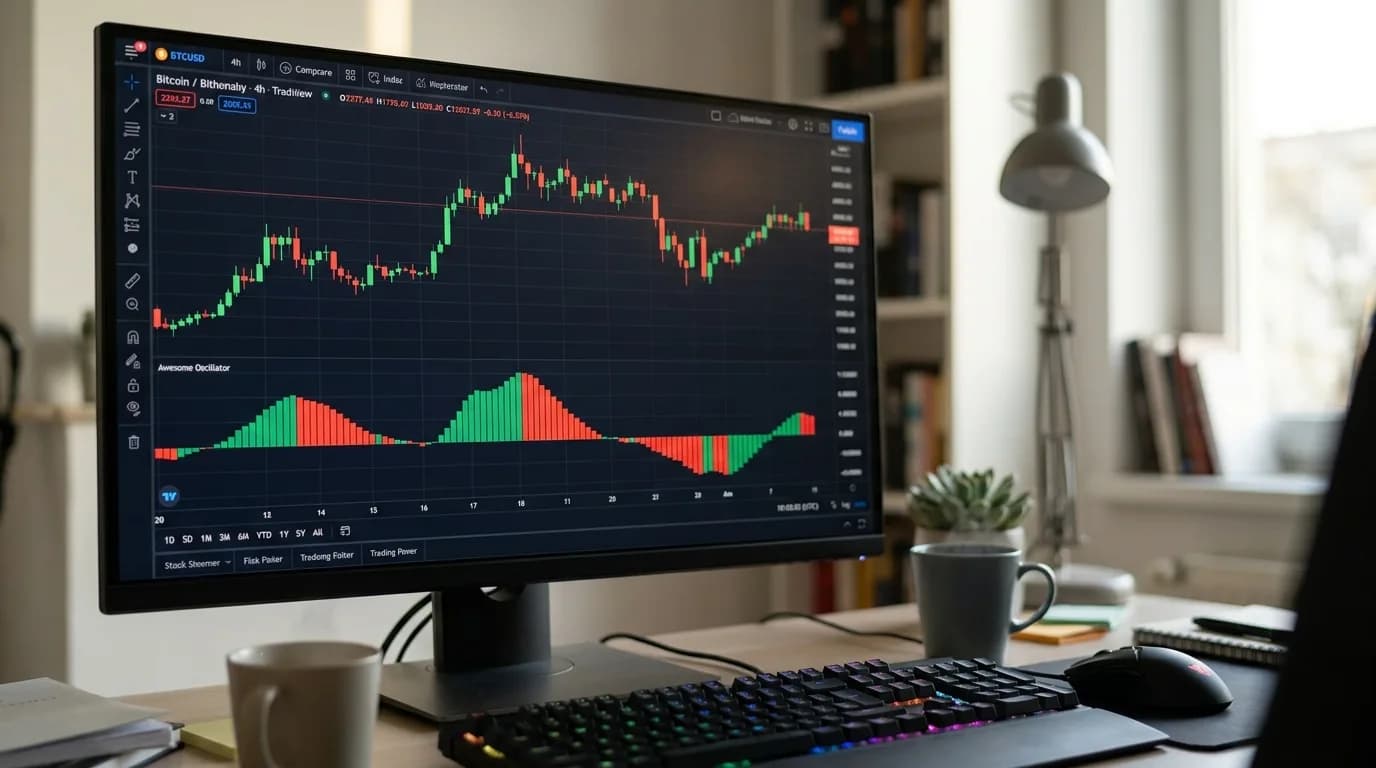
Awesome Oscillator: Bill Williams' Momentum Tool
Bill Williams, a trader and psychologist who authored “Trading Chaos,” developed the Awesome Oscillator as part of his complete trading system. Despite its somewhat grandiose name, AO is conceptually simple — it's the difference between a 5-period and 34-period SMA of the midpoint price. What makes it notable is Williams' specific signal patterns (twin peaks, saucer) that identify momentum shifts with more precision than a basic zero-line cross.
How AO Is Calculated
The formula uses the bar's midpoint rather than the close:
AO = SMA(5, Midpoint) − SMA(34, Midpoint)
Where Midpoint = (High + Low) / 2
The result is a histogram that oscillates around zero. Green bars appear when the current bar is higher than the previous bar (momentum increasing). Red bars appear when it's lower. This color-coding makes momentum acceleration visually obvious.
Using the midpoint instead of the close gives AO a slightly different character than MACD. The midpoint represents the center of each bar's range, capturing the “average” of the bar's price action rather than where it happened to close. This can reduce the impact of whipsaws caused by unusual closing prices.
The Three Main Signals
1. Zero-Line Cross
AO crossing above zero means the 5-period momentum exceeds the 34-period — bullish. Below zero is bearish. This is the simplest and most straightforward AO signal.
On BTC/USDT 4H (2021–2024): 76 signals, 46% win rate, 1.22 PF. With trend filter: 41 signals, 54% win rate, 1.44 PF. Comparable to MACD zero-line performance.
2. Twin Peaks
This is Williams' most distinctive signal. A bullish twin peaks setup requires:
- Two troughs below the zero line (both peaks pointing down)
- The second trough is shallower (less negative) than the first — bearish momentum is weakening
- A green bar follows the second trough — the trigger
The bearish version is the mirror: two peaks above zero with the second being smaller, followed by a red bar. This pattern identifies momentum exhaustion — the market tried twice to push in one direction, and the second attempt was weaker.
In our BTC 4H test, bullish twin peaks produced 21 signals with a 62% win rate and 1.68 PF. The signal is rare but high-quality.
3. Saucer
The saucer signal identifies momentum resumption rather than reversal. For a bullish saucer:
- AO is above zero
- Two consecutive red bars (momentum decelerating)
- A green bar follows (momentum resumes)
This catches the “pause that refreshes” within an ongoing trend. On BTC 4H: 48 signals, 52% win rate, 1.31 PF. Not as strong as twin peaks but much more frequent.
AO vs. MACD
The two indicators are close cousins. We compared them head-to-head on BTC/USDT 4H:
| Strategy | AO | MACD |
|---|---|---|
| Zero-line cross | PF 1.22, 76 trades | PF 1.18, 84 trades |
| Signal-line / Saucer cross | PF 1.31, 48 trades | PF 1.21, 108 trades |
| Divergence | PF 1.52, 18 trades | PF 1.48, 22 trades |
AO produces slightly better results across all signal types but with fewer trades. The 5-period fast MA (vs. MACD's 12) makes AO more selective — it only triggers when short-term momentum is clearly dominant. Whether “fewer, better signals” is preferable depends on your trading style.
Combining AO With Other Indicators
Because AO is a pure momentum indicator, it benefits from pairing with indicators that measure different market dimensions — specifically trend direction and volatility.
AO + EMA Trend Filter: The most impactful combination. When the 50 EMA is rising, take only bullish AO signals (zero-line crosses, saucers, bullish twin peaks). When the 50 EMA is falling, take only bearish signals or stay flat. On BTC/USDT 4H, this filter improved the zero-line cross win rate from 46% to 54% and pushed the profit factor from 1.22 to 1.44 — a meaningful improvement from a single additional condition. The trend filter works because AO signals in counter-trend conditions are the most common source of false signals.
AO + Support/Resistance Zones: Twin peaks signals near established support or resistance levels carry more weight than those in the middle of a range. A bullish twin peaks forming at a known support zone combines momentum exhaustion with a structural price level — two independent reasons to expect a reversal.
AO on Different Timeframes
Williams designed AO for daily charts, but it adapts to other timeframes with predictable trade-offs. On the 1H chart, the 5-period SMA covers just 5 hours — highly responsive but noisy. Saucer signals fire frequently with lower win rates (around 48%), making them marginal without a strong trend filter. Twin peaks remain valuable even on 1H because the pattern itself is a multi-bar structure that naturally filters noise.
On weekly charts, AO becomes a macro momentum tool. Zero-line crosses on the weekly are rare (4–8 per year for major crypto pairs) but carry significant directional information. A weekly AO turning positive often coincides with the start of multi-month trends. Use these weekly readings as directional bias for shorter timeframe strategies rather than as standalone entry signals.
Practical Tips
AO has no adjustable settings — Williams designed it as a fixed 5/34 system. This is both a limitation and an advantage: there's nothing to over-optimize, and everyone using AO sees the same signals. If you want adjustable parameters, use MACD.
AO works best on 4H and daily charts. On lower timeframes, the 5-period SMA is too short (covering only 25 minutes on a 5m chart), making the oscillator noisy. On weekly charts, the 34-period SMA spans 8+ months — too slow for most trading horizons.
Test Awesome Oscillator signals
StratBase.ai supports AO with twin peaks, saucer, and zero-line signals. Compare against MACD on the same data. Start testing →
FAQ
What is the Awesome Oscillator?
A histogram showing the difference between 5-period and 34-period SMA of the midpoint price. Green bars = rising momentum, red bars = falling. Part of Bill Williams' Trading Chaos system. No adjustable parameters — the 5/34 periods are fixed by design.
What are the main AO signals?
Zero-line cross (trend direction), twin peaks (momentum exhaustion — 62% win rate on BTC 4H), and saucer (momentum resumption in an ongoing trend). Twin peaks is the highest quality but rarest signal; saucer is the most frequent.
Is AO similar to MACD?
Very similar. Both measure fast vs slow MA difference. AO uses 5/34 SMA of midpoint, MACD uses 12/26 EMA of close. AO produces fewer, slightly higher-quality signals. MACD offers adjustable parameters and a signal line that AO lacks.
Which timeframe is best for AO?
The 4H and daily charts provide the best balance of signal quality and frequency. On 1H and below, the oscillator becomes noisy (the 5-period SMA covers too little time). On weekly charts, signals are rare but carry strong directional weight for macro bias.
Further Reading
About the Author
Financial data analyst focused on crypto derivatives and on-chain metrics. Expert in futures market microstructure and funding rate strategies.
FAQ
What is the Awesome Oscillator?▾
The Awesome Oscillator (AO) is a histogram showing the difference between a 5-period and 34-period simple moving average of the midpoint price ((High+Low)/2). Green bars indicate the histogram is rising (momentum increasing); red bars indicate it's falling. Created by Bill Williams as part of his Trading Chaos system.
What are the main AO signals?▾
Three main signals: (1) Zero-line cross — AO crosses above/below zero for trend direction. (2) Twin Peaks — two peaks on the same side of zero with a pullback between them; the second peak being smaller triggers a signal. (3) Saucer — three consecutive bars where the first two decrease and the third increases (on the bullish side), signaling momentum resumption.
Is the Awesome Oscillator similar to MACD?▾
Very similar. Both are the difference between a fast and slow moving average. AO uses 5/34 SMA of the midpoint, MACD uses 12/26 EMA of the close. AO is slightly faster due to the shorter fast period (5 vs 12) and uses a different price input (midpoint vs close). The signals and interpretation are comparable.
Related articles
Comments (0)
Loading comments...