

How to Backtest Stock Strategies: Complete Guide for US Equities
Stock backtesting lets you validate trading ideas against historical price data before risking real capital. With 230 US instruments now available on StratBase.ai — from mega-cap stocks to sector ETFs — you can test strategies on the world's largest equity market without writing a single line of code.
Why Backtest Stock Strategies?
Every successful stock trader tests their ideas before going live. Backtesting answers the critical question: would this strategy have made money in the past?
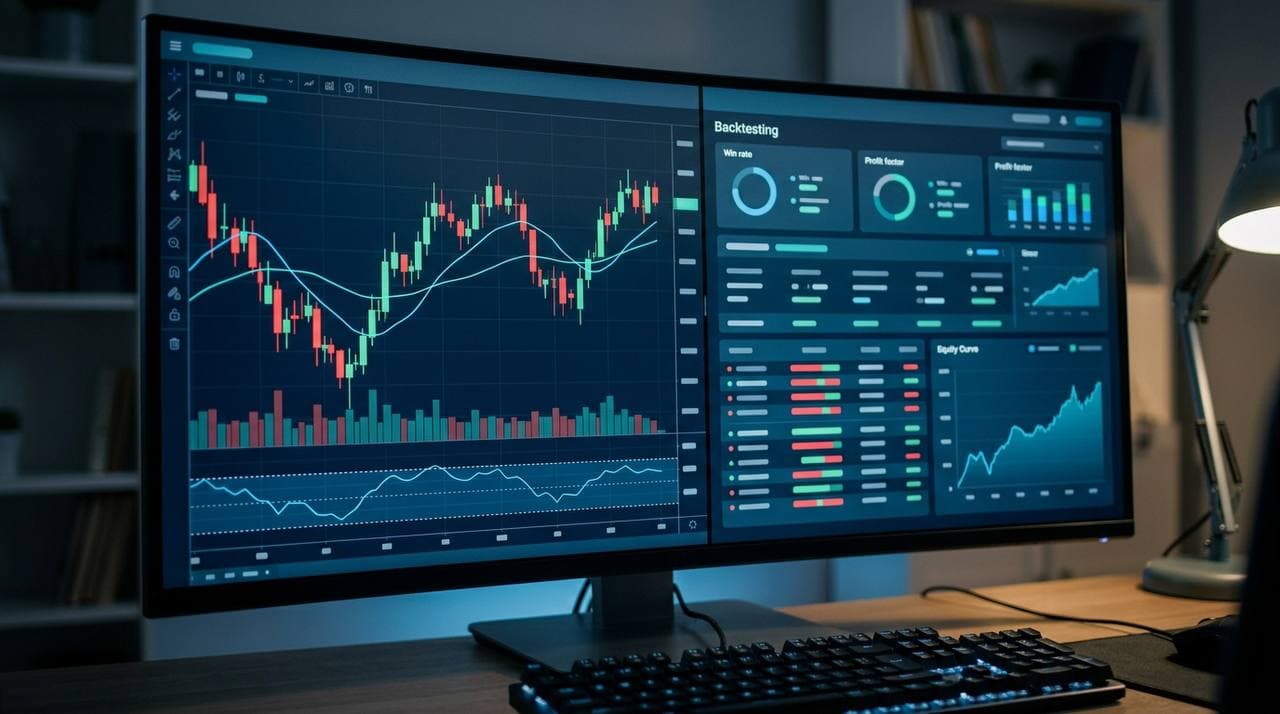
Without backtesting, you're relying on gut feeling. With it, you get concrete metrics: win rate, profit factor, maximum drawdown, average trade duration. These numbers tell you whether a strategy has a statistical edge or is just noise.
Stock markets have unique characteristics that make backtesting especially valuable:
- Defined trading hours — unlike crypto's 24/7 action, stocks trade during market sessions, creating predictable open/close patterns
- Sector rotation — capital flows between sectors create opportunities that backtesting can identify
- ETF availability — index and sector funds let you test macro-level strategies alongside individual stock picks
- Lower noise — established companies tend to have cleaner price action than small-cap crypto tokens
What US Instruments Can You Backtest?
StratBase.ai provides data for 230 US instruments across four categories:
100 Large-Cap Stocks
The biggest names in the market by capitalization. Apple, Microsoft, NVIDIA, Amazon, Tesla, Alphabet, Meta, Berkshire Hathaway, JPMorgan, Visa, and 90 more. These are the most liquid, most-traded stocks in the world — ideal for strategy development.
10 Index ETFs
Broad market exposure through funds like SPY (S&P 500), QQQ (Nasdaq-100), DIA (Dow Jones), IWM (Russell 2000), and VTI (Total Stock Market). Perfect for testing trend-following and mean-reversion strategies on major indices.
10 Sector ETFs
XLF (Financials), XLK (Technology), XLE (Energy), XLV (Healthcare), and six more. Test sector rotation strategies or find which industries your indicators work best on.
10 Thematic ETFs
ARKK (Innovation), TAN (Solar Energy), HACK (Cybersecurity), SOXX (Semiconductors), and others. These capture emerging trends and tend to have higher volatility than broad indices.
Step-by-Step: Your First Stock Backtest
Step 1: Choose Your Instrument
Open the backtest configurator and select an instrument from the US Stocks category. Start with a liquid stock like AAPL or SPY — more data means more reliable results.
Step 2: Define Entry Conditions
Use the AI chat or manual configurator to set up your entry rules. For example, a simple RSI strategy:
- RSI(14) crosses below 30 — oversold entry signal
- Price is above the 200-period EMA — confirming uptrend
Step 3: Set Exit Rules
Configure your take profit and stop loss. For stocks, wider stops often work better than for crypto due to lower volatility. A 5-8% stop loss with a 10-15% take profit is a reasonable starting point for swing trades.
Step 4: Select the Testing Period
US stock data goes back to January 2019. Use at least one full year for meaningful results — this captures both bull and bear market conditions. The 2020 crash and 2021-2022 cycle provide excellent stress-test scenarios.
Step 5: Run and Analyze
Hit Run Backtest and examine the results. Pay attention to:
- Total trades — need at least 30 for statistical significance
- Profit factor — above 1.5 is good, above 2.0 is excellent
- Maximum drawdown — can you tolerate this loss emotionally?
- Win rate vs. average win/loss — low win rate can work if winners are much larger than losers
Stock-Specific Strategy Ideas to Test
Mean Reversion on Large Caps
Large-cap stocks tend to revert to their moving averages. Test buying when RSI drops below 30 and price touches the lower Bollinger Band on stocks like AAPL, MSFT, or JNJ. These established companies rarely stay oversold for long.
Momentum on Tech Stocks
Technology stocks often trend strongly. Use ADX above 25 combined with MACD histogram turning positive for entries on NVDA, AMD, or META. These stocks can sustain directional moves for weeks.
Sector ETF Rotation
Compare the relative strength of sector ETFs. When XLK (tech) shows higher RSI than XLE (energy), it signals sector preference. Test buying the strongest sector ETF and holding until momentum fades.
Breakout on Index ETFs
SPY and QQQ respect support and resistance levels well. Test buying breakouts above the 20-day high with volume confirmation. Index ETFs provide clean price action with minimal gap risk.
Common Mistakes in Stock Backtesting
Ignoring Trading Hours
Stocks don't trade 24/7. Gap opens can trigger stop losses or take profits at unexpected prices. Your backtest engine should account for these gaps — StratBase.ai handles this automatically with its minute-level data.
Over-Optimizing on One Stock
A strategy perfectly tuned for Tesla's wild moves will likely fail on Coca-Cola's steady price action. Test across multiple instruments and sectors. If your strategy only works on one stock, it's curve-fitted, not robust.
Insufficient Sample Size
With stocks trading only during market hours (roughly 6.5 hours per day), you generate fewer signals than with 24/7 crypto markets. Use longer test periods or lower timeframes to ensure you have enough trades for meaningful statistics.
Neglecting Commissions
While many brokers now offer zero-commission stock trading, the spread still matters — especially on lower-timeframe strategies. Factor in realistic execution costs when evaluating your results.
Stocks vs. Crypto: Key Differences for Backtesting
If you're coming from crypto backtesting, keep these differences in mind:
- Volatility: Most stocks move 1-3% daily vs. 5-10%+ for crypto. Adjust your TP/SL levels accordingly
- Gaps: Overnight and weekend gaps are a factor. Crypto trades continuously
- Volume patterns: Stock volume spikes at market open and close. Crypto volume is more evenly distributed
- Correlation: Stocks within the same sector move together more than crypto tokens. Sector ETFs help you identify these patterns
- Data depth: Stock data from 2019 gives you ~5 years. Many crypto pairs have similar or even longer histories
Getting Started
Stock backtesting on StratBase.ai uses the same workflow you know from crypto — just pick a US stock or ETF instead. All 245+ indicators work identically. The AI chat can help you translate stock trading ideas into testable configurations.
Start with a simple strategy on SPY or AAPL, verify it produces enough trades, then expand to other instruments. The best strategies work across multiple stocks — that's how you know the edge is real.
Further Reading
About the Author
Quantitative researcher with 8+ years in algorithmic trading and strategy backtesting. Specializes in technical indicator analysis and risk-adjusted performance metrics.
FAQ
Can I backtest stock strategies for free?▾
Yes. StratBase.ai offers a free plan with up to 5 backtests per day on any instrument, including all 230 US stocks and ETFs. Pro and Premium plans remove daily limits and add advanced features like optimization and AI analysis.
What timeframes are available for stock backtesting?▾
US stock data is available at the 1-minute timeframe, with historical data going back to January 2019. You can also use higher timeframes like 5m, 15m, 1h, 4h, and daily for longer-term strategy testing.
How is stock backtesting different from crypto?▾
The main differences are trading hours (stocks trade during market hours only, not 24/7), lower volatility on average, the availability of sector and index ETFs for diversification testing, and different commission structures. The technical indicators and strategy logic work the same way.
Which US stocks produce the best backtesting results?▾
Results depend entirely on your strategy. High-volatility stocks like Tesla and NVIDIA tend to generate more trading signals, while stable large-caps like Johnson & Johnson may suit mean-reversion strategies. Always test across multiple instruments to validate your edge.
Can I use the same indicators for stocks and crypto?▾
Yes, all 245+ indicators on StratBase.ai work identically across asset classes. RSI, MACD, Bollinger Bands, moving averages, and every other indicator function the same way whether applied to AAPL, BTC/USDT, or EUR/USD.
Comments (0)
Loading comments...