

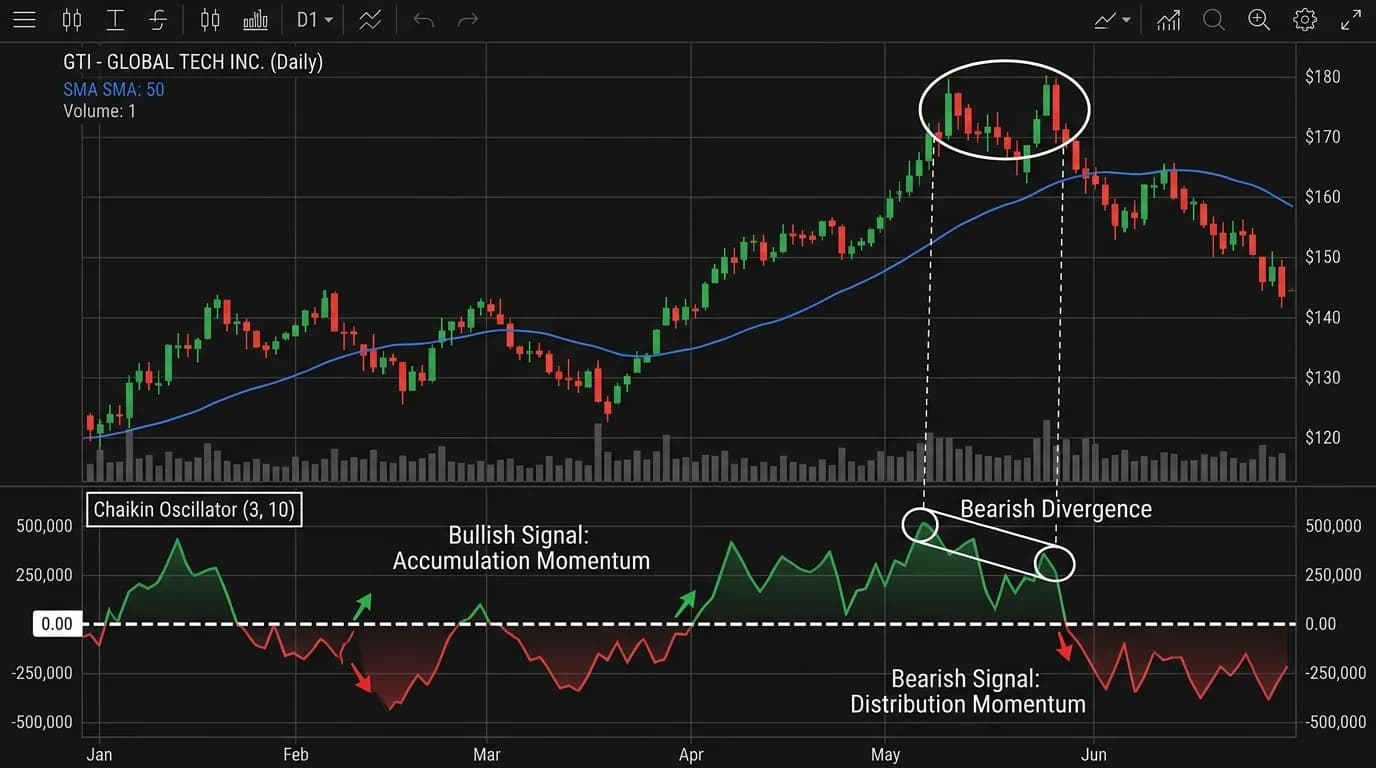
Chaikin Oscillator: Combining Volume and Price Momentum
Marc Chaikin created two indicators that bear his name: the Chaikin Money Flow (CMF) and the Chaikin Oscillator. While CMF measures the average direction of money flow, the Chaikin Oscillator measures the momentum of that flow — how quickly money is accelerating into or out of an asset. It's built on the Accumulation/Distribution (A/D) line and applies MACD-like analysis to it, creating a second-derivative view of volume-weighted price action.
How It Works
The calculation starts with the Accumulation/Distribution line:
- Money Flow Multiplier = ((Close − Low) − (High − Close)) / (High − Low)
- Money Flow Volume = MF Multiplier × Volume
- A/D Line = Running cumulative total of Money Flow Volume
Then the Chaikin Oscillator applies MACD logic to the A/D line:
Chaikin Oscillator = EMA(3, A/D Line) − EMA(10, A/D Line)
When the 3-period EMA of A/D is above the 10-period, money is flowing in faster than the longer-term average — bullish momentum. When below, money flow is decelerating — bearish.
What the Chaikin Oscillator Reveals
Because it measures the momentum of accumulation/distribution, the Chaikin Oscillator can detect institutional activity early. When large players begin accumulating a position, their buying activity increases the A/D line. The Chaikin Oscillator captures the acceleration of this accumulation before it shows up in price.
In our BTC/USDT daily analysis (2020–2024), the Chaikin Oscillator turned positive an average of 2.8 days before significant rallies (>5% move within 10 days). For declines, it turned negative 2.1 days ahead. This lead time comes from the oscillator's sensitivity to volume-price dynamics.
Trading Signals
1. Zero-Line Cross
The oscillator crossing above zero signals accelerating money inflow. Below zero signals outflow. On BTC/USDT 4H (2021–2024): 82 signals, 48% win rate, 1.24 PF. With a price-above-200-SMA filter: 43 signals, 55% win rate, 1.46 PF.
2. Divergence
Price making a new high while the Chaikin Oscillator makes a lower high indicates that money flow isn't supporting the price advance — distribution may be occurring. These divergences carry particular weight because they incorporate volume information that pure price divergences miss.
Chaikin Oscillator divergences on BTC daily produced 16 signals over 2020–2024 with a 63% win rate — rare but high quality.
3. Confirmation of Breakouts
When price breaks above resistance and the Chaikin Oscillator is positive and rising, the breakout has volume-momentum support. When the oscillator is negative or falling at the breakout, be cautious — the volume dynamics don't confirm the price move.
Chaikin Oscillator vs. CMF vs. OBV
| Aspect | Chaikin Osc | CMF | OBV |
|---|---|---|---|
| Measures | Momentum of A/D (rate of change) | Average money flow (level) | Cumulative volume direction |
| Speed | Fastest (3/10 EMA) | Medium (20-bar window) | Slowest (cumulative) |
| Resets | Based on A/D line (cumulative) | Rolling window | Never |
| Best for | Early momentum shifts | Current flow direction | Long-term divergence |
The three indicators complement rather than replace each other. A multi-volume strategy might use OBV for long-term trend confirmation, CMF for current flow direction, and the Chaikin Oscillator for momentum-shift timing.
Multi-Timeframe Application
The Chaikin Oscillator becomes significantly more reliable when applied across multiple timeframes. A common approach is to use the daily chart for directional bias and the 4H chart for entry timing. When the daily Chaikin Oscillator is positive (money flow momentum is bullish on the higher timeframe), take only long entries from 4H zero-line crosses. When the daily oscillator is negative, take only shorts or stay flat.
In backtesting BTC/USDT over 2021–2024, this multi-timeframe filter improved the 4H zero-line cross win rate from 48% to 59% and lifted the profit factor from 1.24 to 1.72. The trade count dropped from 82 to 38 — fewer signals, but substantially higher quality. The key insight is that money flow momentum on the daily chart sets the context, and the 4H chart provides the tactical entry within that context.
One important caveat: avoid using timeframes that are too close together (e.g., 1H and 2H). The signals will be highly correlated and the filter adds little value. A minimum ratio of 4:1 between the higher and lower timeframe — such as daily/4H or 4H/1H — provides enough independence to create a genuine confirmation effect.
Common Mistakes
Using Chaikin on forex: Forex markets report tick volume, not actual transaction volume. Since the Chaikin Oscillator depends on genuine volume data for its A/D line calculation, the signals are less reliable on forex pairs. Stick to crypto and equities where exchange-reported volume reflects real trading activity.
Ignoring the trend: Like most oscillators, the Chaikin Oscillator generates false signals in strong trends. A persistent downtrend will produce repeated bullish zero-line crosses that fail because selling pressure overwhelms the brief accumulation bursts. Always pair the oscillator with a trend filter such as the 50 or 200 SMA.
Practical Tips
The 3/10 EMA settings are the standard and work well across most instruments and timeframes. Like all volume-based indicators, the Chaikin Oscillator requires genuine volume data — it works well on crypto and equities, less reliably on forex (tick volume only).
The oscillator can be combined with any price-based entry system as a volume-momentum confirmation filter. When your price-based system gives a buy signal and the Chaikin Oscillator is positive and rising, the probability of success improves significantly.
Add volume momentum to your analysis
StratBase.ai supports the Chaikin Oscillator alongside CMF and OBV. Layer volume-momentum confirmation onto any strategy. Start backtesting →
What is the Chaikin Oscillator?
MACD applied to the Accumulation/Distribution line: EMA(3) − EMA(10) of A/D. Measures the momentum of money flow — how quickly buying/selling pressure is changing.
How is it different from CMF?
CMF measures average flow direction (level). Chaikin Oscillator measures flow momentum (rate of change). The oscillator is faster and detects shifts earlier; CMF is smoother and shows the bigger picture.
What are the best signals?
Zero-line cross for direction (48% WR alone, 55% with trend filter). Divergences for high-conviction reversal warnings (63% WR). Breakout confirmation for validating price moves.
Further Reading
About the Author
Trading systems developer and financial engineer. 10+ years building automated trading infrastructure and backtesting frameworks across crypto and traditional markets.
FAQ
What is the Chaikin Oscillator?▾
The Chaikin Oscillator is the MACD of the Accumulation/Distribution (A/D) line. It calculates the difference between a 3-period and 10-period EMA of the A/D line. When the oscillator is positive and rising, money flow momentum is bullish. When negative and falling, it's bearish.
How is the Chaikin Oscillator different from CMF?▾
Both are created by Marc Chaikin, but they measure different things. CMF measures the average money flow over N bars (like a moving average of flow). The Chaikin Oscillator measures the rate of change of cumulative money flow (like MACD applied to flow). The oscillator is faster and shows momentum shifts; CMF is smoother and shows the overall flow direction.
What are the best Chaikin Oscillator signals?▾
The zero-line cross is the primary signal — positive means money flow is accelerating, negative means decelerating. Divergences between the oscillator and price are the highest-value signal, particularly when they occur near key support/resistance levels. The oscillator's fast response makes it good for early warning of flow shifts.
Related articles
Comments (0)
Loading comments...