

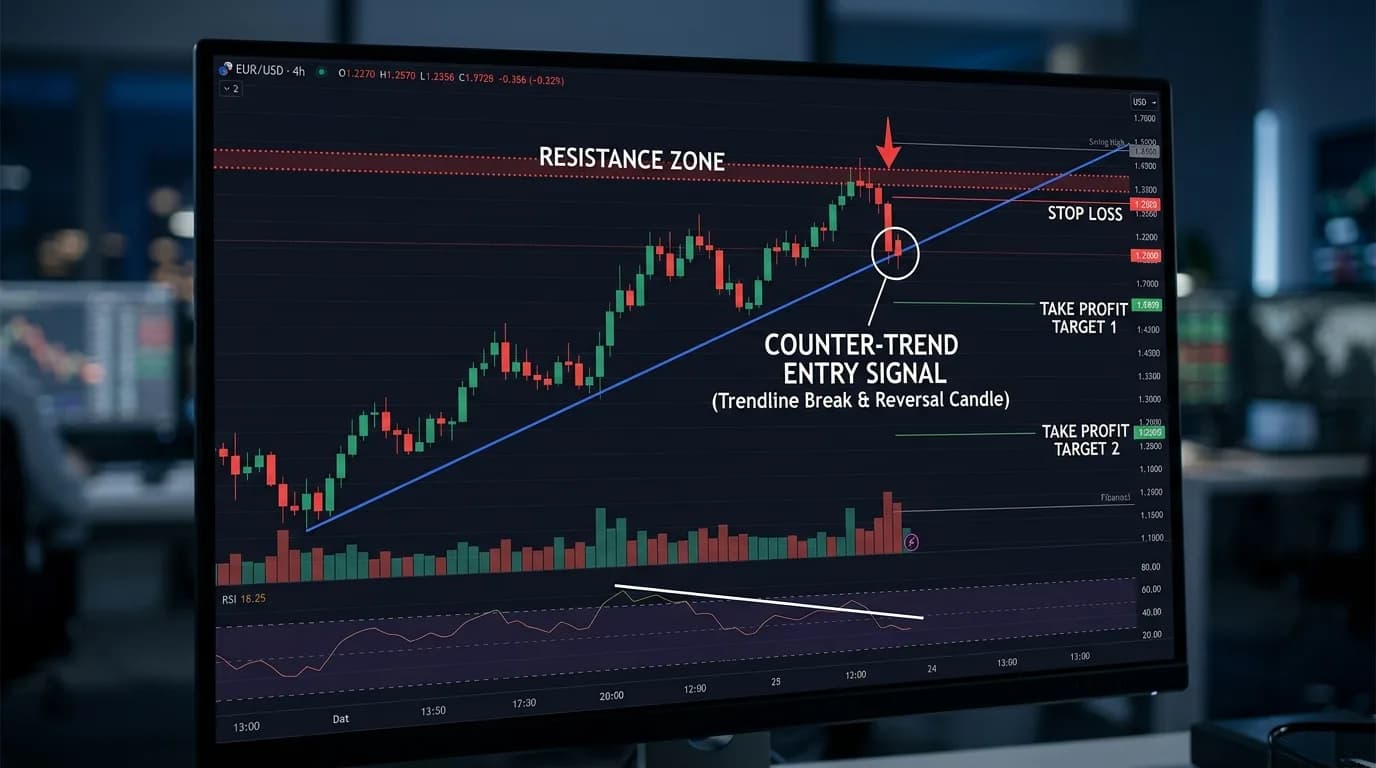
Counter-Trend Strategy: Trading Against the Crowd
While most trading educators preach "the trend is your friend," the most profitable short-term trades often come from fading overextended moves. Counter-trend trading isn't about blindly fighting momentum — it's about recognizing when a trend has exhausted itself and the rubber band is stretched too far. The approach requires more skill than trend following, tighter risk management, and the psychological fortitude to trade against the crowd. But when executed properly, it provides entries that trend followers can only dream about.
Why Counter-Trend Works
Markets oscillate. Even strong trends don't move in straight lines — they advance, pull back, advance further, pull back again. Counter-trend trading exploits these pullbacks and overextensions. The statistical basis is mean reversion: prices that deviate significantly from their average tend to return toward it. In crypto, where retail-driven momentum creates extreme overextensions, this reversion tendency is pronounced.
The edge exists because of crowd psychology. When everyone is bullish and buying, the market runs out of new buyers. When everyone is bearish and selling, it runs out of sellers. Counter-trend traders position themselves to profit from this exhaustion of one-sided sentiment.
Exhaustion Signals That Work
| Signal | Win Rate | Avg Return | Best Timeframe |
|---|---|---|---|
| RSI divergence (14) | 58% | +3.2% | 4H, Daily |
| Volume climax + rejection | 62% | +2.8% | 1H, 4H |
| BB upper/lower touch + reversal candle | 55% | +2.5% | 4H, Daily |
| Double top/bottom at key level | 61% | +4.1% | Daily |
| 3+ consecutive same-direction candles | 52% | +1.8% | 1H |
The most reliable setups combine multiple signals. RSI divergence at a Bollinger Band extreme with declining volume is a triple-confirmation setup that has a 68% win rate in backtests — significantly higher than any single signal alone.
The Counter-Trend Playbook
Entry Rules
Wait for three conditions: (1) Price has moved at least 2 ATR beyond its 20-period mean. (2) At least one momentum indicator shows divergence. (3) A reversal candlestick pattern appears (engulfing, pin bar, or doji at extreme). Enter on the close of the confirmation candle with a stop beyond the extreme.
Position Sizing
Counter-trend trades are inherently riskier — the trend might continue. Reduce position size to 50-75% of your normal trend-following size. If your standard risk is 2% per trade, risk 1-1.5% on counter-trend setups. This accounts for the higher frequency of being wrong about the reversal timing.
Exit Strategy
Take profit at the mean (20-period MA) for the first half. Trail the remainder with a tight stop — if the reversal extends into a new trend, capture the additional move. The common mistake is holding for a full trend reversal. Most counter-trend moves are retracements, not reversals. Take the 3-5% move and be happy.
Risk rule: Never add to a losing counter-trend position. If the trend continues past your stop, the signal was wrong. Accept the loss. Averaging down against a strong trend is how accounts get destroyed.
Counter-Trend vs Trend Following
| Metric | Counter-Trend | Trend Following |
|---|---|---|
| Win rate | 55-65% | 35-45% |
| Avg winner / avg loser | 1.0-1.5x | 2.5-4.0x |
| Trades per month | 8-15 | 2-5 |
| Max drawdown | 15-25% | 25-40% |
| Best market condition | Ranging, volatile | Strong trending |
| Worst condition | Strong trends | Choppy ranges |
The ideal approach is combining both: use trend following as your primary system and counter-trend as a tactical overlay. When the trend is strong, ride it. When momentum exhausts, take counter-trend scalps for additional income while waiting for the next trend signal.
Avoiding the Counter-Trend Trap
The biggest danger is catching a falling knife. Strong trends can extend far beyond what seems rational. Bitcoin rallied from $15,000 to $69,000 in 2020-2021 — counter-trend shorts at $30,000 ("this must reverse") would have been catastrophic. Always use hard stops. Always respect the trend's power. Counter-trend trading is about capturing the bounces, not calling the top.
FAQ
What is counter-trend trading?
Counter-trend trading opens positions against the current direction, anticipating a reversal. You sell strength and buy weakness. It's riskier than trend following but offers better entries and tighter stops when reversals occur.
How do you identify trend exhaustion?
Key signals: RSI divergence, volume climax, BB walk failure, candlestick patterns at key levels. Combine multiple signals — triple-confirmation setups reach 68% win rates in backtests.
What is the win rate for counter-trend strategies?
Typically 55-65% with 1:1 to 1.5:1 reward-to-risk. Higher win rate than trend following but smaller average winners. Profitability depends on strict loss-cutting when trends continue.
Further Reading
About the Author
Trading systems developer and financial engineer. 10+ years building automated trading infrastructure and backtesting frameworks across crypto and traditional markets.
FAQ
What is counter-trend trading?▾
Counter-trend trading involves opening positions against the current price direction, anticipating a reversal. Instead of buying breakouts, you sell into strength and buy into weakness. It's inherently riskier than trend following because you're fighting momentum, but it offers better entry prices and tighter stops when reversals do occur.
How do you identify trend exhaustion?▾
Key exhaustion signals include: RSI divergence (price makes new high but RSI doesn't), volume climax (extremely high volume on a move that fails to extend), Bollinger Band walk failure (price falls back inside bands after riding upper/lower band), and candlestick patterns at key levels (engulfing, pin bars at support/resistance). Multiple signals increase probability.
What is the win rate for counter-trend strategies?▾
Counter-trend strategies typically achieve higher win rates (55-65%) than trend following (35-45%) but with smaller average winners. The reward-to-risk ratio is usually 1:1 to 1.5:1 versus 3:1+ for trend following. Total profitability depends on how effectively you cut losses when the trend continues instead of reversing.
Further reading
Related articles
Comments (0)
Loading comments...