

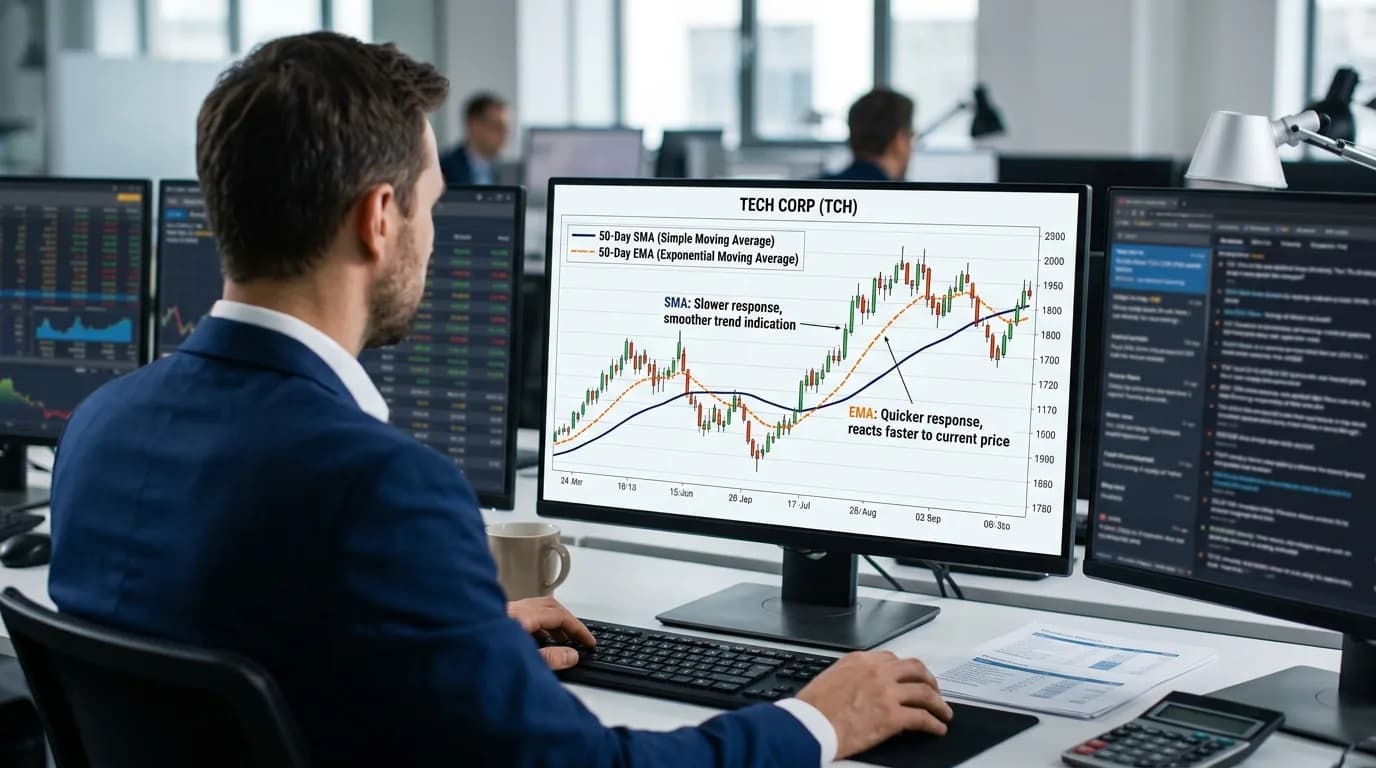
EMA vs SMA: Which Moving Average Is Better? (Data-Driven Answer)
Ask ten traders whether to use EMA or SMA and you'll get ten different opinions, usually based on personal preference rather than data. The exponential moving average reacts faster because it weights recent prices more heavily. The simple moving average treats all prices equally and is smoother. But which actually produces better trading results? We tested both across multiple strategy types, instruments, and timeframes to find out.
How They Differ: The Math
The Simple Moving Average is exactly what it sounds like — the arithmetic mean of the last N closing prices. Every candle in the window carries equal weight:
SMA(N) = (C₁ + C₂ + ... + Cₙ) / N
The Exponential Moving Average applies a smoothing factor (α = 2 / (N + 1)) that gives more weight to recent prices. The calculation is recursive:
EMA(today) = α × Close + (1 - α) × EMA(yesterday)
For a 20-period calculation, α = 2/21 ≈ 0.095. This means today's close contributes about 9.5% to the EMA, yesterday's close about 8.6%, and so on with exponentially declining weights. The practical effect: EMA hugs price more closely and turns direction sooner than SMA.
Visual Difference
On a chart, the EMA is always slightly closer to current price than the SMA of the same period. During a sharp price move, the gap between them widens. During steady trends, they nearly overlap. The EMA "leads" at turning points — it will cross price first when a reversal occurs.
This visual difference becomes more pronounced with longer periods. A 200 EMA and 200 SMA on BTC daily can differ by hundreds of dollars during volatile periods. On a 10-period, the difference is usually negligible.
Backtest Comparison: Crossover Systems
We tested the classic moving average crossover (fast MA crosses above slow MA = buy, crosses below = sell) using both EMA and SMA, across three instrument types:
Fast/Slow Crossover: 9/21 Period
| Instrument | SMA 9/21 | EMA 9/21 | Winner |
|---|---|---|---|
| BTC/USDT 4H (2021-2024) | PF 1.08, WR 42% | PF 1.19, WR 45% | EMA |
| EUR/USD 4H (2021-2024) | PF 0.97, WR 39% | PF 1.02, WR 41% | EMA (marginal) |
| ETH/USDT Daily (2021-2024) | PF 1.15, WR 44% | PF 1.28, WR 47% | EMA |
Slow Crossover: 50/200 Period
| Instrument | SMA 50/200 | EMA 50/200 | Winner |
|---|---|---|---|
| BTC/USDT Daily (2019-2024) | PF 1.52, WR 55% | PF 1.48, WR 52% | SMA (marginal) |
| EUR/USD Daily (2019-2024) | PF 1.11, WR 48% | PF 1.06, WR 46% | SMA |
| SPY Daily (2019-2024) | PF 1.61, WR 58% | PF 1.54, WR 56% | SMA |
A clear pattern emerges: EMA wins on short periods (9/21) and lower timeframes, SMA wins on long periods (50/200) and daily+ charts. The explanation is intuitive — short-period systems need speed, and EMA's responsiveness is an advantage. Long-period systems need stability, and SMA's smoothness reduces whipsaws during choppy periods.
As a Trend Filter
Moving averages are often used not as entry signals but as trend filters — only take longs above the 200 MA, only shorts below. Here, the difference between EMA and SMA is minimal. Both effectively filter out counter-trend trades.
The slight edge goes to SMA for trend filtering because its slower reaction means fewer instances where price briefly crosses below and immediately crosses back above, triggering unnecessary exits. In a 200-period trend filter on BTC daily, SMA produced 8% fewer whipsaw signals than EMA over a 5-year period.
Mean Reversion Strategies
For mean reversion — buying when price deviates from the average and expecting it to return — SMA consistently outperforms EMA. Mean reversion strategies buy when price is X% below the moving average. Because the SMA is smoother, the "mean" it represents is more stable, giving more reliable reversion targets.
On BTC/USDT 4H, buying when price drops 3% below the 20 SMA and selling at the SMA produced a profit factor of 1.24. The same strategy using 20 EMA produced 1.12 — the EMA chases price down during the dip, narrowing the expected reversion distance and reducing the edge.
Dynamic Support/Resistance
Traders often watch how price interacts with key moving averages as dynamic support or resistance levels. Does price "respect" EMA or SMA more? In our analysis of BTC daily data, measuring how often price bounces within 0.5% of the moving average:
- 50 SMA: 31 touches, 61% bounce rate
- 50 EMA: 37 touches, 54% bounce rate
- 200 SMA: 18 touches, 72% bounce rate
- 200 EMA: 22 touches, 64% bounce rate
SMA produces fewer but more reliable "touches." The EMA's proximity to price means it gets touched more often, but those touches are less meaningful — many are just noise. If you're trading support/resistance bounces off a moving average, SMA provides cleaner levels.
Choosing the Right One for Your Strategy
Based on the data, here are practical guidelines:
- Use EMA when you need fast signals: short-period crossovers, trailing stops, volatile crypto on lower timeframes
- Use SMA when you need stability: long-period trend filters, mean reversion targets, support/resistance levels, daily+ charts
- Period matters more than type: the difference between 20 EMA and 20 SMA is smaller than the difference between 20 EMA and 14 EMA. Optimize the period first, then compare EMA vs SMA
On StratBase.ai, you can run the same strategy with both EMA and SMA and compare results directly. Clone your backtest, swap the moving average type, and the performance difference will tell you which is better for your specific configuration.
Test EMA vs SMA in your own strategy
StratBase.ai supports both EMA and SMA with any period. Clone your backtest, swap the MA type, and compare the numbers. Start comparing →
What is the difference between EMA and SMA?
SMA gives equal weight to all periods. EMA weights recent prices more heavily, making it faster to react. For a 20-period average, the EMA will hug price more closely and turn direction sooner.
Is EMA better than SMA?
Neither is universally better. EMA tends to outperform in trend-following on volatile instruments. SMA tends to outperform in mean-reversion strategies and as a support/resistance level. Period selection matters more than the type of average.
What moving average period is best?
For trend following: 50 and 200. For swing trading: 10 and 20. For crossover systems: 9/21 (fast) or 50/200 (slow). Always test on your specific instrument and timeframe.
Further Reading
About the Author
Quantitative researcher with 8+ years in algorithmic trading and strategy backtesting. Specializes in technical indicator analysis and risk-adjusted performance metrics.
FAQ
What is the difference between EMA and SMA?▾
SMA (Simple Moving Average) gives equal weight to all periods in the lookback. EMA (Exponential Moving Average) applies more weight to recent prices, making it more responsive to current price action. For a 20-period average, the EMA reacts faster to price changes but is also more sensitive to noise.
Is EMA better than SMA?▾
Neither is universally better. Backtests show EMA tends to outperform SMA in trend-following strategies on volatile instruments (like crypto) because it reacts faster. SMA tends to outperform in mean-reversion strategies and on less volatile instruments where smoothness matters more than speed.
What moving average period is best?▾
It depends on your timeframe and strategy type. For trend following: 50 and 200 period are standard. For swing trading: 10 and 20 period. For crossover systems: 9/21 (fast) or 50/200 (slow). The period matters more than whether you use EMA or SMA.
Related articles
Comments (0)
Loading comments...