

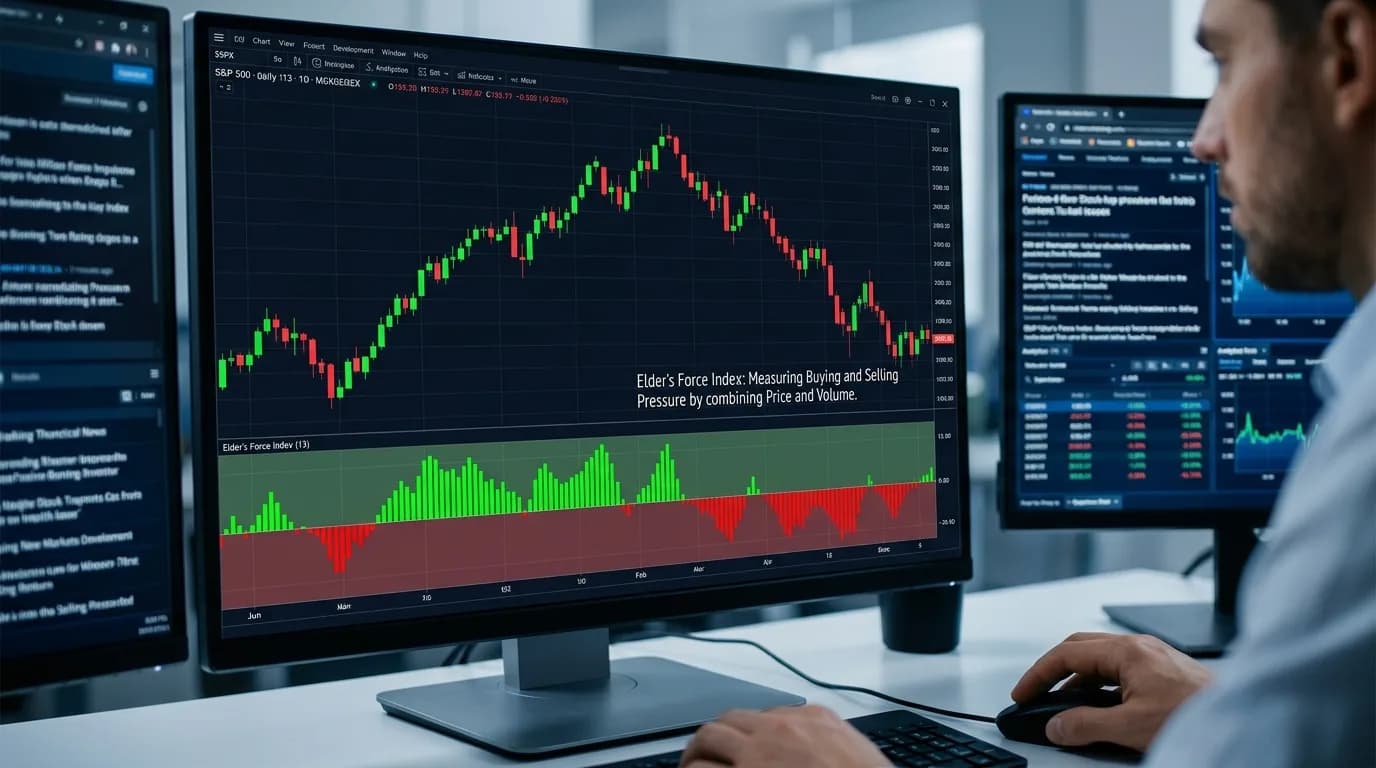
Force Index: Elder's Volume-Price Confirmation Tool
The Force Index, developed by Dr. Alexander Elder, is a deceptively simple indicator that combines price change with volume to measure the force behind market moves. By quantifying whether buyers or sellers are in control and how strongly they are pushing, the Force Index provides actionable signals that many traders overlook in favor of more popular indicators. This guide walks you through building effective Force Index strategies on StratBase.ai, from basic setups to advanced multi-period configurations inspired by Elder’s own trading methodology.
The Force Index is calculated by multiplying the difference between the current close and the previous close by the current volume. A positive Force Index means buyers are in control; a negative value means sellers dominate. The magnitude reflects the conviction behind the move — large price changes on heavy volume produce extreme Force Index readings, while small moves on light volume barely register.
Elder’s Two-Period Approach
Dr. Elder recommended using the Force Index on two timeframes simultaneously. The 2-period EMA of the Force Index captures short-term pullbacks within trends, identifying entry opportunities when the broader trend resumes. The 13-period EMA smooths out the noise and reveals the intermediate-term balance of power between bulls and bears.
The 2-period Force Index is primarily used as an entry timing tool: during uptrends, look for the 2-period Force Index to dip below zero (a brief moment of selling pressure) then recover above zero (buyers reasserting control). This negative-to-positive crossover within an established uptrend is one of Elder’s most reliable buy signals. The inverse applies for short entries during downtrends.
The 13-period Force Index serves as a trend confirmation tool. When the 13-period is consistently above zero, the intermediate trend is bullish. When consistently below zero, it is bearish. Divergences between the 13-period Force Index and price provide early warnings of trend exhaustion, similar to divergences in RSI or MACD but with the added dimension of volume confirmation.
Step 1: Configure the Dual Force Index Setup
In the StratBase.ai configurator, add two Force Index instances. The first uses a 2-period EMA for entry timing, and the second uses a 13-period EMA for trend direction. Select a timeframe that matches your trading style — the 4-hour chart works well for swing trading, while the daily chart suits position traders.
For the trend condition, set the 13-period Force Index above zero as a requirement for long entries and below zero for short entries. For the entry trigger, set the 2-period Force Index crossing above zero (for longs) or crossing below zero (for shorts). This dual-condition setup directly implements Elder’s methodology within StratBase.ai’s backtesting framework.
| Force Index Period | Role | Long Condition | Short Condition |
|---|---|---|---|
| 2-period EMA | Entry timing | Crosses above zero | Crosses below zero |
| 13-period EMA | Trend filter | Above zero | Below zero |
Step 2: Add Moving Average Trend Confirmation
Elder’s Triple Screen Trading System combines the Force Index with moving averages and oscillators across multiple timeframes. You can replicate the essential elements on StratBase.ai by adding an EMA-based trend filter alongside the Force Index conditions.
Add a 26-period EMA to your strategy and require price to be above it for long entries and below it for short entries. This creates a triple confirmation: the EMA defines the trend direction, the 13-period Force Index confirms the intermediate momentum, and the 2-period Force Index provides the entry timing. All three must align before a trade is taken.
This layered approach significantly reduces false signals compared to using the Force Index alone. In backtests on StratBase.ai, the triple-confirmation setup typically shows a 15–25% improvement in profit factor over single-condition Force Index strategies, with noticeably lower maximum drawdown during trending markets.
Step 3: Implement Volume-Weighted Position Sizing
One of the advantages of the Force Index is that it naturally incorporates volume, making it ideal for volume-weighted decision making. Extreme Force Index readings (either positive or negative) indicate high-conviction moves that may warrant larger position sizes, while readings near zero suggest indecision and call for smaller positions or no trade at all.
On StratBase.ai, you can model this concept by using the magnitude of the Force Index as a trade quality filter. Only enter trades when the 2-period Force Index crossover is accompanied by volume exceeding its 20-period average. This ensures that your entry signals are backed by genuine market participation rather than low-volume noise that often produces false crossovers.
Step 4: Detect Divergences for Reversal Trading
Force Index divergences are among the most reliable reversal signals because they incorporate both price and volume information. A bullish divergence occurs when price makes a lower low but the 13-period Force Index makes a higher low — meaning that despite lower prices, selling force is actually diminishing. This weakening of bearish pressure often precedes significant rallies.
To detect divergences on StratBase.ai, configure conditions that compare the direction of price lows/highs with Force Index lows/highs over a defined lookback window. Combine divergence signals with support levels from StratBase.ai’s 34 price level indicators or 23 pivot-based indicators for high-probability reversal entries. A Force Index divergence at a major pivot support level represents a powerful confluence of signals.
Step 5: Backtest Across Crypto Market Conditions
The Force Index was originally developed for stock markets, so validating its effectiveness in crypto markets through rigorous backtesting is essential. Run your strategy across at least two years of data on StratBase.ai, covering both trending and ranging market periods. Pay special attention to how the strategy handles the extremely high-volume liquidation cascades that are unique to leveraged crypto markets.
For futures traders, enhance the Force Index strategy by adding open interest conditions from StratBase.ai’s futures indicator suite. Rising open interest alongside a positive Force Index confirms that new positions are entering the market with bullish conviction. Declining open interest during a positive Force Index suggests short covering rather than genuine buying — a weaker signal that may not sustain.
The Force Index captures what most indicators miss: the volume behind every price move. Dr. Elder designed it to reveal the true power balance between buyers and sellers, and its dual-period configuration provides both strategic direction and tactical timing. Backtest Elder’s methodology thoroughly on StratBase.ai to discover how this underappreciated indicator can become a cornerstone of your trading system.
Further Reading
About the Author
Financial data analyst focused on crypto derivatives and on-chain metrics. Expert in futures market microstructure and funding rate strategies.
FAQ
What is the Force Index?▾
Force Index = (Current Close - Previous Close) × Volume. It measures the force behind a price move by combining three factors: direction (up or down), magnitude (how much price moved), and conviction (volume). A large positive value = strong buying force. A large negative value = strong selling force. Near zero = balance.
How is the Force Index smoothed?▾
Raw Force Index is noisy, so it's typically smoothed with an EMA. Short-term (2-period EMA): shows micro-swings for entry timing. Long-term (13-period EMA): shows the underlying force trend. Elder recommended using both: 13-period for trend direction, 2-period for entry timing within that trend.
Further reading
Related articles
Comments (0)
Loading comments...