
Funding Rate Explained: How Perpetual Futures Stay Anchored
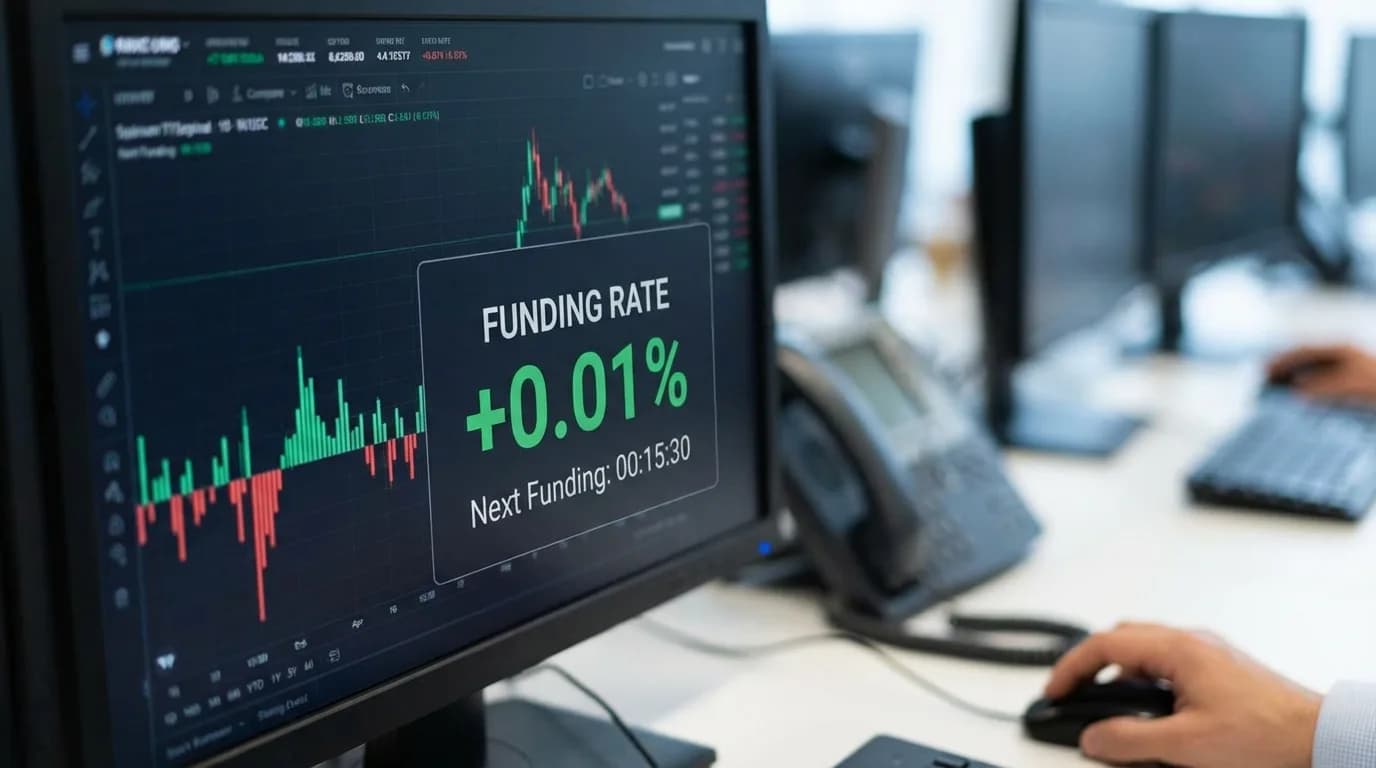
The funding rate is a periodic payment exchanged between long and short traders on perpetual futures contracts. It serves a critical function: keeping the perpetual contract price anchored to the underlying spot price. Without funding rates, perpetual futures — which unlike traditional futures have no expiration date — would drift arbitrarily from fair value, undermining their utility as trading instruments.
Understanding funding rates is essential for any crypto futures trader. They represent both a cost of holding positions and a source of alpha. Extreme funding rates signal market sentiment, and systematic traders increasingly use them as indicators within backtested strategies to filter entries, time exits, and even generate standalone trading signals.
How Funding Rates Work
Funding payments occur at fixed intervals — typically every 8 hours on most exchanges (Binance, Bybit, OKX). The mechanism is straightforward:
- When funding rate is positive: longs pay shorts. This occurs when the perpetual price trades above the spot price, indicating bullish sentiment and excess demand for long exposure.
- When funding rate is negative: shorts pay longs. This occurs when the perpetual price trades below spot, indicating bearish sentiment and excess demand for short exposure.
The payment formula:
Funding Payment = Position Notional Value × Funding Rate
For example, a trader holding a $50,000 long position during a 0.01% funding rate pays $5 per funding period. Over a month with three daily payments, that totals approximately $150 — a non-trivial cost that many traders overlook when calculating strategy profitability.
Crucially, funding payments are exchanged directly between traders, not paid to the exchange. This peer-to-peer mechanism creates a self-correcting system: when too many traders are long, the cost of being long increases, incentivizing some to close positions or go short, which brings the perpetual price back toward spot.
Funding Rate Calculation
The funding rate itself has two components:
| Component | Formula | Purpose |
|---|---|---|
| Interest Rate | Fixed (typically 0.01% per 8h) | Cost-of-carry between base and quote currencies |
| Premium Index | TWAP of (Futures Price − Spot Price) / Spot Price | Measures deviation from spot |
| Final Rate | Clamp(Interest Rate + Premium Index, −0.75%, +0.75%) | Bounded to prevent extreme payments |
Exchanges apply a clamp (usually ±0.75% per period) to prevent extreme funding rates from causing cascading liquidations. However, even within these bounds, annualized funding costs can reach 100%+ during euphoric or panic phases. Some exchanges like Bybit have moved to variable funding intervals (every 4 hours during volatile periods) to keep the perpetual price more closely aligned with spot.
Funding Rate as a Sentiment Indicator
Funding rates are among the most reliable real-time sentiment gauges in crypto markets. Unlike social media sentiment or fear-and-greed indices, funding rates reflect actual capital commitment — traders are literally paying for their positioning:
- Consistently high positive rates (>0.05%) — the market is heavily long. Historically, sustained periods of elevated funding have preceded corrections as leveraged longs become vulnerable to liquidation cascades.
- Deeply negative rates (<−0.03%) — excessive short positioning. Contrarian traders watch for short squeezes when funding turns deeply negative, as shorts must eventually cover.
- Near-zero rates (0.005% to 0.015%) — balanced market with no strong directional bias. This is often the «default» state and represents equilibrium between longs and shorts.
During the 2021 Bitcoin bull run, BTC funding rates on Binance consistently exceeded 0.1% per 8 hours. Annualized, this meant longs were paying over 100% per year to maintain their positions — a clear warning sign that preceded the May 2021 crash from $64,000 to $30,000.
Trading Strategies Using Funding Rates
Savvy traders incorporate funding rates into systematic strategies in several ways:
- Funding rate arbitrage (cash-and-carry) — buy spot, short perpetual. Collect positive funding while being delta-neutral. The return equals the funding rate minus trading fees. This is low-risk and popular among institutional participants. The annualized return during high-funding periods can exceed 30–50% with minimal directional risk.
- Contrarian signals — enter short when funding rates exceed the 95th percentile (historically extreme bullish positioning), or enter long when rates hit the 5th percentile. These signals are most effective on higher timeframes (daily) and when combined with price action confirmation such as bearish divergences or support tests.
- Funding rate divergence — compare funding rates across exchanges. When Binance shows 0.08% and Bybit shows 0.02%, it may indicate localized speculation on one exchange that is likely to revert.
- Regime filter — avoid long entries when funding rates are extremely positive (crowded trade), and avoid shorts when rates are deeply negative. This simple filter can dramatically improve win rates for trend-following strategies by keeping you on the less-crowded side of the market.
Monitoring and Backtesting Funding Data
StratBase.ai collects real-time funding rate data from Binance and Bybit, stores historical snapshots, and includes funding rate as one of 12 futures-specific indicators in its backtesting engine. Traders can:
- View current funding rates across all listed perpetual contracts on the Funding Rate screener page, with sorting by highest/lowest rates and exchange filtering.
- Set up Telegram alerts when funding rates cross user-defined thresholds, ensuring you never miss extreme readings.
- Include funding rate conditions in backtested strategies — for example, only enter long when the funding rate is below 0.02%, or add a condition that exits positions when funding exceeds the 90th percentile.
By combining funding rate analysis with technical indicators and risk management rules, traders can build strategies that account for the true cost and sentiment embedded in futures markets — rather than treating these factors as afterthoughts that erode returns in live trading.
Further Reading
About the Author
Financial data analyst focused on crypto derivatives and on-chain metrics. Expert in futures market microstructure and funding rate strategies.
FAQ
What is the funding rate in crypto?▾
The funding rate is a periodic payment exchanged between long and short position holders on perpetual futures contracts. When the funding rate is positive, longs pay shorts — incentivizing selling and pushing the perp price down toward spot. When negative, shorts pay longs — incentivizing buying and pushing perp price up toward spot. This mechanism keeps the perpetual contract price anchored to the underlying spot price.
How often is funding paid?▾
Most exchanges charge funding every 8 hours (three times daily). Binance and Bybit use 00:00, 08:00, and 16:00 UTC. The rate is typically 0.01% as baseline, varying based on the premium/discount between perp and spot prices. During extreme sentiment, funding can reach 0.1% or higher per 8-hour period — equivalent to 1.1% daily cost for the paying side.
Can you trade based on funding rate?▾
Yes. Two main approaches: (1) Funding rate arbitrage — go long spot and short perp (or vice versa) to collect funding payments while remaining market-neutral. This is a low-risk yield strategy. (2) Sentiment signal — extreme positive funding indicates overleveraged longs (bearish signal), extreme negative funding indicates overleveraged shorts (bullish signal). Use funding as a contrarian indicator.
Comments (0)
Loading comments...