

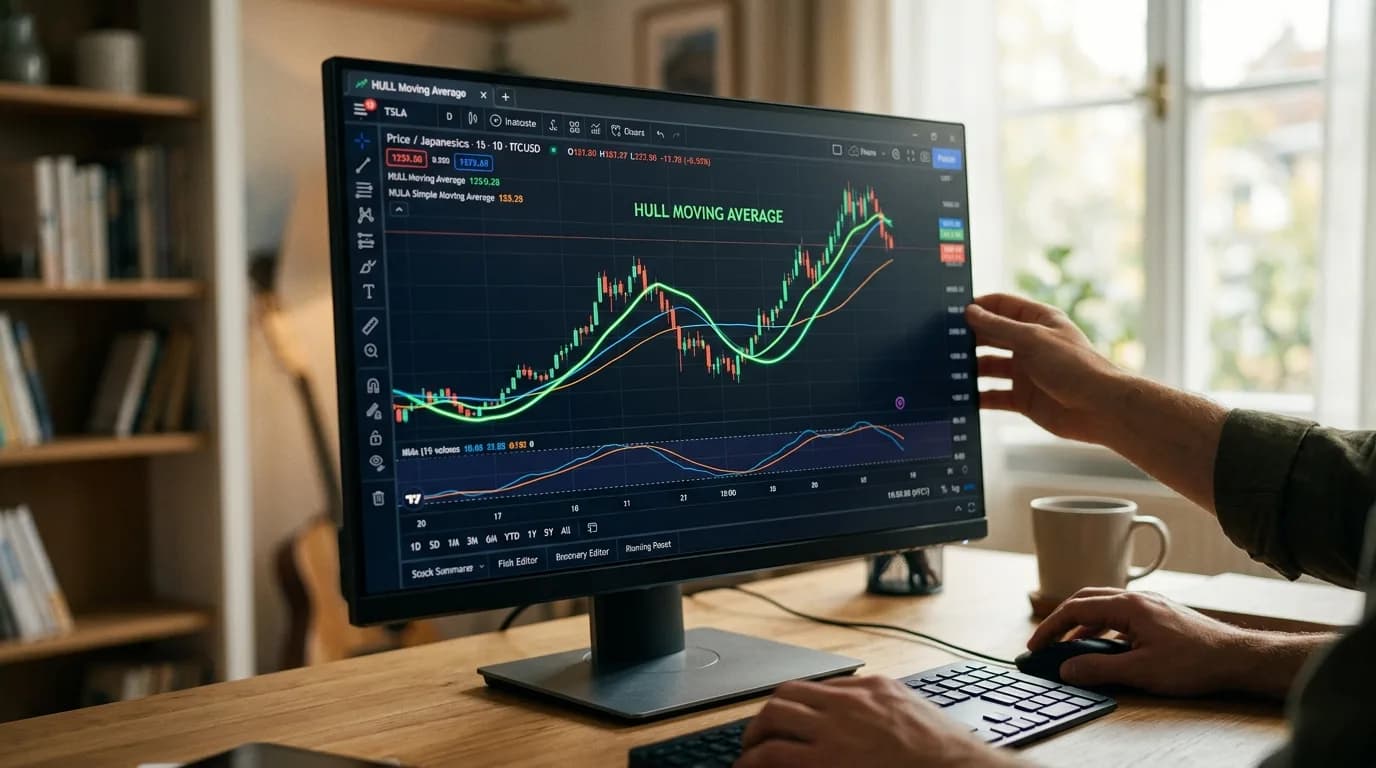
Hull Moving Average: Why It's Better Than Traditional MAs
Every moving average faces the same tradeoff: shorter periods react faster but are noisy, longer periods are smoother but lag. Alan Hull, an Australian mathematician and trader, found an elegant mathematical solution in 2005. By combining weighted moving averages at different periods and applying a square-root transformation, the Hull Moving Average nearly eliminates lag while maintaining remarkable smoothness. The question is whether this mathematical advantage translates into better trading outcomes.
How HMA Is Calculated
The calculation uses three steps that build on each other:
- Calculate a WMA with period N/2 (call it WMA_half)
- Calculate a WMA with period N (call it WMA_full)
- Calculate the "raw" value: Raw = 2 × WMA_half - WMA_full
- Apply a final WMA with period √N to the Raw values
The key insight is step 3: by doubling the half-period WMA and subtracting the full-period WMA, Hull creates a value that effectively "overshoots" in the direction of the trend. The final √N WMA smooths out this overshoot without reintroducing significant lag because √N is much shorter than N.
For a 16-period HMA: WMA(8) is the fast component, WMA(16) is the slow component, and the final smoothing uses WMA(4). The result turns direction 3-5 bars earlier than a 16-period EMA while being comparably smooth.
Visual Comparison: HMA vs. EMA vs. SMA
On a chart, the differences are striking. During a trend change (say, price reversing from bullish to bearish):
- SMA(20) continues rising for 5-8 bars after the reversal
- EMA(20) begins turning after 3-5 bars
- HMA(20) turns within 1-2 bars — and may even lead price briefly
This speed is visually obvious. The HMA hugs price during trends and turns sharply at reversals. The downside is also visible: during choppy conditions, HMA whipsaws more than EMA, creating false direction changes that don't lead to sustained moves.
Backtest: Crossover Systems
We tested price crossing above/below each MA type as a signal (long when above, flat when below) on BTC/USDT 4H (2021-2024):
| Indicator | Trades | Win Rate | PF | Avg Bars to Signal |
|---|---|---|---|---|
| SMA(20) | 89 | 41% | 1.14 | 5.8 |
| EMA(20) | 94 | 42% | 1.21 | 3.9 |
| HMA(20) | 112 | 39% | 1.08 | 1.4 |
| HMA(9) | 146 | 37% | 0.97 | 0.8 |
Interesting results. HMA(20) signals the fastest (1.4 bars average) but its profit factor is lowest among the three 20-period MAs. Why? The extra speed generates more trades — 112 vs. 89 for SMA — but many of those additional signals are whipsaws during consolidation. HMA(9) — which is comparable in smoothness to EMA(20) — actually loses money because it's too fast.
Dual MA Crossover (HMA vs. EMA)
Using a fast/slow crossover reduces whipsaws. HMA(9) crossing above/below HMA(21) versus EMA(9) crossing EMA(21):
| System | Trades | Win Rate | PF |
|---|---|---|---|
| EMA 9/21 crossover | 87 | 43% | 1.19 |
| HMA 9/21 crossover | 104 | 41% | 1.13 |
| HMA 9/21 + ADX > 25 | 48 | 52% | 1.47 |
Without a trend filter, HMA's speed advantage doesn't translate into better crossover performance. But with an ADX filter (only trade when a trend exists), HMA shines — the early crossover signals catch more of the trend, and the filter eliminates the whipsaws.
Where HMA Excels
HMA's strongest use case is as a trend direction indicator with a filter. Rather than using HMA crossovers as entry signals, use HMA slope as a trend confirmation:
- HMA rising → bullish trend confirmed → take long entries from other indicators
- HMA falling → bearish trend confirmed → take short entries or stay flat
HMA's rapid turns mean it identifies trend changes earlier than EMA, giving you a faster "green light" for trend-following entries. The individual entry timing comes from a different indicator (RSI, Stochastic, breakout, etc.).
In our testing, using HMA(16) slope as a trend filter improved EMA crossover strategies by 15%, Stochastic strategies by 22%, and Supertrend strategies by 18%. These improvements exceeded what we saw using EMA slope as a filter.
Where HMA Struggles
HMA is a poor choice for dynamic support/resistance. Because it turns so sharply, it doesn't provide stable levels for bounces. Price may touch an EMA(50) and bounce cleanly, but an HMA(50) will have already moved away from the potential support level by the time price arrives.
HMA also struggles as a standalone system on choppy instruments. Low-volatility forex pairs (EUR/CHF, USD/JPY during calm periods) produce frequent HMA direction changes that lead nowhere. The ADX filter is essentially mandatory for these instruments.
Period Selection
Because HMA reduces lag by approximately √N bars, the effective responsiveness is much faster than EMA of the same period. Rough equivalences:
- HMA(9) ≈ EMA(20) in responsiveness
- HMA(16) ≈ EMA(35) in responsiveness
- HMA(25) ≈ EMA(50) in responsiveness
- HMA(55) ≈ EMA(100) in responsiveness
When switching from EMA to HMA in an existing strategy, roughly halve the period as a starting point, then fine-tune.
Compare HMA to EMA and SMA
StratBase.ai supports Hull Moving Average alongside EMA and SMA. Clone your strategy, swap the MA type, and see the performance difference. Start comparing →
What is the Hull Moving Average?
A fast, smooth moving average created by Alan Hull. It uses a weighted sum of two WMAs and a square-root smoothing to nearly eliminate lag while maintaining smoothness. Turns 3-5 bars earlier than EMA of the same period.
Is HMA better than EMA?
HMA is faster at detecting trend changes. But this speed creates more whipsaws during choppy conditions. HMA excels as a trend filter (slope direction), while EMA is better for dynamic support/resistance. Use HMA with an ADX filter for best results.
What HMA period should I use?
HMA(9) ≈ EMA(20), HMA(16) ≈ EMA(35). For swing trading 4H: 16 or 20. For daily trend filtering: 55. Roughly halve your EMA period when switching to HMA.
Further Reading
About the Author
Financial data analyst focused on crypto derivatives and on-chain metrics. Expert in futures market microstructure and funding rate strategies.
FAQ
What is the Hull Moving Average?▾
The Hull Moving Average (HMA), created by Alan Hull, is a fast, smooth moving average that reduces the lag inherent in SMA and EMA. It uses a weighted moving average of the difference between a short and long WMA, then applies a square-root-period WMA to the result. This mathematical trick nearly eliminates lag while keeping the line smooth.
Is HMA better than EMA?▾
HMA is significantly faster than EMA of the same period — it turns at trend changes 3-5 bars sooner on average. However, this speed comes with a tradeoff: HMA can overshoot price during sharp reversals, creating false signals. For trend-following entries, HMA outperforms. For dynamic support/resistance levels, EMA is more reliable.
What HMA period should I use?▾
9-period HMA is roughly equivalent to a 20-period EMA in responsiveness. For swing trading on 4H charts, 16 or 20 HMA works well. For trend filtering on daily charts, 55 HMA. Remember that HMA periods are not directly comparable to EMA/SMA — an HMA(N) behaves like an EMA of roughly 2N due to its lag reduction.
Related articles
Comments (0)
Loading comments...