
Manual Backtesting vs Automated: Which Should You Choose?
The backtesting world has two camps. Manual testers insist you can't understand a strategy without seeing every trade on a chart. Automated testers argue that manual testing is too slow, too biased, and too small-sample to be statistically meaningful. Both camps have valid points — and both miss what the other offers. The most thorough approach combines both methods, using each where it's strongest.
Manual Backtesting: The Process
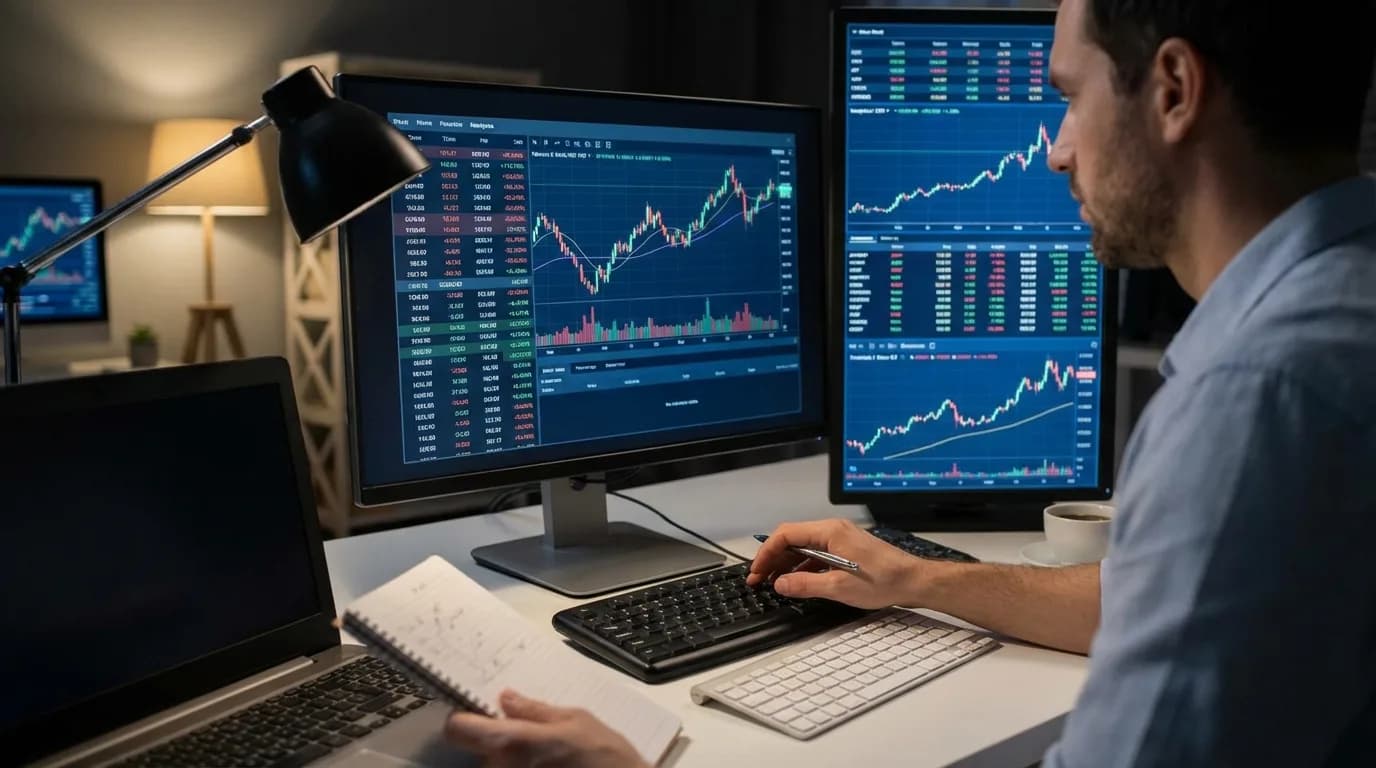
Open a historical chart. Set it to the start date. Scroll forward one bar at a time. At each bar, apply your rules: “Is this an entry signal? An exit signal?” Record every trade in a spreadsheet: entry date, entry price, exit date, exit price, profit/loss. After 50–200 trades, calculate your statistics.
The process is slow — typically 2–4 hours per 100 trades. But the intimacy with each trade builds intuition. You see the market context around each signal. You notice patterns that statistics alone don't capture: “This setup fires a lot during low-volume hours” or “Every losing trade happened right before a major news event.”
Automated Backtesting: The Process
Define your rules as precise conditions. Load historical data. The engine processes every candle, checks conditions, executes trades, and produces comprehensive statistics: win rate, profit factor, max drawdown, Sharpe ratio, equity curve, trade list. Thousands of trades across years of data in seconds.
Side-by-Side Comparison
| Aspect | Manual | Automated |
|---|---|---|
| Speed | Hours per 100 trades | Seconds per 1000+ trades |
| Sample size | 50–200 trades (practical limit) | 500–5000+ trades |
| Look-ahead bias risk | High (see future bars) | None (by design) |
| Statistical significance | Low (too few trades) | High (large sample) |
| Discretionary elements | Can include (“skip if choppy”) | Cannot include (rules only) |
| Qualitative insight | High (see every trade in context) | Low (statistics without context) |
| Reproducibility | Low (human judgment varies) | Perfect (same rules = same result) |
| Optimization | Impractical | Fast (test 1000s of parameters) |
| Cost | Free (chart + spreadsheet) | Platform or library cost |
Where Manual Wins
Discretionary Elements
Some trading decisions can't be fully quantified. “The market structure looks strong” or “this is a low-quality setup” are real assessments experienced traders make. Manual backtesting captures these by allowing you to exercise judgment at each decision point — mimicking how you'd actually trade.
Learning and Intuition
Scrolling through 500 bars and seeing how your setup plays out in different contexts builds pattern recognition that no statistics table can provide. Manual backtesting is educational in a way automated testing isn't.
Strategy Development
When developing a NEW strategy from scratch, manual chart review helps you identify patterns and formulate hypotheses. Before you have rules to automate, you need observations to turn into rules.
Where Automated Wins
Statistical Validity
50 manual trades are not enough for meaningful statistics. The confidence interval on a 60% win rate from 50 trades ranges from 45% to 74% — too wide to draw conclusions. Automated testing provides 500+ trades that narrow this interval to actionable precision.
Elimination of Bias
Manual testers subconsciously see future bars, remember which setups worked from prior experience, and exercise inconsistent judgment. Automated tests apply rules identically to every candle — no exceptions, no bias, no bad days.
Optimization and Iteration
Testing RSI at periods 7, 10, 14, 20, and 30 manually would take weeks. Automated testing handles it in seconds. The ability to rapidly iterate and optimize is essential for finding robust parameter ranges.
Pitfalls of Each Approach
Manual backtesting pitfalls: The most insidious is confirmation bias — your brain naturally seeks patterns that confirm your hypothesis. Another common trap is inconsistent rule application: on bar 50 you might require a “clean” RSI signal; by bar 300, fatigue sets in and you accept a marginal one.
Automated backtesting pitfalls: The primary risk is overfitting. With the ability to test thousands of parameter combinations, it's tempting to keep optimizing until the equity curve looks perfect — but a strategy tuned to historical noise will fail on new data.
The Combined Approach
Step 1 — Automated: Run your strategy on full data (3–5 years). Confirm positive expectancy over 200+ trades. This eliminates strategies with no edge before you invest manual review time.
Step 2 — Manual (sample): Review 30–50 trades from the automated results on a chart. Verify entries make sense visually. Look for patterns in losers — are there context clues the rules missed?
Step 3 — Refine: If manual review reveals consistent patterns (e.g., “losing trades always happen during Asian session”), add a filter to the automated rules and re-test.
Step 4 — Final automated: Run the refined strategy on out-of-sample data. This is your validation — the combination of automated statistical rigor with manual qualitative insight.
When to Use Which: A Decision Framework
The choice depends on where you are in the strategy development lifecycle.
Exploration phase: Use manual testing. You're looking at charts, noticing recurring setups, and forming hypotheses. No rules exist yet to automate.
Hypothesis testing phase: Switch to automated. You have a specific idea and need to know if it has a statistical edge across hundreds of trades.
Refinement phase: Combine both. Use automated testing to identify the weakest trades, then manually review those on a chart. Add discovered filters, re-run, compare.
Monitoring phase: Return to automated. Track real-time performance against the backtest baseline. If metrics drift, trigger a manual review to diagnose the cause.
Start With Automated, Add Manual
StratBase.ai handles the automated portion — testing your rules across years of data with 236 indicators, producing comprehensive statistics in seconds. Use the results to identify which trades to review manually, combining the speed and objectivity of automation with the intuition-building of manual chart review.
Automated rigor. Manual insight. Best of both.
Start with StratBase.ai's automated backtester for statistical validation, then manually review key trades for qualitative insight. Start backtesting →
FAQ
Which is better: manual or automated backtesting?
Neither alone is sufficient. Automated testing provides statistical rigor and large sample sizes. Manual testing provides qualitative insight and captures discretionary elements. The best process uses automated testing first for validation, then manual review of selected trades for refinement.
How many trades do I need for a valid backtest?
A minimum of 100 trades for basic confidence, 200+ for robust statistical conclusions. At 50 trades, a 60% win rate has a confidence interval of 45–74% — too wide to be actionable. Manual backtesting rarely reaches even 200 trades due to the time required.
Can I automate a discretionary strategy?
Partially. Identify the rule-based components (indicator levels, price conditions) and automate those. The discretionary elements (“market structure quality”) remain manual filters you apply after the automated engine identifies candidates. This hybrid approach captures most of the edge while maintaining statistical validity.
Further Reading
About the Author
Trading systems developer and financial engineer. 10+ years building automated trading infrastructure and backtesting frameworks across crypto and traditional markets.
FAQ
What is manual backtesting?▾
Manual backtesting means scrolling through historical charts bar-by-bar, identifying entries and exits based on your trading rules, and recording the results in a spreadsheet. You're simulating what you would have done in real-time, without the benefit of seeing future bars. Some tools provide 'bar replay' features to assist this process by hiding future data.
Is manual backtesting more accurate than automated?▾
Manual backtesting is more prone to look-ahead bias (you subconsciously see future bars), slower (days vs seconds), and limited in sample size (50-100 trades vs 500+). However, it excels at testing discretionary elements — things like 'market looks choppy, skip this setup' — that automated backtests can't capture. For fully rule-based strategies, automated is more accurate and comprehensive.
Should I do both manual and automated backtesting?▾
Ideally yes, in this order: (1) Automated backtest first to verify the rules produce positive expectancy over a large sample. (2) Manual backtest on a subset to verify the entries 'make sense' visually and to identify conditions your rules don't capture. The automated test provides statistical validity; the manual test provides qualitative validation.
Comments (0)
Loading comments...