

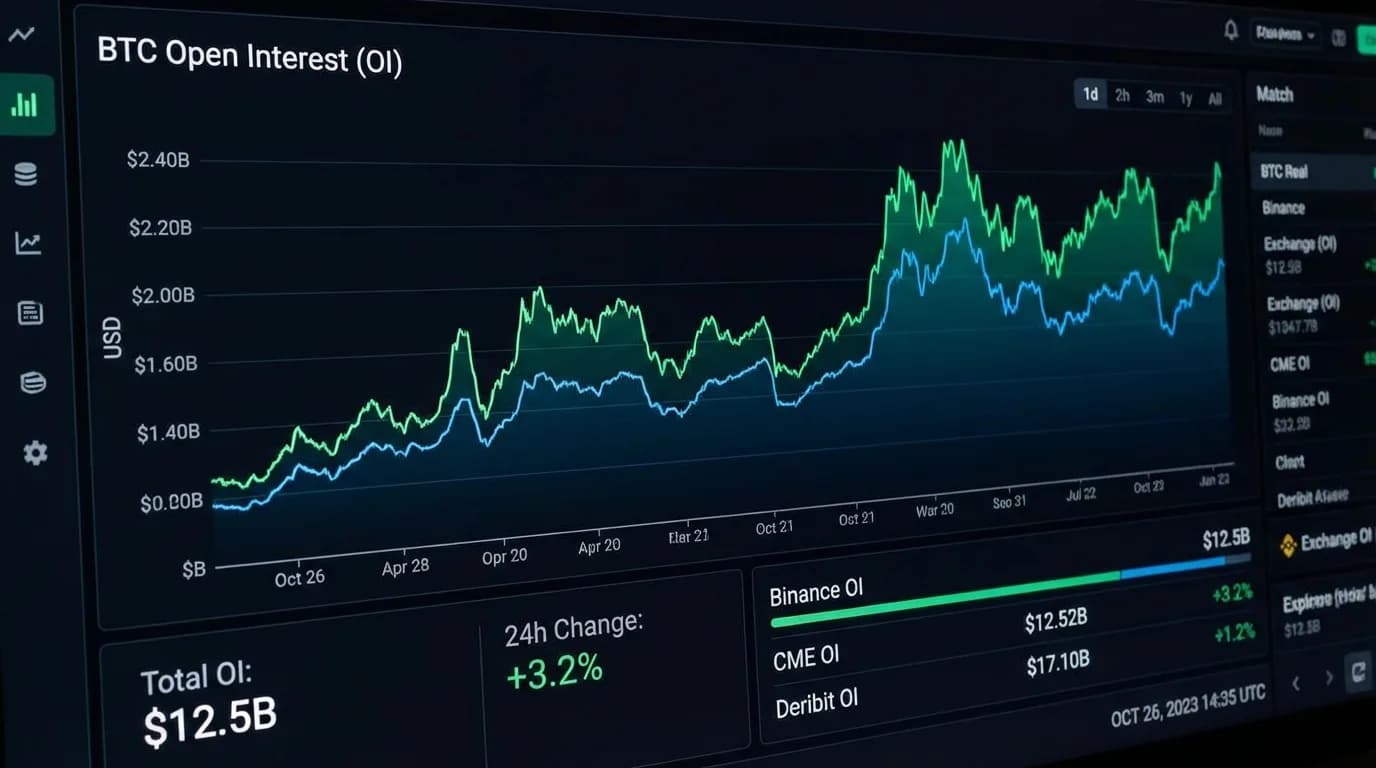
Open Interest Explained: What It Tells You About the Market
Open Interest (OI) is one of the most powerful yet frequently misunderstood metrics in derivatives trading. It represents the total number of outstanding futures or options contracts that have not been settled or closed. Unlike trading volume, which counts every transaction, open interest tracks the net number of active positions — making it a unique window into market commitment, leverage exposure, and potential volatility.
In cryptocurrency perpetual futures markets, where the majority of trading volume now occurs, open interest has become an essential tool for gauging market sentiment and anticipating liquidation-driven price moves. Understanding how to read and interpret OI changes can significantly improve your trading decisions and strategy design.
How Open Interest Works
Open interest changes based on whether new positions are being created or existing positions are being closed:
| Buyer Action | Seller Action | OI Change | Interpretation |
|---|---|---|---|
| New long | New short | +1 | New money entering the market |
| Close long | Close short | −1 | Money leaving the market |
| New long | Close long (transfer) | 0 | Position transferred, no new commitment |
| Close short | New short (transfer) | 0 | Position transferred, no new commitment |
This mechanism means that for OI to increase, both a new buyer and a new seller must enter the market simultaneously. Rising OI therefore signals growing participation and conviction on both sides of the trade, not just one direction. Conversely, falling OI means positions are being unwound, reducing the overall leverage in the system.
OI and Price: The Four Scenarios
The most valuable information comes from combining OI changes with price direction:
| Price | Open Interest | Signal | Explanation |
|---|---|---|---|
| Rising ↑ | Rising ↑ | Bullish confirmation | New money entering long positions, trend strengthening |
| Rising ↑ | Falling ↓ | Short covering rally | Bears closing positions, not new bullish conviction — weaker move |
| Falling ↓ | Rising ↑ | Bearish confirmation | New money entering short positions, downtrend strengthening |
| Falling ↓ | Falling ↓ | Long liquidation | Longs closing positions, selling pressure may be exhausting |
These four scenarios form the foundation of OI-based analysis. A rally accompanied by rising OI is far more trustworthy than one accompanied by falling OI, because the former represents genuine new buying interest while the latter is simply existing shorts covering their positions.
Open Interest in Crypto Perpetual Futures
Cryptocurrency perpetual futures add unique dimensions to OI analysis. Unlike traditional futures with expiration dates, perpetuals never expire, meaning OI can build up to extreme levels over time. This creates a market dynamic where large OI relative to spot volume signals high leverage and increased liquidation risk.
Key OI metrics for crypto traders include:
- Absolute OI: total value of open positions in USD — Binance BTC perpetuals regularly carry $5–10 billion in OI
- OI/Market Cap ratio: how leveraged the market is relative to the asset’s total value
- OI change rate: the speed at which OI is increasing or decreasing — rapid changes signal imminent volatility
- Cross-exchange OI: comparing OI levels across Binance, Bybit, and other venues reveals where positioning is concentrated
- Long/Short ratio: the proportion of long versus short positions among retail traders (note: this is often contrarian)
OI as a Liquidation Predictor
Perhaps the most actionable use of OI in crypto is predicting liquidation cascades. When OI reaches historically elevated levels, it means a large amount of leveraged capital is at risk. A sudden price move in either direction can trigger a chain reaction:
- Price moves against overleveraged positions
- Initial liquidations trigger forced market orders
- These market orders push price further, triggering more liquidations
- The cascade continues until enough OI is flushed to stabilize the market
On StratBase.ai, the OI Screener provides real-time cross-exchange open interest data with historical context, helping you identify when OI levels have reached extremes that historically preceded major liquidation events. The platform’s alert system can notify you when OI changes exceed customizable thresholds across Binance, Bybit, and other supported exchanges.
Using OI in Backtesting Strategies
OI data can be directly incorporated into algorithmic strategies as a filter or signal component. Common approaches include:
- Trend confirmation filter: only take long signals when OI is rising alongside price, filtering out short-covering rallies
- Extreme OI reversal: fade the trend when OI reaches historical extremes (e.g., >2 standard deviations above the 30-day mean), anticipating a liquidation flush
- OI divergence: when price makes a new high but OI is declining, treat it as a bearish divergence signal
- Volume × OI confirmation: require both high volume and rising OI for valid breakout entries
StratBase.ai’s backtesting engine includes 12 futures-specific indicators, including open interest levels, OI change rates, and funding rate data. These can be combined with standard technical indicators to create multi-factor strategies that incorporate market microstructure data alongside traditional price analysis.
Common Mistakes with OI Analysis
Avoid these frequent pitfalls when working with open interest data. First, do not confuse rising OI with bullish sentiment — OI increases when both sides add positions, so it reflects commitment, not direction. Second, always normalize OI by historical levels rather than using raw numbers; what constitutes «high» OI for BTC today is different from a year ago. Third, remember that reported long/short ratios from exchanges typically cover only retail accounts — institutional positioning may be the opposite. Finally, be aware that cross-exchange arbitrage positions inflate OI without representing directional bets, especially during periods of high funding rate divergence between venues.
When combined with price action and volume analysis, open interest provides a dimension of market insight that purely technical indicators cannot match. It tells you not just what the market is doing, but how committed participants are to the current move — information that can make the difference between a successful trade and a failed one.
Further Reading
About the Author
Quantitative researcher with 8+ years in algorithmic trading and strategy backtesting. Specializes in technical indicator analysis and risk-adjusted performance metrics.
FAQ
What is open interest?▾
Open interest (OI) is the total number of outstanding derivative contracts (futures or options) that have not been settled. Each contract requires a buyer and a seller, so one contract = one unit of OI. When a new buyer and new seller open positions, OI increases by 1. When an existing holder closes their position with another existing holder, OI decreases by 1.
How do you use open interest in trading?▾
OI combined with price movement reveals market conviction: (1) Price up + OI up = strong uptrend (new money entering long). (2) Price up + OI down = weak uptrend (shorts covering, not new buying). (3) Price down + OI up = strong downtrend (new money entering short). (4) Price down + OI down = weak downtrend (longs exiting, not new selling). Scenario 1 and 3 are high-conviction moves. Scenarios 2 and 4 suggest exhaustion.
What does rising open interest mean?▾
Rising OI means new positions are being opened — new money is entering the market. If price is also rising, it confirms bullish conviction (new longs). If price is falling, it confirms bearish conviction (new shorts). Rising OI during a trend suggests the trend has fuel. Falling OI during a trend suggests the trend is losing participation and may be nearing exhaustion.
Comments (0)
Loading comments...