

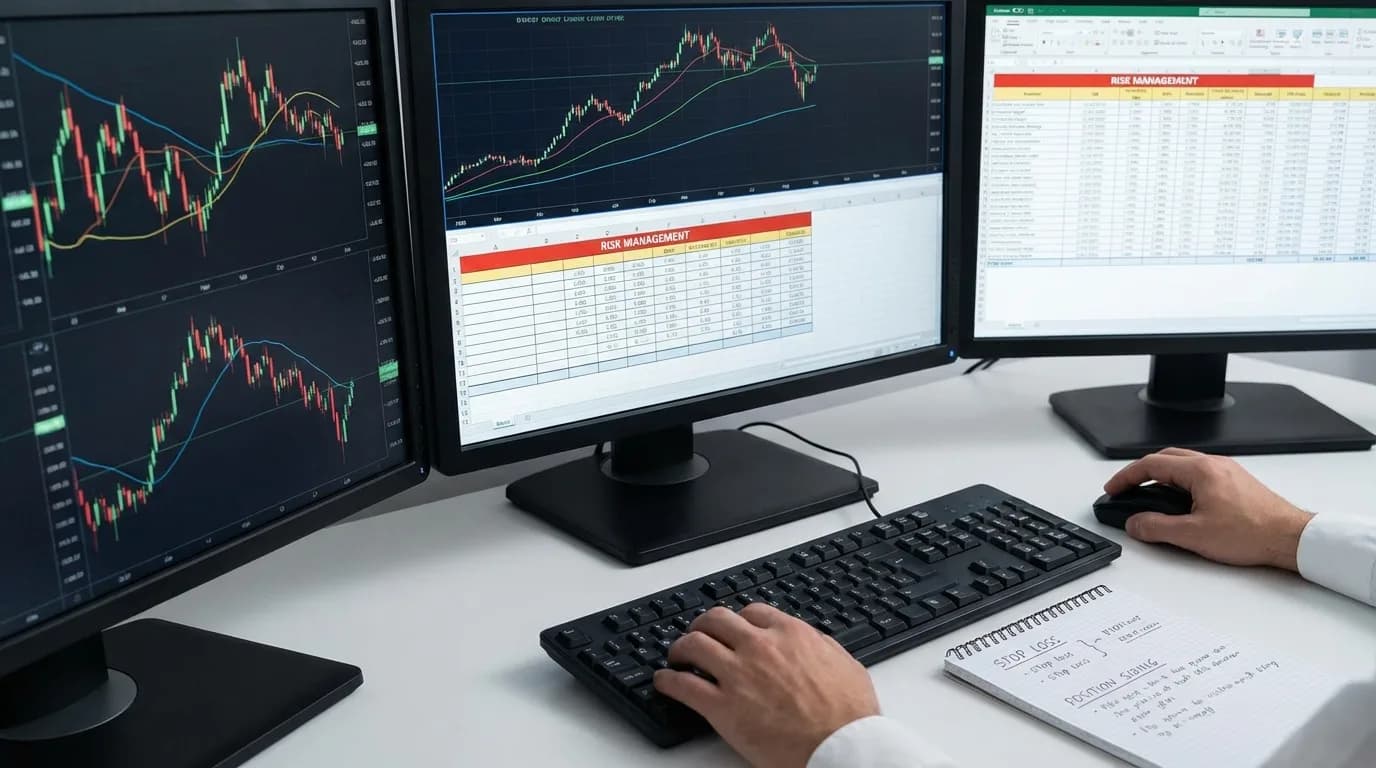
Risk Management Fundamentals Every Trader Must Know
Why Risk Management Decides Your Trading Career
Every successful trader will tell you the same thing: risk management is the single most important skill. Not chart reading, not indicator optimization, not market timing. Risk management. The math is unforgiving — a 50% loss requires a 100% gain to recover, a 75% loss needs 300%.
The most common pattern among failed traders: they develop a strategy with genuine edge, size positions too aggressively, hit an inevitable drawdown, panic, and either blow up the account or abandon the strategy right before it would have recovered. Proper risk management prevents every step of this sequence.
The 1% Rule: Your First Line of Defense
The 1% rule is simple: never risk more than 1% of your total capital on any single trade. This isn't a suggestion — it's the mathematical foundation of survival.
At 1% risk per trade, the probability of a 20-trade losing streak is astronomically low for any strategy with genuine edge. Even if it happens, you've only lost 18.2% of capital — painful but recoverable.
At 5% risk per trade, a 10-trade losing streak (which is common for trend-following strategies with 40% win rates) produces a 40% drawdown. Your strategy might be profitable in the long run, but your psychology — or your margin call — won't let you find out.
For beginners: start at 0.5% risk. For experienced traders: 1-2%. For aggressive professionals with proven strategies: up to 3%. Above 3% per trade requires either extraordinary confidence in your edge or extraordinary tolerance for pain.
Stop Losses: Types and Implementation
A stop loss is your pre-committed exit point when a trade goes against you. Setting stops before entering is critical because in-the-moment decisions are compromised by emotion.
Fixed stop: Set a specific price level based on technical analysis — below support, below a moving average, below the last swing low. Simple and effective.
ATR-based stop: Set the stop at entry ± (ATR × multiplier). Typically 1.5-3× ATR. This automatically adapts to current volatility — wider stops in volatile markets, tighter in calm ones.
Trailing stop: The stop moves in your favor but never against you. A 2× ATR trailing stop locks in profits as the trade progresses while giving enough room for normal pullbacks.
Time stop: Exit after N bars if the trade hasn't reached a minimum profit threshold. This prevents capital from being tied up in dead trades that aren't losing enough to trigger the price stop but aren't winning either.
In backtesting, always test your strategy with each stop type. The "best" stop depends entirely on your strategy's characteristics — trend followers generally need wider stops, mean reversion strategies need tighter ones.
Correlation: The Hidden Risk Multiplier
Most traders understand single-trade risk. Few understand portfolio-level correlation risk, which is where the real danger lurks.
Imagine you risk 2% on each of 5 positions. Your total risk appears to be 10% maximum. But if all 5 positions are in crypto altcoins (correlation 0.85+), a market crash hits all 5 simultaneously. Your "10% maximum risk" becomes a 10% actual loss in a single day.
True risk calculation must account for correlation. Five independent positions at 2% risk each have a maximum correlated loss much lower than five correlated positions at the same sizing. This is why diversification across truly uncorrelated assets — different market types, different timeframes, different strategy types — is the most effective portfolio-level risk management technique.
In practice: limit your total correlated exposure. If you trade 5 crypto pairs, treat them as 1-2 independent bets for risk calculation purposes. Allocate the remaining risk budget to genuinely uncorrelated strategies or assets.
Drawdown Limits: The Circuit Breaker
Even with proper position sizing, drawdowns happen. Pre-set drawdown limits act as circuit breakers that force you to reduce risk or stop trading before damage becomes catastrophic.
Daily limit: If you lose X% in a single day (typically 3-5%), stop trading. Emotional state after significant losses produces worse decisions. Come back tomorrow with a clear head.
Weekly/monthly limit: Reduce position size by 50% after a 10% monthly drawdown. This cuts your bleed rate while keeping you in the game.
Maximum drawdown limit: If total drawdown exceeds 20-25%, stop trading entirely and review your strategy. Either market conditions have changed, or your strategy has a flaw that backtesting didn't reveal.
These limits should be written down and treated as inviolable rules. When you're in a drawdown is exactly when your judgment is worst — having pre-committed rules removes the decision from your compromised emotional state.
Backtesting Risk Management
The beauty of backtesting is that you can test risk management rules before risking real money. In StratBase, you can configure position sizing, stop loss types, and risk parameters, then see exactly how they affect your strategy's drawdown profile, Sharpe ratio, and total return.
Key tests to run:
- Position sizing comparison: Run the same strategy at 1%, 2%, 3%, and 5% risk — see where the risk-adjusted return peaks
- Stop loss optimization: Test fixed vs. ATR-based vs. trailing stops — but be careful of over-optimization
- Monte Carlo simulation: Randomize trade order to see the range of possible drawdowns, not just the historical one
- Out-of-sample validation: Optimize on 70% of data, validate on 30%. If risk-adjusted returns hold, your risk management is robust
The goal isn't to eliminate drawdowns — that's impossible. The goal is to find the risk management settings that maximize return per unit of drawdown, giving you the confidence to stay disciplined during inevitable rough patches.
Further Reading
About the Author
Financial data analyst focused on crypto derivatives and on-chain metrics. Expert in futures market microstructure and funding rate strategies.
FAQ
What is the most important rule of risk management?▾
Never risk more than you can afford to lose on a single trade. The standard guideline is 1-2% of total capital per trade. At 1% risk, you can endure 20 consecutive losses and still have 82% of your capital. At 5% risk, 20 losses leave you with only 36%. Risk management is about surviving long enough for your edge to play out — it's a mathematical necessity, not a suggestion.
How do you calculate proper position size?▾
Position Size = (Account Balance × Risk Per Trade) / (Entry Price - Stop Loss Price). Example: $10,000 account, 2% risk ($200), entry at $50, stop loss at $47 (risk = $3 per share). Position = $200 / $3 = 66 shares. This ensures that if your stop loss triggers, you lose exactly 2% of your account regardless of the stock price or volatility.
What is correlation risk in trading?▾
Correlation risk occurs when multiple positions move in the same direction simultaneously. If you hold 5 crypto positions and the market drops 20%, all 5 may lose money at once — your 'diversified' portfolio behaves like one giant position. True diversification means holding assets with LOW correlation. In crypto, most altcoins are 0.7-0.95 correlated with Bitcoin, so '5 crypto positions' is effectively 1-2 independent bets.
Comments (0)
Loading comments...