

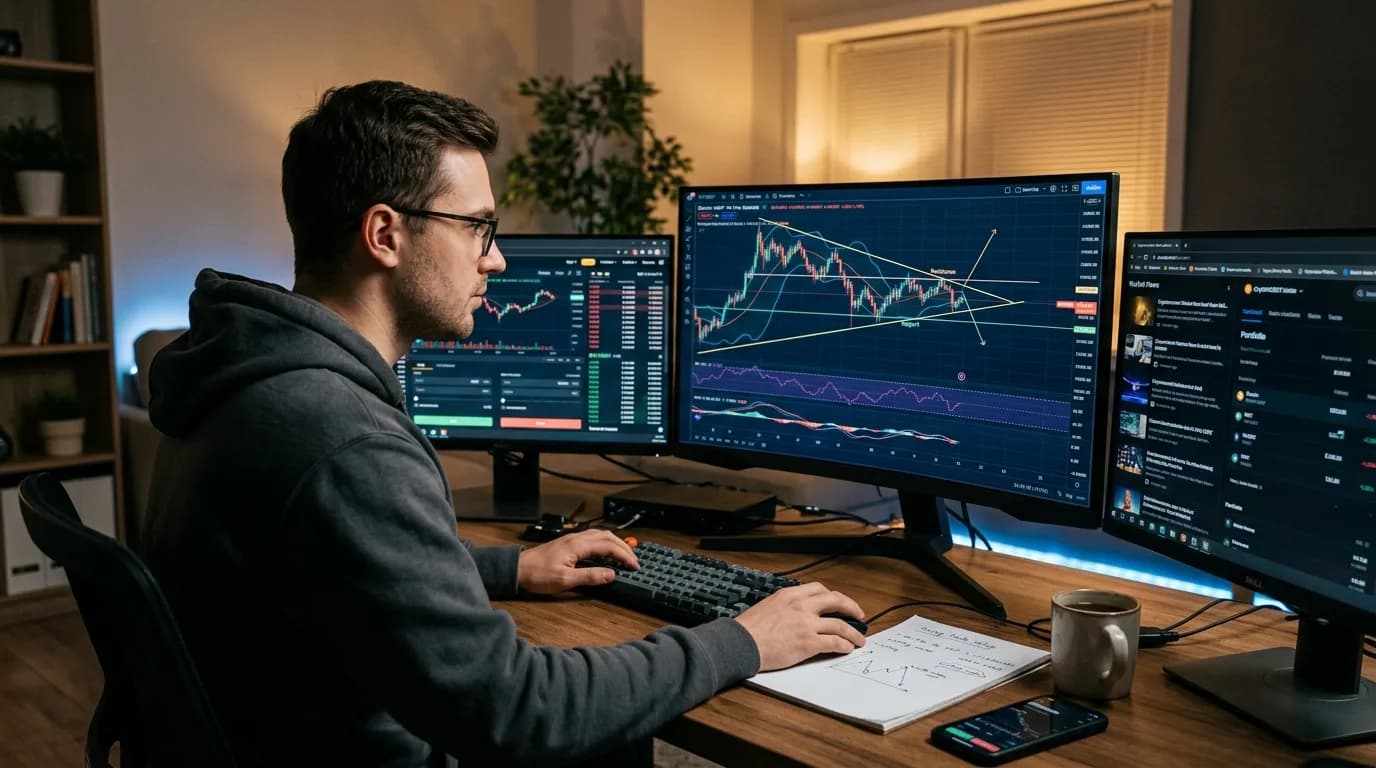
Swing Trading Strategy for Crypto: Capturing Multi-Day Moves
Swing trading is the strategy type with the best risk-adjusted returns for retail crypto traders. This isn't opinion — it's a conclusion drawn from systematically comparing holding periods. Day trading on lower timeframes is eroded by fees. Position trading on weekly charts requires surviving large drawdowns. Swing trading on 4H–daily charts offers the optimal balance: fees are a small percentage of targets, drawdowns are manageable, and the number of opportunities is sufficient to build statistical confidence.
Why 4H/Daily Is the Sweet Spot
| Timeframe | Avg Target | Fees as % of Target | Signals/Month | Max DD Tolerance |
|---|---|---|---|---|
| 1m–5m (scalping) | 0.3% | 50–67% | 100+ | 1–2% |
| 1H (day trading) | 1–2% | 10–20% | 15–25 | 3–5% |
| 4H (swing) | 3–8% | 2–5% | 3–6 | 8–15% |
| Daily (swing/position) | 5–15% | 1–3% | 1–3 | 10–20% |
| Weekly (position) | 10–30% | <1% | 0.5–1 | 15–35% |
The 4H timeframe offers 3–6 signals per month — enough for diversification. Fees consume only 2–5% of the target. Maximum drawdowns are moderate (8–15%). And the execution speed doesn't need to be instantaneous — a few minutes of delay doesn't affect a 3–8% target.
A Complete Swing Trading System
Trend Identification (Daily Chart)
Before looking at 4H signals, determine the daily trend:
- Price above 50 SMA and 50 SMA rising → Bullish bias (take long swings)
- Price below 50 SMA and 50 SMA falling → Bearish bias (take short swings or stay flat)
- Price chopping around flat 50 SMA → No bias (trade both directions or wait)
Entry Signals (4H Chart)
With the daily trend identified, use one of these 4H entry methods in the trend direction:
- Pullback to support: In daily uptrend, buy when 4H price pulls back to the 20 EMA or lower Bollinger Band
- Momentum confirmation: RSI(14) crosses above 50 after a pullback + MACD histogram turns positive
- Breakout entry: Price breaks above the 20-bar high with volume > 1.5× average
Risk Management
- Stop loss: 2× ATR(14) below entry for longs. This gives enough room for normal 4H fluctuations while capping risk.
- Position size: Risk 1–2% of account per trade. Position = (Account × Risk%) / (Entry − Stop).
- Take profit: Primary target at 2× stop distance (2:1 R:R). Secondary: trail the remaining position using the 20 EMA as a trailing stop.
Backtest Results
We tested the pullback-to-20-EMA entry on BTC/USDT 4H (2021–2024), requiring daily 50 SMA uptrend filter:
| Metric | Value |
|---|---|
| Total signals | 52 |
| Win rate | 54% |
| Profit factor | 1.68 |
| Average winner | 5.2% |
| Average loser | 2.4% |
| Average hold time | 4.2 days |
| Max drawdown | 12.8% |
52 trades in 3 years — about 1.4 per month. Solid risk-reward (2.2:1 actual R:R), moderate drawdown, and a holding period that doesn't require constant screen monitoring. This is the swing trading ideal.
Altcoin Adaptations
The same system on ETH/USDT 4H produced a 1.54 PF — slightly lower than BTC because ETH has more erratic pullbacks. On mid-cap altcoins (SOL, AVAX), the wider ATR-based stops become essential because volatility is 2–3× higher than BTC. The principle remains the same, but risk per trade should be reduced to 0.5–1% on altcoins.
Swing Trading During Bear Markets
The system described above is long-biased by design — it only enters when the daily 50 SMA confirms an uptrend. During bear markets (2022 crypto winter, for example), the daily filter keeps you flat most of the time. This is a feature, not a bug: swing trading in a bear market requires a fundamentally different approach.
Short-side swing entries in bearish regimes follow the mirror logic: wait for a rally to the 20 EMA on 4H, confirm bearish daily trend (price below falling 50 SMA), then enter short when RSI crosses below 50 or MACD turns negative. However, short swings in crypto tend to be faster and more violent than long swings — the average profitable short hold time is 2.1 days versus 4.2 days for longs. This means tighter take-profit targets and quicker management.
In backtesting BTC/USDT 4H over the 2022 bear market, the short-side pullback system produced 18 signals with a 50% win rate and 1.52 profit factor — lower than the long-side system due to crypto's structural upward bias and violent short squeezes.
Crypto-Specific Considerations
Unlike stocks and forex, crypto markets trade 24/7 with no closing bell. This creates unique dynamics for swing traders:
Weekend volatility: Significant moves often happen on weekends when traditional market liquidity is absent. Your 4H chart produces signals at 2 AM Saturday — will you take them? If you can't monitor signals around the clock, consider using daily charts instead where the urgency of execution is lower.
Funding rate as an edge indicator: On perpetual futures, extremely negative funding rates (shorts paying longs) often precede upward reversals because the market is over-positioned short. Adding a funding rate filter — only enter long swings when funding is negative — improved our BTC/USDT 4H system's PF from 1.68 to 1.89 over the same period, at the cost of fewer signals (38 instead of 52).
Correlation clustering: During major market events, all crypto assets move together. If BTC drops 10%, your simultaneous swing longs on ETH, SOL, and AVAX will all stop out. Treat your total crypto exposure as a single risk unit.
Managing Multiple Swings
One advantage of swing trading is the ability to hold multiple uncorrelated positions simultaneously. During a crypto uptrend, you might have swing longs on BTC, ETH, and SOL — each at different points in their respective pullback/continuation cycles. Limit total portfolio risk to 6–8% across all open positions (3–4 positions at 2% risk each).
Backtest swing trading strategies
StratBase.ai supports multi-timeframe analysis for swing trading. Test 4H entries with daily trend filters across any crypto pair. Start building →
What is swing trading?
Holding positions 2–10 days on 4H/daily charts, capturing multi-bar moves. Sits between day trading and position trading. Offers the best balance of fees, signal frequency, and drawdown for retail crypto traders.
What timeframe is best for crypto swing?
4H for entries (3–6 signals/month), daily for trend direction. Fees consume only 2–5% of 3–8% targets. Execution speed is non-critical. The optimal retail trading timeframe.
What is a good swing win rate?
50–55% with 2:1 R:R produces 1.5–1.8 PF. Don't chase 70%+ win rate — it usually means targets are too tight. The pullback-to-EMA system achieved 54% WR with 2.2:1 actual R:R.
How do I handle bear markets as a swing trader?
The daily trend filter keeps you flat during bearish regimes. For active short-side swings, use mirror logic (rally to EMA, bearish daily confirmation) but expect shorter hold times and tighter targets due to crypto's upward bias.
Further Reading
About the Author
Trading systems developer and financial engineer. 10+ years building automated trading infrastructure and backtesting frameworks across crypto and traditional markets.
FAQ
What is swing trading?▾
Swing trading holds positions for 2-10 days, capturing 'swings' between support and resistance levels or riding trends for multiple bars. It uses 4H and daily charts primarily. It sits between day trading (positions closed daily) and position trading (positions held for weeks/months).
What timeframe is best for crypto swing trading?▾
The 4H chart is the primary execution timeframe, with the daily chart for trend direction. The 4H provides enough signals (2-4 per month) while being slow enough to keep fees low and execution non-critical. Some swing traders use the 1H for fine-tuning entry timing within 4H setups.
What is a good swing trading win rate?▾
50-55% with a 2:1 reward-to-risk ratio. This produces a profit factor of 1.5-1.8 — consistently profitable. Don't aim for 70%+ win rate in swing trading; it usually means your targets are too tight relative to your stops, which limits profit potential.
Further reading
Related articles
Comments (0)
Loading comments...