

How to Account for Slippage in Your Backtest
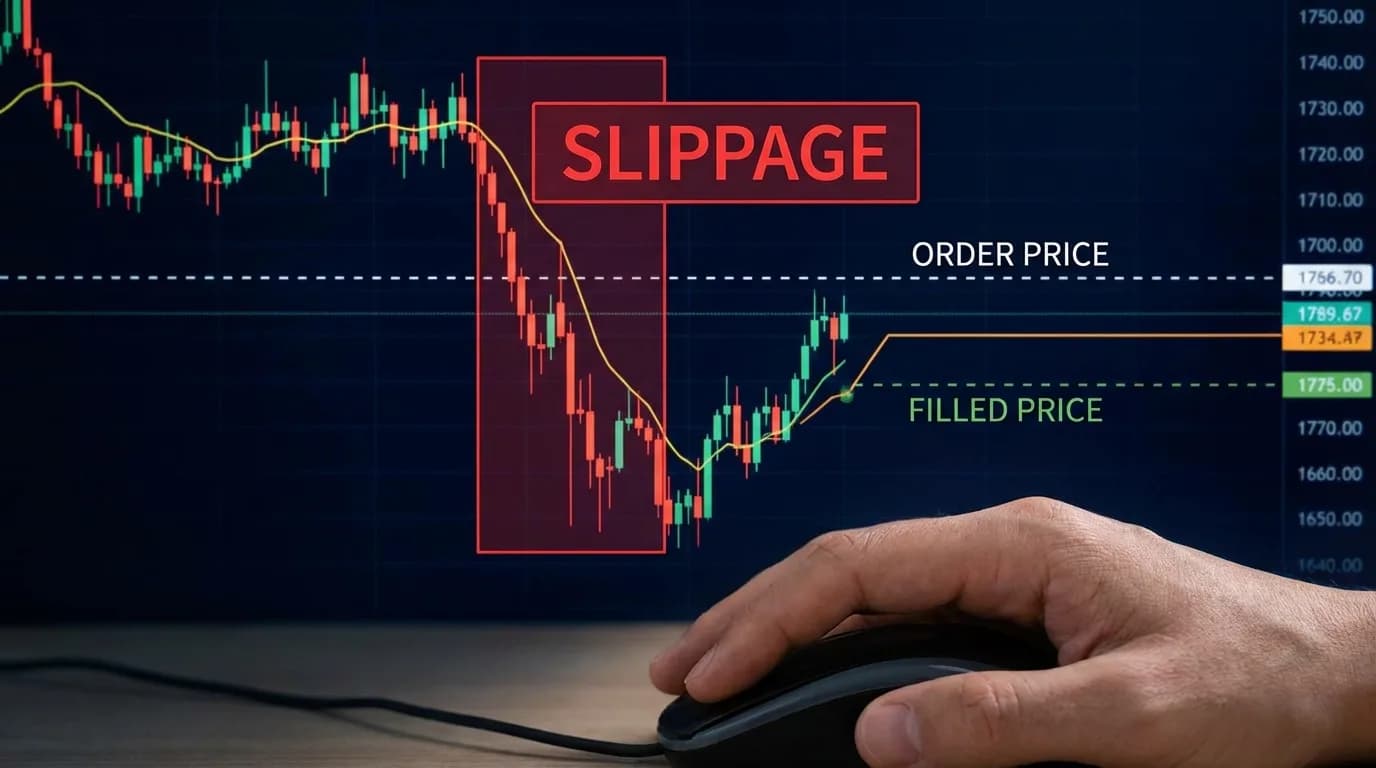
Your backtest says you bought BTC at $64,250.00. In reality, your market order filled at $64,267.35 — that's $17.35 worse, or about 0.027%. Doesn't sound like much until you multiply it across 400 trades per year. That 0.027% per trade becomes 10.8% annual drag. For a strategy targeting 25% annual returns, slippage just consumed 43% of your profit.
Slippage is one of those costs that's easy to ignore because it's invisible in most backtests. Your backtester assumes you execute at the exact candle price. The real market doesn't care about your assumptions.
Why Slippage Happens
Slippage has three primary causes, and understanding each helps you model it correctly:
1. Latency slippage. Time passes between signal detection and order submission. On a 1-minute chart, by the time your code detects a signal at the close of candle N and submits an order, candle N+1 has already started. If price moved 0.05% in those milliseconds, that's your slippage.
2. Liquidity slippage. Your order size exceeds the liquidity at the best price level. If you want to buy $50,000 of BTC and only $12,000 sits at the best ask, the remaining $38,000 fills at increasingly worse prices as it eats through the order book.
3. Volatility slippage. During high-volatility events, spreads widen and prices move faster. The slippage during a FOMC announcement or a flash crash can be 5-10x normal levels. This is the slippage that really hurts, because it hits hardest during the trades where your stop-loss is most likely to trigger.
Slippage by Market
| Market | Normal Slippage | High-Vol Slippage | Key Factor |
|---|---|---|---|
| BTC/USDT (Binance) | 0.01-0.03% | 0.1-0.5% | Liquidity depth |
| ETH/USDT | 0.02-0.05% | 0.1-0.5% | Slightly less liquid than BTC |
| Mid-cap crypto | 0.05-0.15% | 0.5-2.0% | Thin order books |
| EUR/USD | 0.2-0.5 pips | 2-5 pips | Session-dependent |
| USD/JPY | 0.3-0.7 pips | 3-8 pips | News events |
| AAPL stock | $0.01 | $0.05-0.10 | Near-zero for large caps |
| Small-cap stocks | $0.05-0.20 | $0.50-2.00 | Wide spreads, low volume |
How to Configure Slippage in Your Backtest
Most backtesting platforms let you set slippage as either a fixed amount (pips, dollars) or a percentage. Here's my approach:
Fixed percentage method: Simple and works well for most cases. Set slippage to 0.05% per trade for liquid crypto, 0.1% for less liquid instruments. This is applied on top of commission — so your total execution cost per trade is commission + slippage + spread.
Volatility-scaled method: More sophisticated. Set slippage as a fraction of ATR — for example, 5% of ATR(14). This automatically increases slippage during volatile periods and decreases it during calm ones. If BTC's ATR(14) on 1-hour is $500, slippage would be $25 (0.04% at $64,000). During a flash crash when ATR spikes to $2,000, slippage increases to $100 (0.16%). This is more realistic.
Order-book simulation: The most accurate method, but requires order book depth data. Your backtester simulates filling your order against the actual order book, calculating the real price impact. This is what institutional backtesting systems use, but it requires specialized data that most retail platforms don't provide.
The Asymmetry Problem
Here's something most traders never consider: slippage is asymmetric. When you enter on a breakout (price moving fast in your direction), slippage works against you — you get filled worse because you're chasing momentum. When you're stopped out (price moving against you), slippage also works against you — you get filled worse because you're exiting into adverse pressure.
This means slippage hits you on both winning and losing trades, but especially on the losing ones. Stop-loss slippage during volatile drops can be 3-5x the normal slippage, which means your actual losses are larger than what the backtest shows.
A conservative approach: model entry slippage at 1x your normal estimate and exit slippage at 1.5-2x, particularly for stop-loss exits.
"The market doesn't owe you the price you want. It gives you the price it has. The difference between those two prices is called slippage, and it's always in the market's favor." — A trading axiom I learned the expensive way
Slippage Stress Testing
After running your backtest with normal slippage assumptions, run it again with 2x and 3x slippage. This tells you how sensitive your strategy is to execution quality:
- Strategy profitable at 3x slippage: Robust to execution. Safe to deploy.
- Profitable at 2x but not 3x: Acceptable but monitor execution closely in live trading.
- Only profitable at 1x: Fragile. Small execution issues will kill profitability. Consider whether the edge is sufficient.
- Unprofitable even at normal slippage: Reject the strategy entirely.
Slippage modeling works together with fee modeling to give you the complete picture of execution costs. Both must be right for your backtest to be trustworthy.
Model slippage correctly from the start. StratBase.ai lets you configure slippage per instrument with percentage or fixed-value settings, ensuring your backtest results reflect real trading conditions.
FAQ
What is slippage in trading?
The difference between expected and actual execution price. It occurs due to latency, insufficient liquidity, or high volatility at the time of execution.
How much slippage should I add?
Liquid crypto: 0.03-0.05%. Mid-cap crypto: 0.05-0.15%. Forex majors: 0.2-0.5 pips. Large-cap stocks: $0.01-0.03/share. Double during high-volatility events.
Further Reading
About the Author
Trading systems developer and financial engineer. 10+ years building automated trading infrastructure and backtesting frameworks across crypto and traditional markets.
FAQ
What is slippage in trading?▾
Slippage is the difference between the price you expect to get when placing an order and the price you actually receive. It occurs because the market moves between when you decide to trade and when your order is filled, or because your order size exceeds the available liquidity at your target price.
How much slippage should I add to my backtest?▾
For liquid crypto pairs (BTC, ETH): 0.03-0.05%. For mid-cap crypto: 0.05-0.15%. For forex majors: 0.2-0.5 pips. For large-cap US stocks: $0.01-0.03/share. Double these values during high-volatility events like FOMC announcements or flash crashes.
Further reading
Related articles
Comments (0)
Loading comments...