

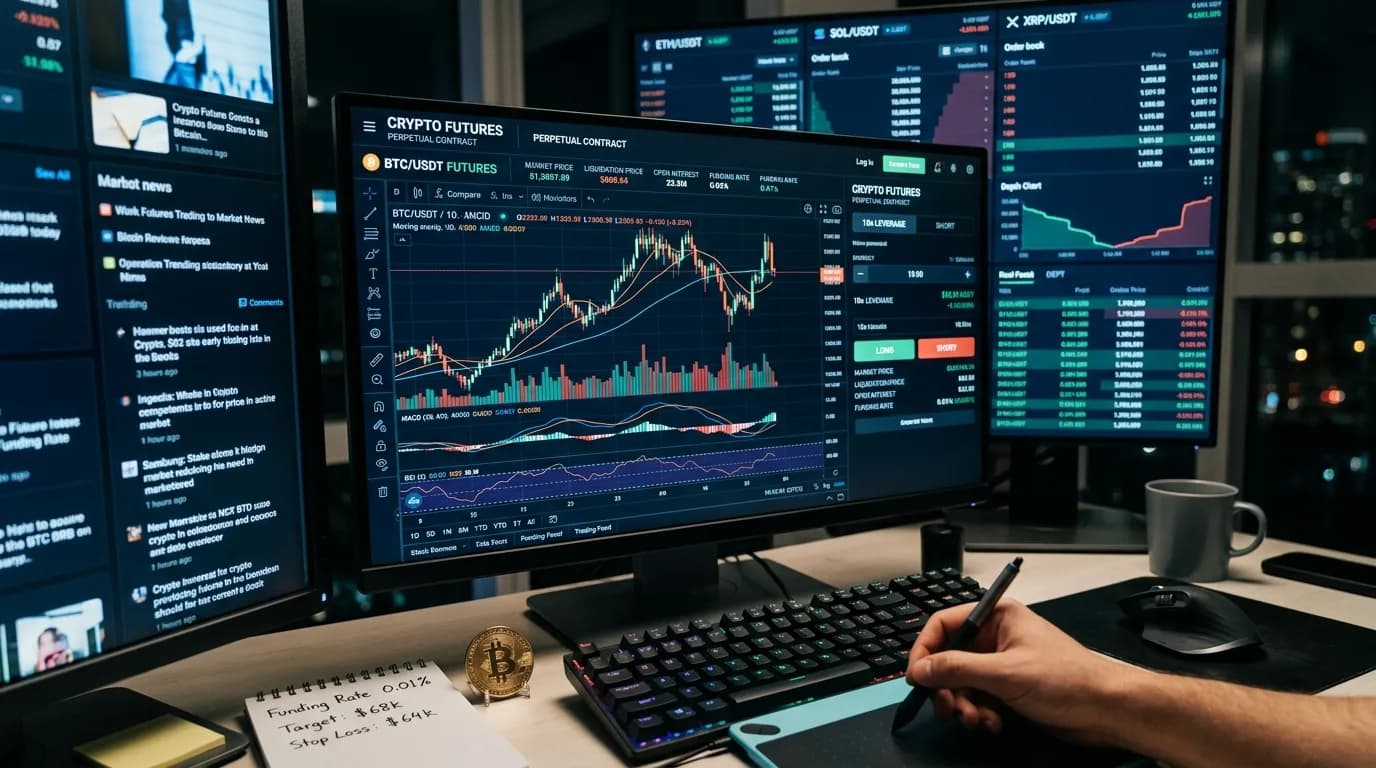
Backtesting Crypto Futures: Leverage, Funding, and Liquidation
Perpetual futures are the most traded instruments in crypto — often 3-5x the volume of their spot counterparts. But backtesting futures strategies introduces three complications that spot trading doesn't have: leverage mechanics, funding rate costs, and liquidation risk. Get any of these wrong and your backtest is fiction.
Leverage: The Double-Edged Amplifier
Leverage in crypto futures is straightforward in concept but dangerous in practice. At 5x leverage, you control $50,000 worth of BTC with $10,000 of capital. Your returns are 5x amplified in both directions.
The critical addition: liquidation. Your position is automatically closed (liquidated) if losses reach your margin. The liquidation price formula for an isolated margin long position:
Liquidation Price = Entry Price × (1 − 1/Leverage + Maintenance Margin %)
| Leverage | Liquidation Distance | Max Adverse Move |
|---|---|---|
| 2x | ~49% | Large — relatively safe |
| 5x | ~19% | A single bad week |
| 10x | ~9.5% | A bad day in crypto |
| 20x | ~4.7% | A few hours of volatility |
| 50x | ~1.9% | Normal market noise |
| 100x | ~0.9% | One adverse candle |
BTC regularly moves 5-10% in a single day. At 10x leverage, a single bad day can liquidate your entire position. At 20x, it happens almost weekly. Your backtest must enforce liquidation at the mathematically correct price — if it doesn't, all results above 3-5x leverage are meaningless.
Funding Rate: The Perpetual Tax
Perpetual futures have no expiration date (unlike traditional futures). To keep the perpetual price close to the spot price, exchanges use a funding rate mechanism: every 8 hours, one side pays the other.
When funding is positive (the usual state during bull markets), longs pay shorts. When negative (bear markets or oversold conditions), shorts pay longs. The rate is typically 0.01% per 8-hour interval, but can spike to 0.1% or higher during extreme sentiment.
Funding's impact over time:
| Funding Rate | Annual Cost (Long) | Impact on 30% Strategy |
|---|---|---|
| 0.005% / 8h | ~5.5% | 30% → 24.5% net |
| 0.01% / 8h | ~11% | 30% → 19% net |
| 0.03% / 8h | ~33% | 30% → -3% (net loss!) |
| 0.05% / 8h | ~55% | 30% → -25% (disaster) |
During the 2021 bull run, BTC funding rates averaged 0.03-0.05% for weeks. Any long-biased strategy that didn't model funding would show massively inflated returns for that period.
Proper Futures Backtest Configuration
Here's the complete configuration checklist for crypto futures backtesting:
- Leverage: Set to your intended live leverage. Never backtest at higher leverage than you'll actually use. I recommend 3-5x maximum for any strategy you plan to trade with real money.
- Margin mode: Isolated (separate margin per position) or cross (shared margin). Isolated is safer and easier to model — each position can only lose its own margin.
- Funding rate: Use historical funding rate data if available. Otherwise, model at 0.01% per 8h for longs and -0.01% for shorts as a baseline.
- Liquidation: Must be enforced. If price reaches the liquidation level, the position closes at a 100% loss of margin, not at your stop-loss.
- Maker/taker fees: Futures fees are lower than spot. Use 0.02% maker, 0.04-0.055% taker for most exchanges.
- Position sizing: Calculate based on margin, not notional value. At 5x leverage, a $10,000 account can hold $50,000 notional, but your risk calculation should be based on the $10,000 margin.
Futures-Specific Indicators
Futures markets provide data that spot markets don't. Using this data can significantly improve your strategy:
Open Interest (OI): The total number of outstanding futures contracts. Rising OI with rising price = new money entering long positions (bullish). Rising OI with falling price = new short positions opening (bearish). OI divergence from price is a powerful signal.
Long/Short Ratio: The proportion of long vs short accounts. Extreme readings (>70% long or >70% short) often precede reversals as the crowded side gets squeezed.
Liquidation data: Large liquidation cascades can accelerate price movement and provide mean-reversion opportunities after the cascade exhausts itself.
These indicators are available in StratBase.ai's futures backtesting mode and can be combined with standard technical indicators for more nuanced strategies. See the crypto backtesting guide for spot-market testing fundamentals.
"Leverage doesn't create edge. It amplifies whatever edge — or lack of edge — you already have. If your strategy has a 1% edge, leverage makes it a 5% edge. If it has a -0.5% edge, leverage makes it a -2.5% disaster. Know your edge before you leverage it." — A quantitative risk manager's perspective
Backtest futures strategies with full leverage and funding rate modeling. StratBase.ai supports perpetual futures data from Binance and Bybit with OI, funding rates, and long/short ratio — all integrated into the backtesting engine.
FAQ
How does leverage affect backtesting results?
Leverage amplifies gains and losses. At 10x, a 10% adverse move liquidates your position. Backtests must model liquidation or they dramatically overstate leveraged performance.
How much does funding rate impact a futures strategy?
At 0.01%/8h, funding costs ~11% annually. A 30% gross strategy nets only ~19%. During bull markets, rates spike to 0.03-0.05%/8h, potentially turning profitable strategies negative.
Further Reading
About the Author
Quantitative researcher with 8+ years in algorithmic trading and strategy backtesting. Specializes in technical indicator analysis and risk-adjusted performance metrics.
FAQ
How does leverage affect backtesting results?▾
Leverage amplifies both gains and losses linearly. A 5x leveraged position makes 5x the profit on winning trades and 5x the loss on losers. But the critical addition is liquidation risk: at 10x leverage, a 10% adverse move liquidates your position entirely. Backtests must model liquidation or they dramatically overstate leveraged strategy performance.
How much does funding rate impact a futures strategy?▾
Funding rates on perpetual futures are typically ±0.01% every 8 hours, but can spike to ±0.1% during extreme market conditions. Over a year, positive funding on a long-biased strategy costs approximately 11-15% annually. A strategy showing 30% gross returns could net only 15-19% after funding.
Further reading
Related articles
Comments (0)
Loading comments...