
Why Demo Trading Profits Don't Transfer to Real Accounts
The leap from demo to real trading is the graveyard of trading careers. Forums are filled with traders who crushed it on paper, switched to real money, and watched their performance collapse. This isn't about skill degradation or bad luck — it's about fundamental differences between the two environments that no amount of demo practice can bridge.
The Execution Gap
Demo accounts provide perfect fills: instant execution at the exact price you clicked. Real markets work differently. Your market order gets filled at the best available price, which may be 0.1-0.5% away from what you saw on screen. Limit orders may not fill at all if the price touches your level briefly. In fast-moving markets — exactly when your strategy produces the best signals — slippage can reach 1-3%.
Over hundreds of trades, this execution gap compounds dramatically. If your strategy's average winner is 3% and slippage costs 0.3% per round trip (entry plus exit), that's 10% of your edge erased before you even account for commissions. On demo, a healthy 1.5:1 profit factor might shrink to 1.1:1 in live trading — barely profitable after fees.
The gap widens further in illiquid markets. A demo trade on a low-volume altcoin fills instantly at $1.00, but a real order might fill across multiple price levels at an average of $1.03. This difference is invisible on paper and devastating in practice, particularly for strategies that target small percentage moves.
The Psychology Gap
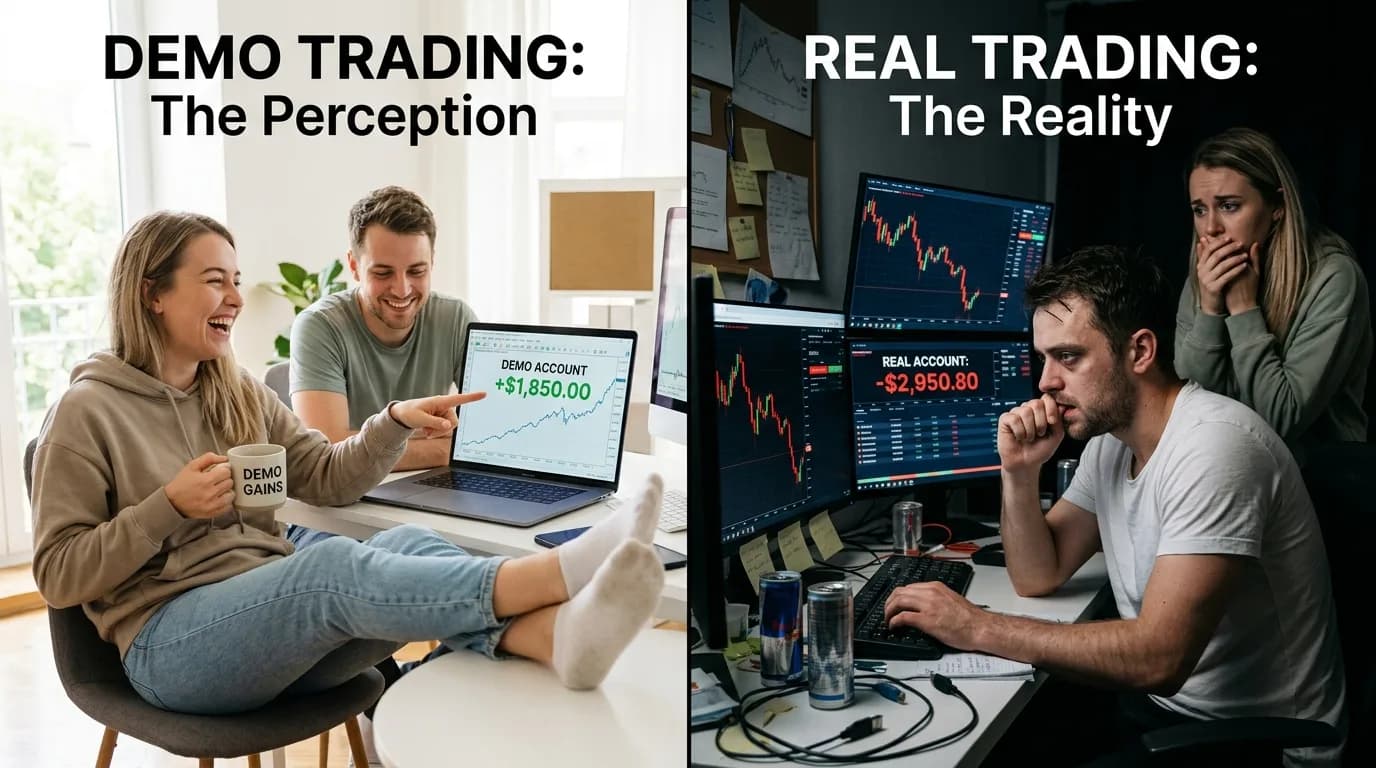
This is the gap that kills most traders. On demo, a $5,000 loss is a number on a screen. On a real account, it's rent money, vacation savings, or a child's education fund. The emotional weight of real money changes every decision you make.
Consider how behavior shifts between environments:
Taking entries: On demo, you enter without hesitation. With real money, you second-guess signals, delay entries, and miss trades entirely — especially after a recent loss.
Managing drawdowns: Demo drawdowns are painless. Real drawdowns trigger panic: the tight chest, the urge to check your phone every 30 seconds, the inability to sleep after a losing day. These physical responses override logical decision-making.
Letting winners run: On demo, following exit rules is simple. With real money, you close winners early to "lock in" profits, cutting your average win in half. Meanwhile, you hold losers too long, hoping they'll recover — increasing your average loss.
After losing streaks: Three consecutive demo losses? Take the next setup calmly. Three real losses? Most traders either freeze (skipping valid signals) or revenge trade (doubling position sizes to "get back" their losses).
The pattern is consistent: real money makes you close winners too early and hold losers too long. Both shifts destroy the risk-reward ratio that made the strategy profitable on demo. A strategy with a 45% win rate and 2:1 reward-to-risk ratio works beautifully — until psychology turns it into a 45% win rate with 1:1 reward-to-risk.
The Selective Memory Gap
On demo, traders remember their wins vividly and forget losses quickly — there's no financial pain to anchor the memories. This creates an inflated perception of performance.
When reviewing their demo track record, traders recall the big winners and gloss over drawdown periods. They remember the 15% gain on that Tesla trade but forget the five 3% losers that preceded it. The net result is a dramatically distorted view of their actual edge.
Switching to real money inverts this bias entirely. Every loss is seared into memory while wins feel insufficient. The same strategy that felt like a money machine on demo now feels broken — not because performance changed, but because perception did.
This is why raw numbers matter more than feelings. Without objective performance data, you're navigating by a broken compass that always points toward the last thing that hurt.
Why Backtesting Bridges the Gap
Backtesting doesn't solve the psychological gap — only real trading experience does that. But it solves something equally important: it proves whether your strategy has a genuine statistical edge, independent of your execution ability or emotional state.
A properly configured backtest runs your exact rules across thousands of candles, producing hundreds of trades across multiple market conditions. Here's what it reveals:
Expected drawdown. If your backtest shows a 25% maximum drawdown, you know this is normal for your strategy. When it happens live, you won't panic — you planned for it. Without this data, a 25% drawdown feels like catastrophic failure.
Worst-case losing streaks. If the backtest shows 8 consecutive losers as the worst streak, you can mentally prepare. Demo trading rarely runs long enough to encounter worst-case scenarios, leaving you blindsided when they inevitably occur live.
True win rate. Not the cherry-picked memory of demo wins, but the actual percentage calculated across hundreds of trades in bull markets, bear markets, and everything between.
Profit factor under pressure. The ratio of gross profit to gross loss tells you how much room your edge has for real-world degradation. A profit factor above 1.5 means you have genuine breathing room. Below 1.2 means execution costs and psychology will likely eliminate your edge entirely.
The Correct Progression: Backtest First, Demo Second
Most traders follow the wrong path: demo → live → failure → repeat. The correct progression uses backtesting as the foundation:
Step 1: Backtest Thoroughly
Prove the strategy has a statistical edge over at least 200 trades and 2-3 years of data. Test across different market conditions — trending, ranging, volatile, and quiet. If it doesn't pass this test, no amount of demo or live practice will make it profitable. Kill the strategy and start over.
Step 2: Demo for Mechanics Only (2-4 Weeks Maximum)
Use demo trading exclusively to learn platform mechanics: order entry, chart navigation, alert setup. Don't try to validate the strategy here — the backtest already did that. If you spend months on demo trying to "prove" a strategy works, you're procrastinating, not preparing.
Step 3: Micro-Live Trading
Trade the smallest possible real position. On crypto, this might be $10-50 per trade. On stocks, one share. The goal isn't profit — it's experiencing the psychological pressure with minimal financial risk. Track every trade meticulously and compare your real execution against backtest expectations.
Step 4: Scale Gradually
Increase position size by 25% increments as you demonstrate consistent, disciplined execution. Move to full position sizing only after 100+ live trades where you followed your rules without emotional deviation. This process takes months, not weeks — and that's by design.
What Demo Trading Can't Teach You
No amount of paper trading prepares you for the physical sensation of watching real money evaporate. The racing heart. The dry mouth before clicking "Buy." The regret loop of "what if I had just..." after every loss. These reactions are human — they don't disappear with experience, they just become manageable.
The only teacher for these lessons is real money at risk. But here's the critical insight: the amount doesn't matter for the lesson. Trading with $50 of real capital teaches you more about your psychology than $100,000 on demo. The key is having real skin in the game, however small.
Demo trading also can't teach you about the impact of fees on a real portfolio. Overnight funding costs, exchange fees, withdrawal charges — these invisible drains don't exist on demo accounts but steadily erode real returns, especially for strategies with high trade frequency.
Building Confidence From Data
Here's what backtesting gives you that demo never can: conviction grounded in evidence. When your live strategy hits a 20% drawdown and you've seen in the backtest that identical drawdowns occurred three times before recovering to new equity highs, you can hold through it. Without that data, the same drawdown feels like strategy failure, and you abandon a perfectly good system at the worst possible time.
This data-driven confidence is the real bridge between demo and live trading. Not false confidence from demo wins that never tested your emotions — but genuine understanding of what your strategy does in every market condition.
Backtest your strategy against real historical data, understand the worst-case scenarios before they happen, and transition to real trading with evidence-based conviction rather than demo-fed hope. The numbers don't lie — even when your emotions do.
Further Reading
About the Author
Quantitative researcher with 8+ years in algorithmic trading and strategy backtesting. Specializes in technical indicator analysis and risk-adjusted performance metrics.
FAQ
Why do demo trading results differ from real trading?▾
Three gaps cause the difference: execution (slippage and partial fills), psychology (emotional decisions with real money), and selective memory (inflated perception of demo performance). Together these can reduce a profitable demo strategy to break-even or losing in live trading.
Should I skip demo trading entirely?▾
No. Demo trading is useful for learning platform mechanics like order entry and chart tools. But limit it to 2-4 weeks. Backtesting provides much more reliable strategy validation across hundreds of trades and multiple market conditions.
How does backtesting help with the transition to real trading?▾
Backtesting shows expected drawdowns, worst-case losing streaks, and true win rate based on real historical data. This gives you data-driven confidence during rough patches, preventing you from abandoning a good strategy at the worst time.
What profit factor do I need for real trading?▾
A backtest profit factor above 1.5 gives meaningful breathing room for real-world degradation from slippage, commissions, and psychological errors. Below 1.2, execution costs and emotional trading will likely eliminate your edge.
How much capital should I start live trading with?▾
Start with the smallest possible real position. Trading with 10-50 dollars of real money teaches more about your psychology than a large demo account. The key is having real skin in the game, however small.
Comments (0)
Loading comments...