

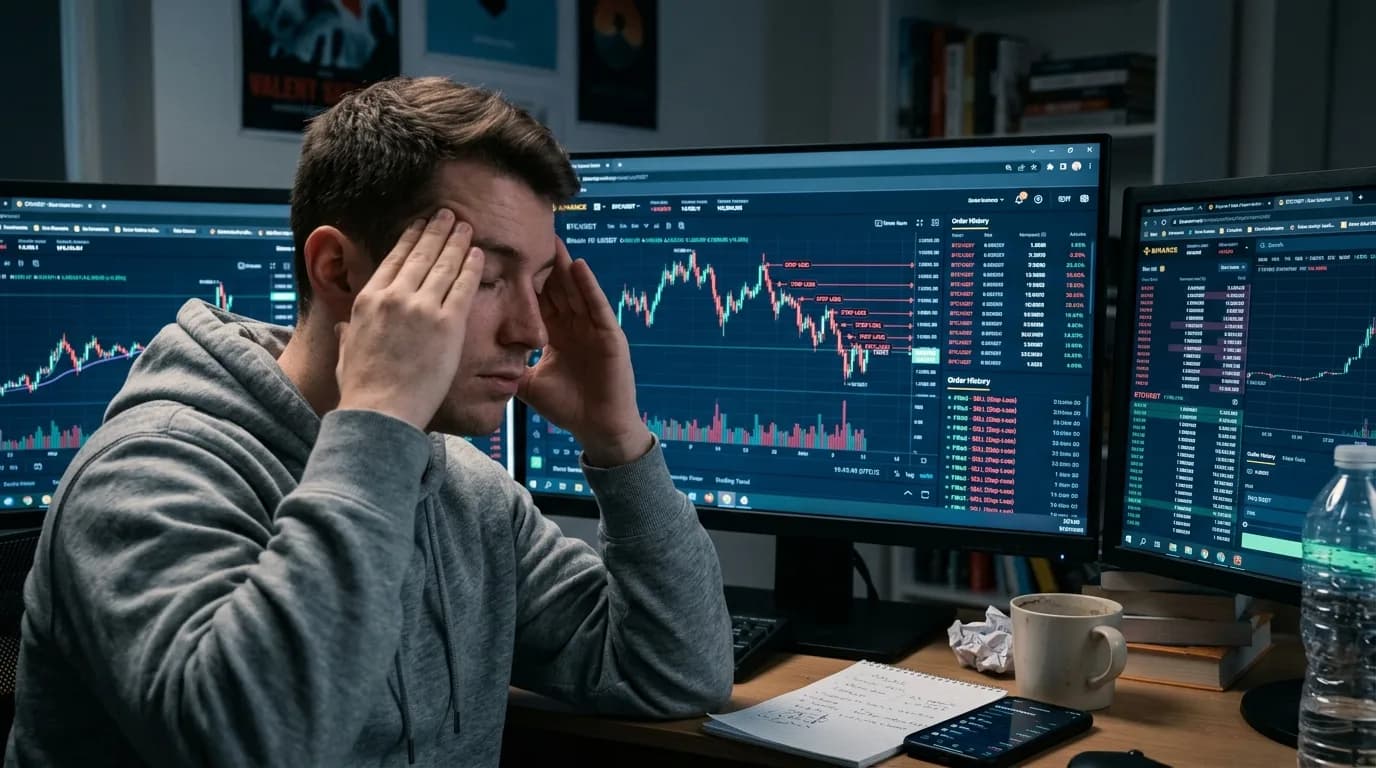
Why Your Stop Loss Keeps Getting Hit (And How to Fix It)
You enter a trade. You set your stop loss — a responsible, disciplined decision. Price drops to your stop, triggers it, and immediately reverses. The trade runs exactly where you predicted, but you're already out at a loss. This scenario isn't bad luck and it's not random. It happens because of how you're placing your stop, and it's fixable once you understand the mechanics behind it.
Why Fixed-Percentage Stops Fail
The most common stop loss approach: "I'll set my stop at 2% below entry." This feels rational — you're controlling risk per trade. But 2% of what? If BTC is at $60,000, a 2% stop is $1,200 below entry. On a quiet Monday, BTC's daily range might be $800. Your stop sits comfortably outside normal noise. On a volatile Friday before options expiry, the daily range might be $3,000. Your $1,200 stop is inside NORMAL price fluctuation — it's guaranteed to get hit.
Fixed-percentage stops ignore the fundamental variable: volatility changes constantly. A stop that works in low volatility is too tight in high volatility. A stop wide enough for high volatility wastes opportunity in low volatility. One size does not fit all market conditions.
The Stop Hunting Mechanism
Retail traders overwhelmingly place stops at the same levels: round numbers ($60,000, $50,000), recent visible swing lows, or standard percentage levels. This creates "stop clusters" — price levels where thousands of stop-loss orders sit waiting.
Large players need liquidity to fill big positions. If a fund wants to buy $50 million of BTC, they can't just market-buy — the slippage would be enormous. But if they push price down to a stop cluster, thousands of retail stops trigger simultaneously, creating a wave of sell orders (stop-loss sells). The fund buys these sells at discount prices, fills their position, and price reverses — because the selling was artificial (forced stops), not organic.
This isn't conspiracy. It's visible on the order book. And it's why your stop at the "obvious" level gets hit with surgical precision before price rockets in your direction.
Volatility-Based Stops: The ATR Method
ATR (Average True Range) measures the average candle size over N periods. If BTC's ATR(14) on the daily chart is $2,000, that means price typically moves $2,000 per day. A stop placed within $2,000 of your entry has a HIGH probability of being hit by normal market noise — not by adverse price action, just by regular breathing.
The ATR stop method: place your stop at 1.5-3× ATR from entry. This puts your stop beyond where normal price noise reaches.
| ATR Multiplier | Characteristics | Best For |
|---|---|---|
| 1× ATR | Very tight. Hit by normal noise 50%+ of time | Scalping (with high win count) |
| 1.5× ATR | Moderate. Filters most noise, still relatively close | Swing trading, shorter holds |
| 2× ATR | Standard. Requires significant adverse move to trigger | Position trading, trend following |
| 3× ATR | Wide. Only major moves trigger stop | Long-term trend following, high conviction |
The Position Size Adjustment
Wider stops don't mean more risk — if you adjust position size correctly. The formula is simple:
Position Size = (Account × Risk %) / Stop Distance
Example: $10,000 account, 1% risk ($100), stop at 2× ATR ($4,000 for BTC)
Position Size = $100 / $4,000 = 0.025 BTC (~$1,500 position)
With a tighter stop of $1,200 (fixed 2%): Position = $100 / $1,200 = 0.083 BTC (~$5,000 position). The tighter stop allows a bigger position but gets hit by noise. The wider stop uses a smaller position but only triggers on genuine adverse moves. Your risk per trade is IDENTICAL: $100 both ways. The difference is how often you get stopped out unnecessarily.
Structure-Based Stop Placement
The best stops combine ATR with market structure. Instead of placing your stop at an exact ATR distance, use ATR as a minimum and place the stop below a structural level:
Step 1: Identify the nearest swing low below your entry. This is where buyers previously stepped in — it's a logical level for a stop.
Step 2: Add a buffer below that swing low. The buffer should be at least 0.5× ATR. This accounts for the fact that price often wicks below swing lows to trigger stops before reversing.
Step 3: If the total distance (entry to stop) is less than 1.5× ATR, the stop is too tight. Either find a wider structural level or skip the trade entirely.
This approach places your stop where it has structural meaning (below support) with a noise buffer (ATR), rather than at arbitrary levels that the market routinely pierces.
Timeframe Matters
A common mistake: setting a 1-hour stop on a 4-hour trade. If you entered based on 4-hour chart analysis, your stop should reflect 4-hour volatility. The 1-hour ATR is roughly half the 4-hour ATR — your stop is inside the noise of the timeframe you're actually trading.
Rule of thumb: your stop should be based on the same timeframe as your entry signal. If the 4-hour chart showed a bullish setup, use 4-hour ATR for stop placement. If a daily chart pattern triggered entry, use daily ATR.
When Stops Should Get Hit
Good stops get hit when your trade thesis is genuinely wrong — not when the market is just oscillating normally. If you're long BTC because the daily trend is up and your stop is below the previous higher low, that stop getting hit means the uptrend structure broke. The thesis is invalidated. That's a CORRECT stop-out — the system working as designed.
If your stop gets hit and price immediately reverses, the thesis wasn't wrong — your stop was poorly placed. Track how often this happens. If more than 30% of your stop-outs are followed by immediate reversal, your stops are too tight or too predictably placed.
Practical Steps to Fix Your Stops
Immediate: Switch from fixed-percentage to ATR-based stops. Start with 2× ATR(14) and adjust position size to maintain your risk percentage.
Short-term: Backtest your strategy with different ATR multipliers (1.5×, 2×, 2.5×, 3×). Find the multiplier that maximizes profit factor, not win rate. Wider stops lower win rate but dramatically improve average winner size.
Long-term: Learn to read order book heatmaps to identify stop clusters. Place your stop away from these visible clusters. On StratBase.ai, you can configure ATR-based stops and test different multipliers to find the optimal placement for your specific strategy and instrument.
Find your optimal stop distance.
StratBase.ai lets you backtest ATR-based stops with different multipliers, showing exactly how stop placement affects your strategy's win rate, profit factor, and maximum drawdown.
Further Reading
About the Author
Financial data analyst focused on crypto derivatives and on-chain metrics. Expert in futures market microstructure and funding rate strategies.
FAQ
Why does my stop loss always get hit before price reverses?▾
Most likely your stop is placed at an obvious level — round numbers, recent swing highs/lows, or fixed percentages that thousands of other traders use. Market makers and algorithmic traders target these clusters of stops because they provide liquidity. The solution is volatility-based stops using ATR — placing your stop where normal price noise can't reach it, rather than at arbitrary fixed levels.
How do you use ATR for stop loss placement?▾
ATR (Average True Range) measures the typical price movement per candle. A stop at 1.5× ATR below your entry sits beyond normal market noise — price would need an unusually large move to trigger it. For BTC on the daily timeframe, ATR(14) might be $2,000. A 1.5× ATR stop = $3,000 below entry. Adjust position size so this wider stop still risks only 1-2% of account.
Is stop hunting real?▾
Yes, in the sense that large players and algorithms deliberately push price to levels where stop orders cluster. This provides them with the liquidity they need to fill large positions. In crypto specifically, where order books are visible, you can see large limit orders sitting just below obvious stop levels. This isn't conspiracy — it's rational market behavior that exploits predictable retail trader placement.
Comments (0)
Loading comments...