

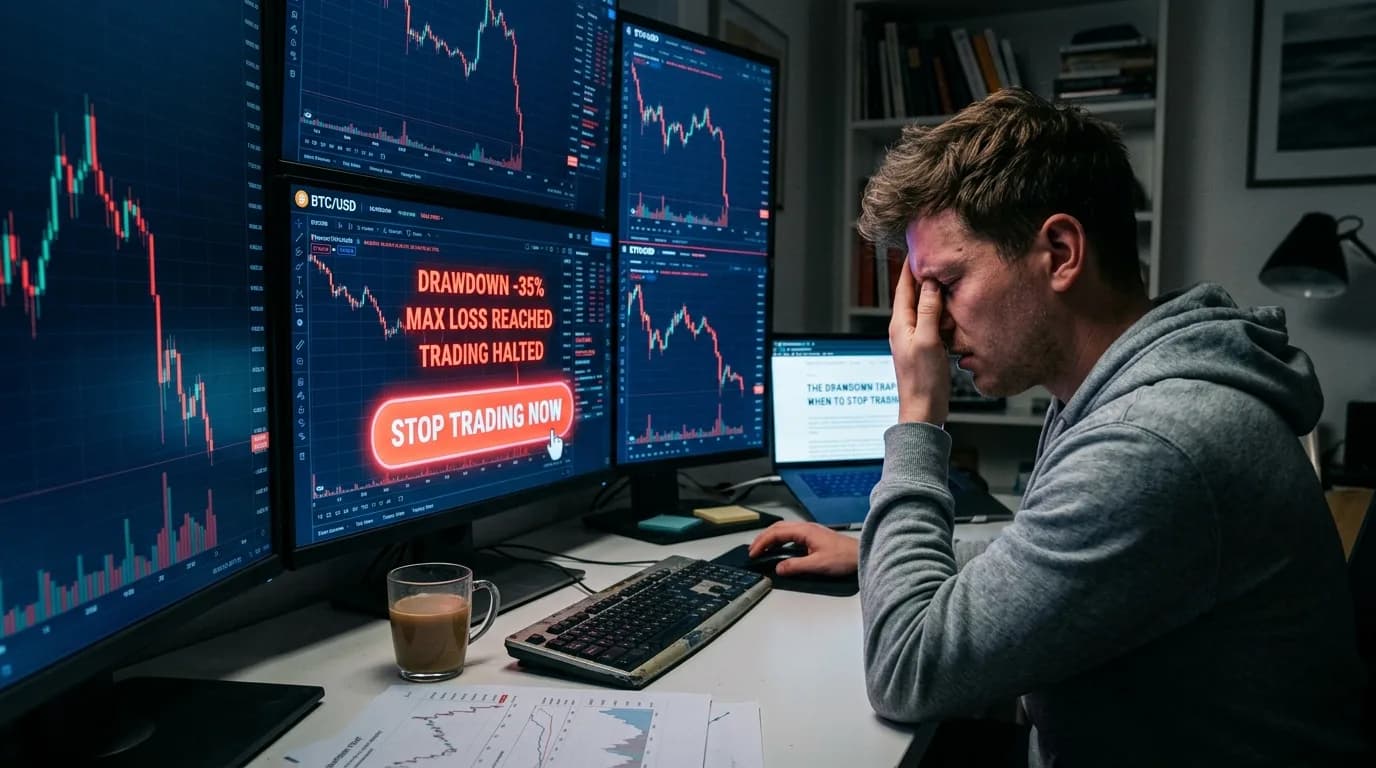
The Drawdown Trap: When to Stop Trading a Strategy
Every strategy has drawdowns. The question that torments traders during a losing streak isn't "will I recover?" but "is there anything to recover TO?" A strategy in a 25% drawdown might be experiencing its normal worst-case scenario — the kind you saw in backtesting and accepted. Or it might be permanently broken due to changed market conditions. Making the wrong call in either direction is costly: abandoning a good strategy at the bottom locks in the loss, while continuing a broken one makes it worse. This guide provides a framework for making that decision.
Why Drawdowns Are Inevitable
Even the best strategies lose money periodically. A strategy with a 60% win rate and 2:1 reward-to-risk ratio (excellent metrics) will still experience runs of 5-8 consecutive losses. These runs are mathematical certainties, not signs of failure.
Consider: with a 60% win rate, the probability of 5 consecutive losses is 0.4^5 = 1%. Over 250 trading days, you'll have about 50 such starting points. A 1% event happening 50 times means you should EXPECT roughly one run of 5 losses per year. If each loss is 1% of equity, that's a 5% drawdown from random variance alone — no edge degradation, no regime change, just math.
The Two Drawdown Mistakes
Mistake 1: Abandoning Too Early
The most common error. The strategy hits a 15% drawdown, you panic and stop trading. Over the next month, the strategy would have recovered and made new highs — but you weren't in. You just experienced the worst of the drawdown and missed the recovery. This pattern — buy high, sell low, applied to strategy allocation — is the #1 wealth destroyer for systematic traders.
Mistake 2: Holding Too Long
The less common but more destructive error. The strategy's edge has genuinely disappeared — maybe the market structure changed, maybe too many traders adopted the same approach — but you keep trading it because "drawdowns are normal" and "I need to trust the system." The drawdown goes from 30% to 40% to 50% before you finally stop, having lost far more than necessary.
The Drawdown Decision Framework
Step 1: Know Your Baseline
Before trading any strategy live, you must know from backtesting: maximum drawdown, longest losing streak, longest time to recovery. These are your benchmarks for "normal."
Step 2: Set Kill Switches Before You Need Them
Pre-define three thresholds while you're emotionally neutral:
| Threshold | Action | Example |
|---|---|---|
| 1.0× backtest max DD | Reduce position size 50% | Backtest max = 20%, reduce at 20% |
| 1.5× backtest max DD | Pause strategy, paper trade only | Pause at 30% |
| 2.0× backtest max DD | Full stop, review strategy fundamentals | Stop at 40% |
Step 3: Analyze the Drawdown Cause
When you hit a threshold, don't just stop — investigate. The cause determines whether to pause temporarily or retire permanently:
Regime change: Your trend strategy is losing in a sideways market. The strategy isn't broken — conditions are wrong. Pause and wait for regime to shift back. This is temporary.
Structural change: An exchange changed its fee structure, a regulatory event altered market dynamics, or the market has become too efficient for your approach. This may be permanent — the edge itself has degraded.
Random variance: No identifiable cause, just a bad streak. This is the hardest to handle because "no cause" could mean truly random OR a cause you haven't identified. Default to the threshold system: trust your pre-set rules.
Recovery Analysis
The time to recover from a drawdown is often more important than the drawdown size. A 25% drawdown that recovers in 2 months is far more tradeable than a 15% drawdown that takes 8 months to recover. Why? Because during recovery time, your capital is locked in underperformance — it's an opportunity cost even if no additional money is lost.
Recovery % needed = 1 / (1 - Drawdown%) - 1
10% drawdown → need 11% gain to recover
20% drawdown → need 25% gain to recover
30% drawdown → need 43% gain to recover
50% drawdown → need 100% gain to recover
The math is asymmetric and gets worse fast. A 50% drawdown requires a 100% return just to get back to even. This is why maximum drawdown limits matter more than return targets.
The Emotional vs Systematic Decision
During a drawdown, your brain screams "STOP!" regardless of whether stopping is correct. The only defense against emotional decision-making is a pre-written, specific, non-negotiable plan. Write your drawdown rules when you're NOT in a drawdown. Then follow them mechanically when you are.
This is where backtesting provides its greatest value — not in identifying entries and exits, but in setting realistic expectations. When you've seen your strategy go through 20% drawdowns three times in backtesting and recover each time, the live drawdown doesn't trigger panic. You've already lived through it in simulation.
Know Before You Start
StratBase.ai shows maximum drawdown, longest losing streak, and recovery time for every backtest. Use these metrics to set your kill switches BEFORE going live. The worst time to decide "is this drawdown normal?" is while you're in it.
Set drawdown limits with data, not emotion.
StratBase.ai calculates maximum drawdown, longest losing streaks, and recovery periods — giving you the benchmarks to set rational stop-trading thresholds before you need them.
Further Reading
About the Author
Trading systems developer and financial engineer. 10+ years building automated trading infrastructure and backtesting frameworks across crypto and traditional markets.
FAQ
How do you know if a drawdown is normal or if the strategy is broken?▾
Compare the current drawdown to the backtest's maximum drawdown. If the backtest showed 25% max drawdown over 5 years, a 20% live drawdown is within expected range — painful but normal. If the drawdown exceeds the backtest maximum by 50% or more (e.g., 40% drawdown when backtest max was 25%), the strategy may be experiencing conditions outside its design parameters. That's a signal to reduce size or pause.
When should you stop trading a strategy?▾
Three triggers: (1) Drawdown exceeds 1.5× the backtest maximum drawdown — conditions have changed beyond expectations. (2) The strategy's logic no longer matches market structure — e.g., a range strategy when the market enters a strong trend. (3) More than 2× the longest losing streak in the backtest. Any of these suggests the strategy's edge may have disappeared.
Should you ever come back to a stopped strategy?▾
Yes, but only after analyzing WHY it stopped working. If the cause was a temporary regime shift (bear market for a long-biased strategy), resume when the regime returns. If the cause is structural (exchange rule changes, new market dynamics), the strategy may need modification or retirement. Run updated backtests including the failure period to verify the strategy still has long-term edge before restarting.
Comments (0)
Loading comments...