
Forward Testing vs Backtesting: Which One Should You Trust?
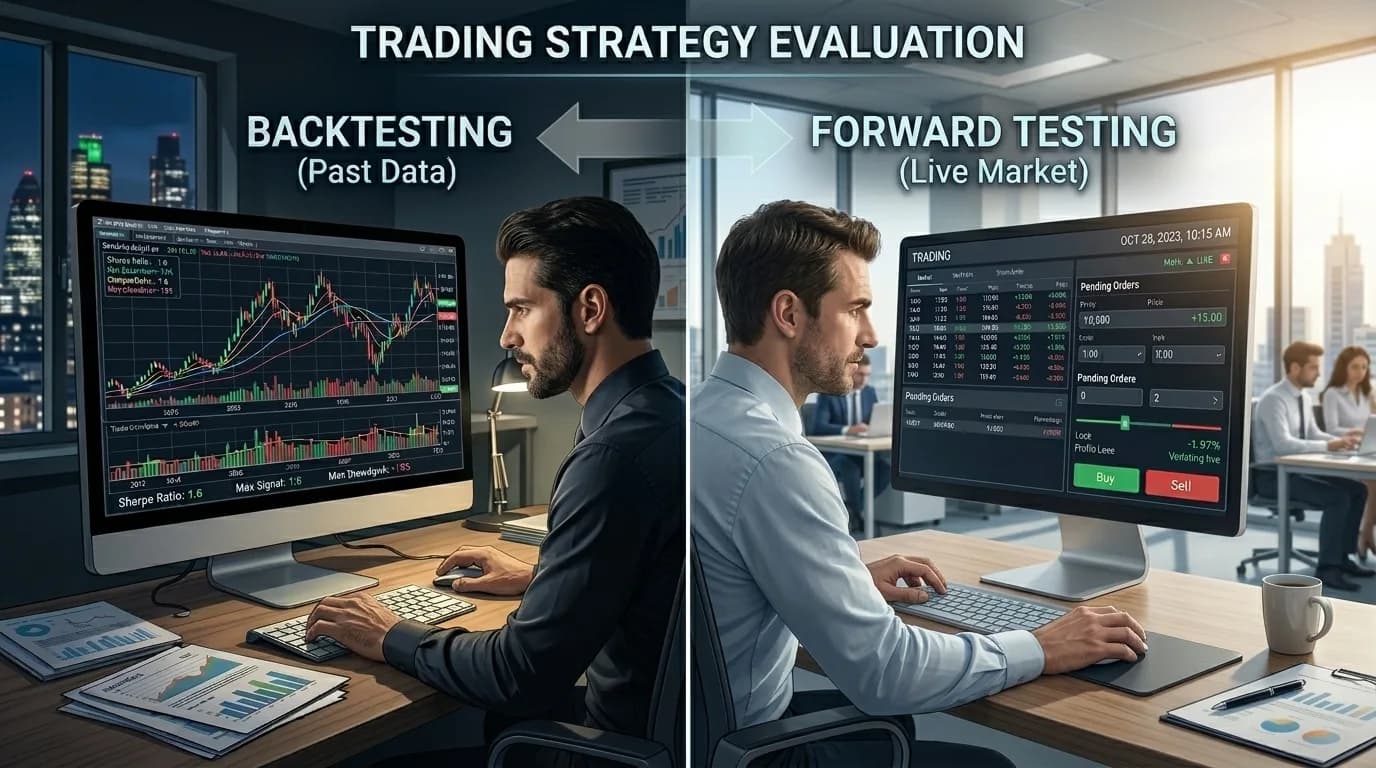
Traders constantly debate whether backtesting or forward testing is more reliable. The answer is neither — they test different things. Asking which is better is like asking whether a blueprint or a test drive is more important when building a car. You need both, in the right sequence, for different reasons.
What Each Method Actually Tests
| Aspect | Backtesting | Forward Testing |
|---|---|---|
| Speed | Instant — years in seconds | Real-time — takes weeks/months |
| Data | Historical (known) | Live (unknown) |
| Execution | Theoretical (simulated fills) | Actual (real or simulated fills) |
| Bias risk | Overfitting, look-ahead bias | Very low — data is unseen |
| Iteration speed | Fast — test many variants | Slow — one test at a time |
| Sample size | Large (years of data) | Small (weeks/months) |
| Psychological test | None | Partial (no real money risk) |
| Execution quality test | No | Yes — tests real fills |
The Backtesting Phase: Strategy Design
Backtesting is for strategy design and initial validation. Its advantages are speed and sample size — you can test 50 strategy variations across 5 years of data in an afternoon. This lets you explore the strategy space efficiently.
Use backtesting to answer: “Does this strategy concept have an edge?” Test the core logic, optimize parameters (carefully, avoiding overfitting), and validate with out-of-sample testing.
What backtesting can't tell you:
- Whether your actual execution matches the simulated fills
- Whether your data feed in live trading matches historical data quality
- Whether you can actually follow the rules under the pressure of real-time markets
- Whether the market structure has changed since the end of your historical data
The Forward Testing Phase: Execution Validation
Forward testing (paper trading) fills the gaps that backtesting leaves. Run the strategy in real-time, simulating trades at actual market prices but without risking real money.
What forward testing validates:
Signal-to-execution timing. In your backtest, you enter at the close of the signal candle. In forward testing, you discover that by the time you see the signal, check it, and place the order, 3–5 seconds have passed. On a volatile 1-minute chart, that gap can be 0.05–0.1% of adverse price movement.
Data consistency. Historical data is clean and complete. Live data feeds occasionally have gaps, spikes, or recalculations. Forward testing reveals how your strategy handles these imperfections.
Practical execution. Can you actually monitor the markets during the hours your strategy trades? If your strategy generates signals at 3 AM your local time, forward testing will quickly show whether that's sustainable.
The Right Sequence
- Backtest on 70% of historical data (design and optimize)
- Out-of-sample backtest on remaining 30% (validate)
- Forward test for 30–50+ trades (confirm execution)
- Small live at 10–25% position size (verify with real stakes)
- Full deployment (if all gates pass)
Skipping any step increases risk. Skipping forward testing is particularly dangerous because it's the only step that tests execution realism.
Sample Size Requirements for Each Phase
One of the most common mistakes traders make is moving from one phase to the next too quickly — before collecting enough data to draw meaningful conclusions.
| Phase | Minimum Trades | Why This Number |
|---|---|---|
| Initial backtest | 50–100 | Enough to calculate reliable win rate, PF, and drawdown statistics |
| Out-of-sample validation | 20–30 | Confirms edge persists on unseen data; 30% of total dataset |
| Forward test | 30–50 | Validates execution quality; exposes slippage and timing issues |
| Small live | 20–30 | Tests psychology and real money execution at reduced size |
With a swing trading strategy producing 3–5 signals per month, the forward testing phase alone takes 6–12 months. This is why most traders skip it — and why most traders lose money.
When Forward Testing Disagrees With Backtesting
If forward test results are significantly worse than backtest results, investigate these causes in order:
- Execution slippage. Most common cause. Your actual fills are worse than the backtest assumed. Solution: increase slippage in backtest and re-validate.
- Data differences. The live data feed might calculate indicators slightly differently than historical data. Check for discrepancies in indicator values between backtest and live.
- Market regime change. The current market might be in a different regime than the backtest period. Not the strategy's fault, but important to recognize.
- Operator error. You're not following the rules exactly. Maybe you're hesitating on entries, moving stops, or exiting early. The strategy is fine; the execution is broken.
Expected Performance Degradation
A well-constructed backtest should produce results slightly better than forward testing. Typical degradation: win rate drops 2–5 percentage points, profit factor decreases 10–20%, and max drawdown increases 10–25%.
If your backtest shows a 1.8 profit factor, expect approximately 1.4–1.6 in forward testing. If it drops below 1.2, investigate the causes above. This is why many experienced traders set 1.5 PF as their minimum backtest threshold — strategies below that often become unprofitable after real-world degradation.
The Hybrid Approach: Walk-Forward Analysis
Walk-forward analysis bridges the gap between backtesting and forward testing. It simulates what you'd actually do: optimize on a historical window, test on the next period, roll forward, repeat. For example, with 5 years of data: optimize on years 1–2, test on year 3, then optimize on years 2–3, test on year 4, and so on. Each test period uses unseen data with freshly optimized parameters.
Walk-forward is the most realistic simulation of how a strategy performs over time. If your strategy passes walk-forward analysis, you can have substantially more confidence in its forward-testing results.
“A backtest is a promise. Forward testing is a reality check on that promise. Live trading is keeping the promise when money is on the line.”
For the full strategy validation process including all five gates from backtest to deployment, check the dedicated guide.
Start with a solid backtest foundation
StratBase.ai provides comprehensive historical data, realistic fee modeling, and detailed performance metrics to validate your strategy before you forward test it. Get started →
FAQ
What is the difference between forward testing and backtesting?
Backtesting runs on historical data instantly. Forward testing runs in real-time on live data without real money. Backtesting tests logic; forward testing tests execution.
Should I forward test before going live?
Always. Backtesting proves the concept; forward testing proves execution. Many strategies pass backtesting but fail due to execution delays, data differences, or trader discipline.
How many forward test trades do I need?
Minimum 30–50 trades to draw statistically meaningful conclusions. For a swing strategy producing 3–5 trades per month, expect 6–12 months of forward testing before deployment.
What performance drop is acceptable from backtest to forward test?
A 10–20% drop in profit factor is normal and expected. Win rate may decrease by 2–5 percentage points. If degradation exceeds 30%, investigate execution slippage, data differences, or market regime changes.
Further Reading
About the Author
Trading systems developer and financial engineer. 10+ years building automated trading infrastructure and backtesting frameworks across crypto and traditional markets.
FAQ
What is the difference between forward testing and backtesting?▾
Backtesting runs your strategy on historical data and gives results instantly. Forward testing (paper trading) runs your strategy in real-time on live market data without real money. Backtesting tests the strategy's logic; forward testing tests the strategy's execution in real market conditions.
Should I forward test before going live?▾
Yes, always. Backtesting proves the concept; forward testing proves the execution. A strategy can pass backtesting but fail in forward testing due to execution delays, data feed differences, or the trader's inability to follow the rules under real-time pressure.
Further reading
Related articles
Comments (0)
Loading comments...