
Keltner Channels: A Better Alternative to Bollinger Bands?
Chester Keltner introduced his channel concept in the 1960s, and Linda Bradford Raschke modernized it with ATR in the 1990s. The result is a volatility band system that's inherently smoother than Bollinger Bands because ATR changes gradually while standard deviation can spike on a single bar. This smoothness makes Keltner Channels particularly effective for trend-following strategies and as a component of the famous "squeeze" setup.
How Keltner Channels Work
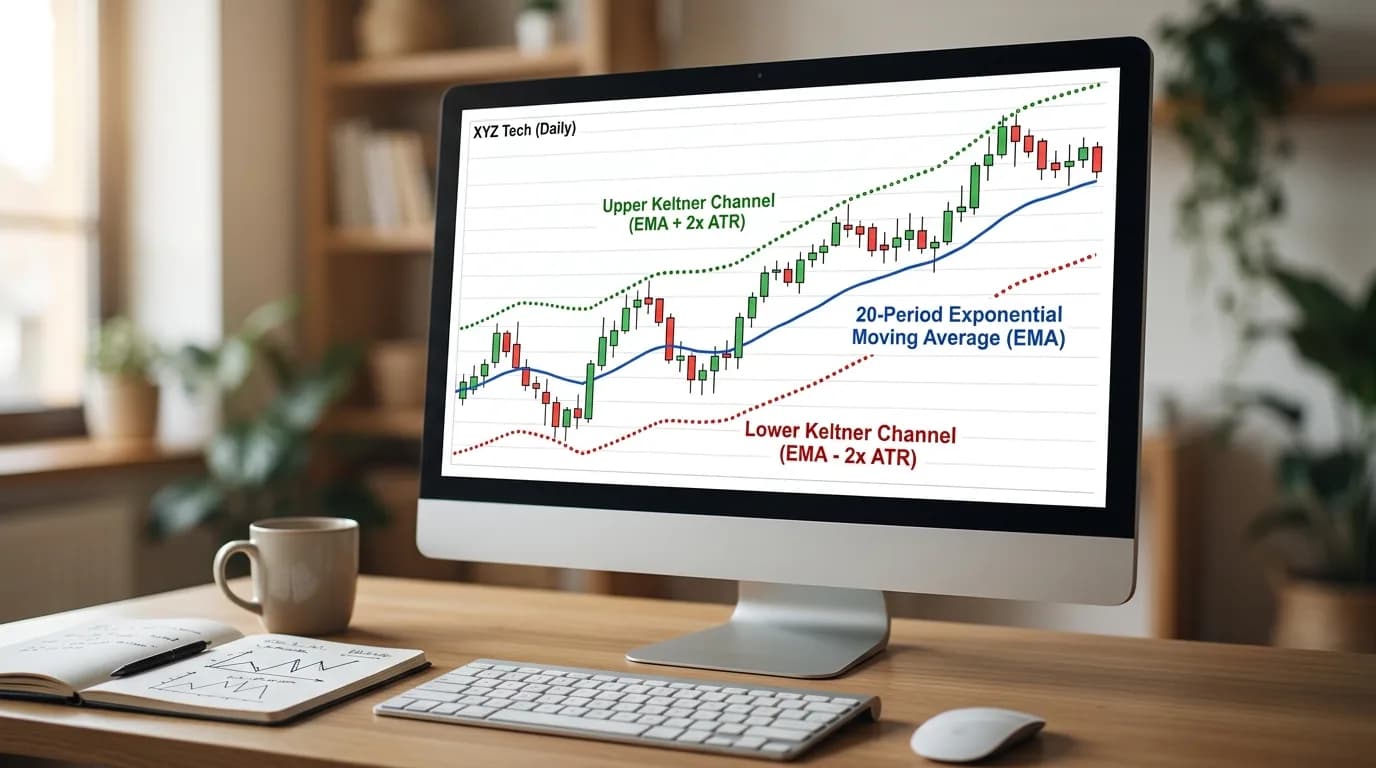
The construction uses three components:
- Middle Line: Exponential Moving Average (typically 20 period)
- Upper Band: EMA + (ATR × multiplier)
- Lower Band: EMA - (ATR × multiplier)
The default multiplier is 2, meaning the bands sit 2× ATR above and below the EMA. Some traders use 1.5× for tighter channels or 2.5× for wider ones. The ATR period typically matches the EMA period (both 20).
Because ATR is a smoothed average of True Range, the Keltner bands adjust gradually to volatility changes. They don't suddenly expand or contract based on a single volatile candle — they evolve over multiple bars. This behavioral difference from Bollinger Bands is Keltner's core advantage.
Keltner vs. Bollinger: The Critical Differences
| Aspect | Keltner Channels | Bollinger Bands |
|---|---|---|
| Volatility measure | ATR (smooth, captures gaps) | Standard deviation (reactive, mathematical) |
| Band behavior | Gradual expansion/contraction | Rapid expansion on single bars |
| Center line | EMA (faster) | SMA (slower) |
| Price outside bands | Less frequent (stronger signal) | More frequent (weaker individual signal) |
| Best for | Trend following, smooth signals | Mean reversion, squeeze detection |
In our side-by-side backtest on BTC/USDT 4H (2021-2024), price closed outside Keltner Channels (2× ATR) on 8% of bars versus 5% for Bollinger Bands (2 SD). Both percentages are "normal" by design, but the distribution matters: Keltner's outside-band events tend to cluster during genuine trends, while Bollinger's can occur on isolated volatile bars that don't lead to sustained moves.
Trading Strategies
1. Channel Breakout (Trend Following)
Buy when price closes above the upper Keltner band, sell when it closes below the lower band. This is a pure momentum play — the assumption is that a close outside the channel signals the beginning of a directional move.
On BTC/USDT 4H: upper band breakouts (with a 20-bar holding period) produced a 52% win rate and 1.37 profit factor. Adding a volume filter (above 20-period average) improved the profit factor to 1.54. The smoothness of Keltner bands means fewer false breakouts compared to Bollinger band breakouts (which had a 1.21 profit factor on the same test).
2. Channel Bounce (Mean Reversion)
When price touches the lower Keltner band in an uptrend (price above 200 SMA), buy for a reversion to the middle line (EMA). This works because the Keltner lower band represents a "normal" pullback within the trend. The EMA center line is the natural target.
This strategy produced a 1.43 profit factor on BTC 4H with the trend filter — better than the comparable Bollinger band bounce (1.28 PF). The key advantage: Keltner's lower band doesn't jump upward on a single volatile bar, so the "bounce" level is more consistent and predictable.
3. The Squeeze (Keltner + Bollinger)
The most famous Keltner setup uses both indicators together. When Bollinger Bands contract inside Keltner Channels (BB upper < Keltner upper AND BB lower > Keltner lower), the market is in a low-volatility squeeze. This compression precedes significant moves.
The squeeze fires when Bollinger Bands expand back outside Keltner Channels. The direction of the expansion determines the trade:
- BB upper breaks above Keltner upper → bullish squeeze release → buy
- BB lower breaks below Keltner lower → bearish squeeze release → sell
In our BTC/USDT 4H test, the squeeze setup produced 34 signals with a 59% win rate and 1.62 profit factor. The key is patience — squeezes can last 20-40 bars before releasing, and entering too early (before the directional signal) is a common mistake.
Settings Optimization
The EMA period and ATR multiplier interact. We tested multiple combinations on BTC 4H for the channel breakout strategy:
| EMA | ATR Mult | Signals | PF |
|---|---|---|---|
| 20 | 1.5 | 118 | 1.22 |
| 20 | 2.0 | 67 | 1.37 |
| 20 | 2.5 | 38 | 1.41 |
| 10 | 2.0 | 92 | 1.19 |
| 50 | 2.0 | 31 | 1.52 |
Longer EMA periods and wider multipliers produce fewer but higher-quality signals. The 50-period EMA with 2× ATR had the best profit factor but only 31 trades — potentially too few for statistical confidence. The standard 20/2 is a reliable default.
Practical Tips
Keltner Channels are particularly effective on assets with gap behavior (stocks, some crypto pairs during exchange outages) because ATR captures gaps while standard deviation may not fully reflect them. If your instrument regularly gaps, Keltner has a structural advantage over Bollinger.
For the squeeze setup, track the squeeze duration. Short squeezes (5-10 bars) tend to produce smaller moves. Long squeezes (30+ bars) produce the biggest moves. Filtering for squeezes lasting at least 15 bars significantly improves the average win size.
Test Keltner Channels and the squeeze setup
StratBase.ai supports Keltner Channels with configurable EMA and ATR settings. Combine with Bollinger Bands for the squeeze strategy. Start backtesting →
What are Keltner Channels?
Volatility bands plotted around an EMA using ATR. Upper = EMA + ATR×multiplier, Lower = EMA - ATR×multiplier. Smoother than Bollinger Bands because ATR changes gradually.
Are Keltner Channels better than Bollinger Bands?
Keltner is smoother and better for trend following. Bollinger is more reactive and better for mean reversion. The best approach uses both together for the squeeze setup.
What is the Keltner Channel squeeze?
When Bollinger Bands contract inside Keltner Channels, signaling extremely low volatility before a big move. The breakout direction indicates the trend. 59% win rate and 1.62 PF in BTC backtests.
Further Reading
About the Author
Financial data analyst focused on crypto derivatives and on-chain metrics. Expert in futures market microstructure and funding rate strategies.
FAQ
What are Keltner Channels?▾
Keltner Channels are volatility bands plotted around an EMA center line. The upper band is EMA + (ATR × multiplier), and the lower band is EMA - (ATR × multiplier). Default settings are 20-period EMA with 2x ATR multiplier. Unlike Bollinger Bands (which use standard deviation), Keltner uses ATR for smoother, more consistent band width.
Are Keltner Channels better than Bollinger Bands?▾
Neither is universally better. Keltner Channels are smoother (fewer false breakout signals) and better for trend following. Bollinger Bands are more reactive to sudden volatility changes and better for identifying squeezes and mean reversion. Many traders use both together — the Bollinger/Keltner squeeze is a powerful setup.
What is the Keltner Channel squeeze?▾
When Bollinger Bands contract inside Keltner Channels, it signals extremely low volatility — a 'squeeze.' This compression typically precedes a large directional move. The breakout direction (BBs expanding outside Keltner) indicates the trend. This TTM Squeeze concept, popularized by John Carter, is one of the most reliable volatility-breakout setups.
Related articles
Comments (0)
Loading comments...