
Look-Ahead Bias: The Hidden Backtest Killer
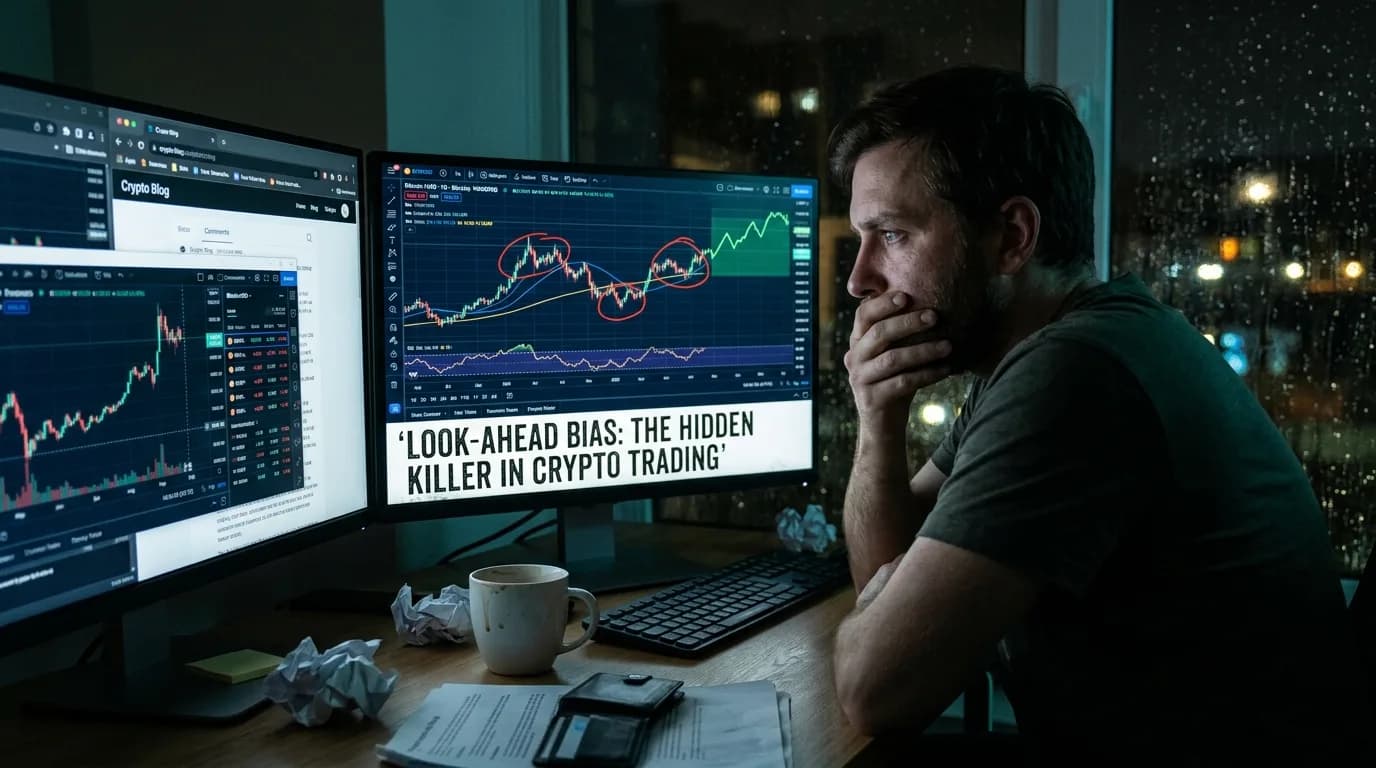
Look-ahead bias is the ghost in the machine of backtesting. Unlike overfitting (which you can see in unrealistic returns) or survivorship bias (which you can reason about), look-ahead bias is invisible. Your backtest produces reasonable-looking results — 55% win rate, 1.6 profit factor, normal drawdown — but the strategy fails in live trading. The reason: the backtest unknowingly peeked at future data, giving your strategy a tiny edge that doesn't exist in real time. That tiny edge was the entire edge.
What Look-Ahead Bias Actually Is
At its core, look-ahead bias means making a decision using information you wouldn't have had at the time. In daily life, this is like reading tomorrow's newspaper to place today's bets. In backtesting, it's subtler — and that subtlety makes it dangerous.
When you backtest manually (scrolling through charts and marking entries), look-ahead bias is almost impossible to avoid. Your eyes see the bars to the right of your "entry point." Subconsciously, you know the trade works out. You wouldn't have taken that entry in real time because the chart looked ambiguous — but with future bars visible, it looks "obvious."
The Five Most Common Forms
1. Same-Candle Execution
The signal fires on the daily close. Your backtest enters the trade at that same close price. In reality, you would see the signal AFTER the close (when the candle is complete) and could only enter at the NEXT candle's open. The difference between today's close and tomorrow's open can be 0.5-2% in crypto — and that's often the entirety of the strategy's edge.
Fix: Always execute signals on the next candle's OPEN, not the signal candle's close.
2. Indicator Calculation Including Current Bar
A 20-period moving average of closing prices should use the 20 most recently COMPLETED candles. But some backtesting tools include the current (incomplete) candle in the calculation. During the day, the "current close" changes tick-by-tick, making the indicator value unstable. The backtest uses the final value (which was only known at the end of the day), creating look-ahead.
Fix: Ensure indicators are calculated on completed candles only. MA(20) at bar N should use closes from bars N-20 through N-1.
3. Survivorship in Instrument Selection
"I'll test my strategy on BTC, ETH, and SOL because they're the top 3 by market cap." But SOL was effectively dead in 2023 and exploded in 2024. Selecting it for your 2020-2024 backtest is using knowledge of its future performance. In 2020, you might have selected LUNA instead of SOL — and LUNA went to zero.
Fix: Select instruments based on what you would have known at the START of the backtest period. Use historical market cap rankings, not current ones.
4. Fundamental Data Timing
Using an earnings report released at 4:30 PM to justify a trade placed at 2:00 PM. Or using a Fed rate decision to enter a position before the announcement. In retrospect, the data and the trade coexist on the same day. In real time, the data wasn't available when the trade was placed.
Fix: Timestamp every data source and verify it was available before the trade decision timestamp.
5. Strategy Selection Based on Results
You test 50 strategy variations. Three produce profit factor above 2.0. You "select" those three and declare them your strategies. But the selection was based on their backtest results — you used the full dataset's information to choose which strategies to deploy. This is a meta-level look-ahead: using results to select the strategies that produced those results.
Fix: Use walk-forward analysis: develop on period A, select on period B, validate on period C. The selection must happen on different data than the development.
Why It's So Dangerous
Look-ahead bias is dangerous because it produces PLAUSIBLE results. An overfitted strategy might show 90% win rate — obviously unrealistic. Look-ahead bias might add just 2-3% to your win rate or 0.2 to your profit factor. The results look normal, reasonable, trustworthy. You trade real money confidently. Then reality hits: without the look-ahead advantage, your 55% win rate was actually 52%, your 1.6 profit factor was 1.1, and the strategy barely breaks even after costs.
The Acid Test
The simplest test for look-ahead bias: walk-forward validation. Take your strategy and run it on a brand new data period it's never seen. If performance drops significantly (more than 20-30% degradation in profit factor), look-ahead bias or overfitting is likely present. Walk-forward testing is the closest simulation of live trading conditions.
A strategy that passes walk-forward validation across multiple periods has demonstrated genuine edge — not an artifact of future information leaking into past decisions.
How StratBase.ai Handles It
StratBase.ai eliminates the two most common forms of look-ahead bias by design. All signals execute on the next candle open — never on the signal candle itself. Indicators are calculated on completed bars only. This doesn't prevent all forms (instrument selection and fundamental timing are your responsibility), but it eliminates the execution-level biases that are hardest to detect manually.
Bias-free backtesting by design.
StratBase.ai executes signals on the next candle open and calculates indicators on completed bars only — eliminating the most common sources of look-ahead bias automatically.
Further Reading
About the Author
Quantitative researcher with 8+ years in algorithmic trading and strategy backtesting. Specializes in technical indicator analysis and risk-adjusted performance metrics.
FAQ
What is look-ahead bias in backtesting?▾
Look-ahead bias occurs when a backtest uses data that wouldn't have been available at the time the trading decision was made. Examples: using today's closing price for a decision made at noon, selecting instruments based on future performance (only testing coins that survived), or applying news events that were published after market close for same-day decisions. It inflates backtest results because you're giving your strategy 'future vision.'
How do you detect look-ahead bias?▾
Three checks: (1) For every trade, verify that ALL data inputs were available BEFORE the trade time — indicator calculations should use only completed candles. (2) Check if instrument selection was influenced by future knowledge — would you have picked these exact instruments without knowing future prices? (3) Verify execution timing — signals should execute on the NEXT candle's open, not the current candle's close.
Does StratBase.AI prevent look-ahead bias?▾
Yes. StratBase.AI executes all signals on the next candle's open after the signal forms. Indicators are calculated using only completed candle data. This eliminates the two most common forms of look-ahead bias: same-candle execution and intra-bar indicator calculation.
Comments (0)
Loading comments...