TradeStation vs StratBase.ai: Traditional vs Modern Backtesting
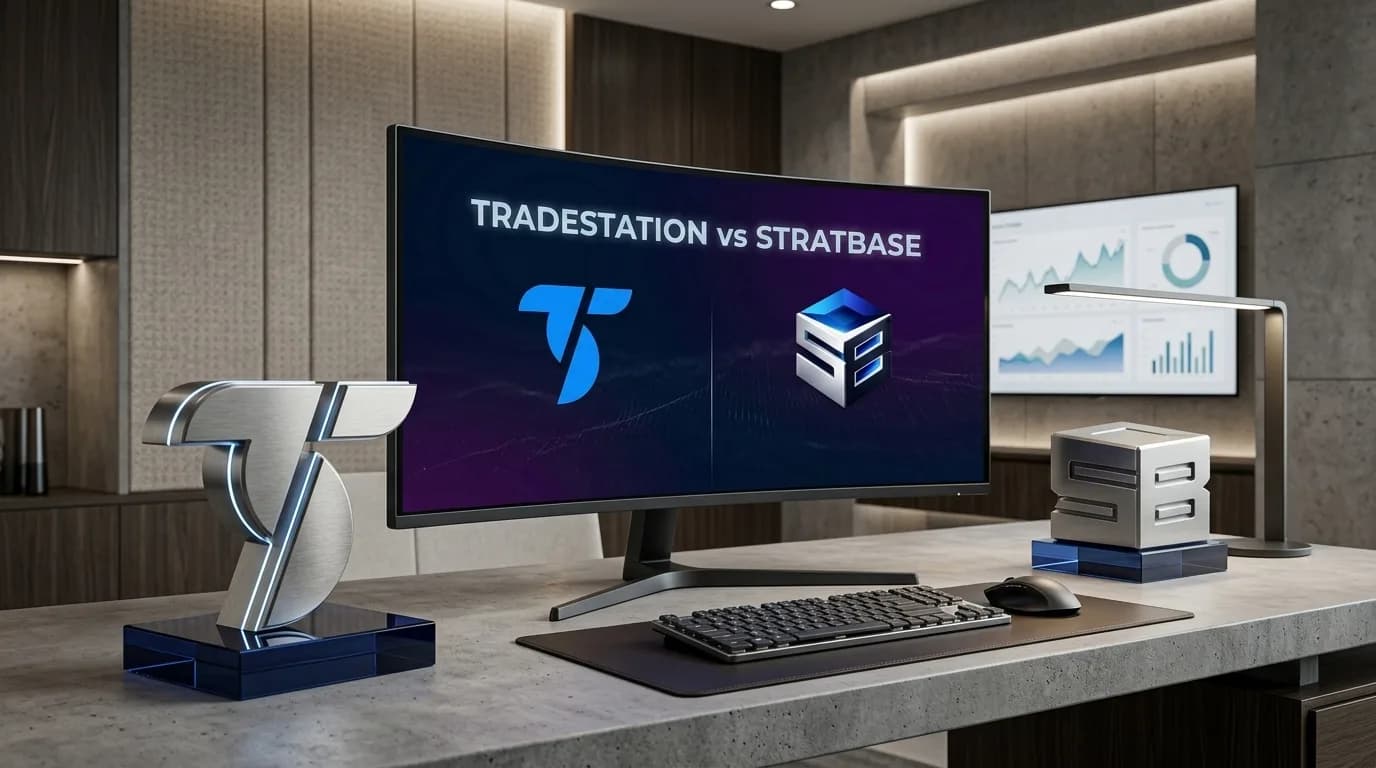
TradeStation pioneered retail algo trading over 40 years ago. StratBase.ai represents the 2025 generation. Comparing them reveals how backtesting technology has evolved — and where each excels today.
Heritage vs Innovation
TradeStation launched in the early 1980s and practically invented the concept of retail strategy backtesting with EasyLanguage. Generations of traders learned algo concepts on this platform. It's deep, mature, and battle-tested across decades of market data. The trade-off: the interface shows its age — desktop-centric, complex menus, steep learning curve.
StratBase.ai was built in 2025 on a modern stack: Rust backtesting engine for speed, React frontend for accessibility, AI chat for strategy design. It's web-first, works on any device, and targets a generation of traders who expect software to be intuitive, not just powerful.
The fundamental difference isn't just features — it's philosophy. TradeStation asks “What can you code?” StratBase.ai asks “What do you want to test?”
Strategy Language
TradeStation's EasyLanguage was designed to be “easy” compared to C++ or assembly. And it is — relative to professional programming. But it's still code: variables, conditions, loops, event-driven logic. You write strategies like programs. Learning EasyLanguage to proficiency takes 2–4 weeks for someone with programming experience, and 2–3 months for a beginner.
StratBase.ai's approach is fundamentally different. A visual configurator lets you select from 236 indicators, define conditions (RSI below 30, MACD crossover), and configure risk management — all through a graphical interface. The AI chat goes further: describe your idea in plain language, and the AI translates it to a formal configuration. Learning time: minutes.
“The goal of a trader is not to demonstrate technical skill — it's to make money. Use the simplest tools that do the job.” — Van Tharp
Feature Comparison
| Feature | TradeStation | StratBase.ai |
|---|---|---|
| Strategy language | EasyLanguage (proprietary) | No-code visual + AI chat |
| Indicators | 300+ built-in + custom code | 236 built-in (incl. crypto-specific) |
| Engine | Proprietary (C++) | Rust (open-architecture) |
| Optimization | Genetic, walk-forward, Monte Carlo | Grid + AI-powered analysis |
| Live trading | Full brokerage integration | Analysis only (no execution) |
| Market data history | 40+ years stocks, 20+ years intraday | 1–6 years (crypto, stocks, forex) |
| Crypto support | Limited | 1500+ pairs + futures metrics |
| Platform | Desktop (Windows/Mac) | Web (any browser) |
| Price | $99/mo or brokerage account | Free tier, Pro $29/mo |
| AI assistance | None | Strategy design + backtest analysis |
Data and Markets
TradeStation: Decades of US stock and futures data — daily going back to the 1950s, intraday to the early 2000s. Options chains, index data, and comprehensive US market coverage. This historical depth is unmatched. If you're testing strategies across multiple market cycles (2000 dot-com crash, 2008 financial crisis, 2020 COVID), TradeStation has the data.
StratBase.ai: Crypto (1500+ pairs, 1–5 years depending on listing date), US stocks (130 symbols, 6 years of 1-minute data), forex (27 pairs, 10+ years). Shorter history but broader crypto coverage. The unique advantage: crypto-specific metrics (open interest, funding rate, liquidation data) usable as strategy inputs — data types TradeStation doesn't offer.
Execution: All-in-One vs Analysis Focus
TradeStation is a full brokerage. You develop a strategy, backtest it, optimize it, and click “deploy” to run it live with real money on the same platform. Direct market access for low-latency execution. For traders who want end-to-end automation, this is extremely compelling.
StratBase.ai is backtesting and analysis only. No live execution. The philosophy: strategy discovery and validation should be separate from execution. Find out “does this idea work?” first, then take it to your preferred exchange or broker. This keeps the platform focused and avoids the conflicts of interest inherent in brokerage-integrated backtesting.
Learning Curve Comparison
The learning curve is one of the starkest differences between the two platforms and often the deciding factor for traders choosing between them.
| Milestone | TradeStation | StratBase.ai |
|---|---|---|
| First backtest | 1–3 hours (requires EasyLanguage) | 5–15 minutes (visual configurator) |
| Custom strategy | 1–2 weeks (coding proficiency) | 30–60 minutes (AI chat assistance) |
| Optimization run | 2–4 weeks (walk-forward setup) | Same day (built-in grid search) |
| Full proficiency | 2–6 months | 1–2 weeks |
TradeStation's depth rewards the investment — once you master EasyLanguage, the flexibility is substantial. But that upfront time commitment filters out traders who want to test ideas quickly. StratBase.ai trades some of that flexibility for immediate accessibility, letting traders focus on strategy logic from day one rather than spending weeks learning a proprietary scripting language.
For traders with programming backgrounds, the EasyLanguage learning curve is manageable. For those without coding experience — which includes the majority of retail crypto traders — the no-code approach removes a significant barrier to entry.
Who Chooses What
Choose TradeStation if: You trade US stocks or futures. You want strategy development + brokerage in one platform. You're comfortable learning EasyLanguage. You need 20+ years of historical data for multi-cycle testing. You prioritize live execution from the same environment.
Choose StratBase.ai if: You trade crypto (especially Binance/Bybit perpetuals). You want no-code simplicity. You value AI-assisted strategy design. You need crypto-native indicators (funding rate, OI, liquidations). You prefer web-based access over desktop software.
For crypto traders, StratBase.ai is purpose-built. For US equity/futures traders with programming skills, TradeStation remains the professional standard. They solve different problems for different markets.
Further Reading
About the Author
Trading systems developer and financial engineer. 10+ years building automated trading infrastructure and backtesting frameworks across crypto and traditional markets.
FAQ
What is TradeStation?▾
TradeStation is a veteran trading platform (since 1982) offering brokerage + strategy development. Its EasyLanguage programming language was the first widely-used strategy scripting tool. It covers stocks, options, futures, and crypto. Features: 40+ years of historical data, strategy optimization, portfolio-level testing, and live execution.
Is TradeStation good for crypto?▾
TradeStation added crypto in recent years, but its crypto offering is limited compared to dedicated platforms: fewer pairs, less crypto-specific data (no funding rate, OI, liquidations), and no crypto derivatives support. For stocks and futures — excellent. For crypto — StratBase.AI is more comprehensive.
Further reading
Related articles
Comments (0)
Loading comments...