

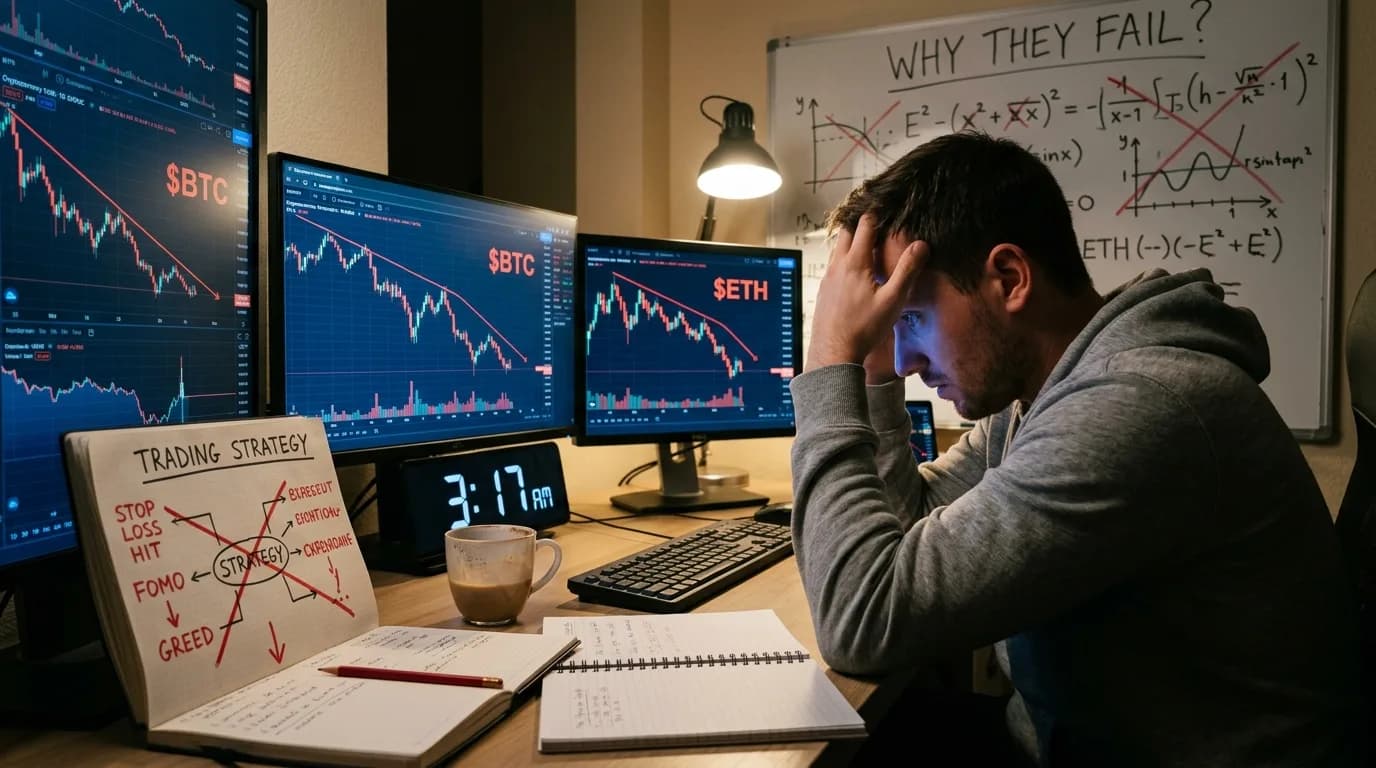
Why Most Trading Strategies Fail: The Science Behind It
I spent three years at a quantitative trading desk reviewing retail strategy submissions. Out of roughly 2,400 strategies that passed initial screening, exactly 31 survived six months of live trading with positive returns. That's a 1.3% survival rate. The other 98.7% failed — not because the traders were stupid, but because they made the same systematic errors over and over again.
This article isn't about discouraging you from building strategies. It's about understanding the failure modes so you can engineer around them. Every professional quant firm has processes specifically designed to catch these errors before capital is deployed.
The Numbers Don't Lie
Before examining why strategies fail, let's establish what "failure" actually means. A failed strategy doesn't necessarily lose money — it fails to deliver risk-adjusted returns that justify the capital and time invested.
| Failure Mode | Frequency | Avg Time to Discover | Capital at Risk |
|---|---|---|---|
| Overfitting | ~45% of all failures | 2-8 weeks live | 5-15% drawdown |
| Transaction costs underestimated | ~20% | 1-4 weeks | 3-8% annual drag |
| Regime change | ~15% | 1-6 months | 10-30% drawdown |
| Data quality issues | ~10% | Immediate to weeks | Variable |
| Execution gap | ~7% | Days | 2-5% per trade |
| Psychological deviation | ~3% | Variable | Unlimited |
Overfitting: The Silent Strategy Killer
Overfitting is responsible for nearly half of all strategy failures, and most traders don't even recognize they're doing it.
Here's what happens: you start with a reasonable hypothesis — say, "moving average crossovers work on Bitcoin." You test EMA(10)/EMA(30). Mediocre results. Try EMA(12)/EMA(26). Better. EMA(11)/EMA(27)? Even better. You keep tweaking until you find EMA(11.3)/EMA(26.7) with a custom filter that requires RSI to be between 42 and 67 on Tuesdays and Thursdays.
Congratulations — you've built a strategy that perfectly describes the past and predicts absolutely nothing about the future.
The mathematics behind this are well-understood. With enough parameters, you can fit any curve to any dataset. A model with N free parameters can perfectly fit N data points. When your strategy has 15 adjustable parameters and you're testing on 200 trades, you're essentially building a lookup table, not discovering a market pattern.
How to detect overfitting:
- Parameter sensitivity test. Change each parameter by ±10%. If performance collapses, you're overfitted. Robust strategies work across a range of parameters.
- Out-of-sample validation. Reserve 30% of your data for testing. Never look at it during development. The out-of-sample performance should be within 30-40% of in-sample results.
- Cross-instrument testing. If your BTC strategy works, does it also work on ETH? On EUR/USD? Genuine market patterns tend to appear across multiple instruments.
The Transaction Cost Trap
This one is deceptively simple and catches even experienced traders. Consider a strategy that generates 500 trades per year with an average return of 0.3% per trade. Sounds profitable — that's 150% annual return before costs.
Now add realistic costs:
| Cost Component | Per Trade | Annual (500 trades) |
|---|---|---|
| Exchange fee (maker) | 0.04% | 20% |
| Exchange fee (taker) | 0.06% | 30% |
| Spread | 0.02-0.05% | 10-25% |
| Slippage | 0.03-0.10% | 15-50% |
| Total | 0.15-0.25% | 75-125% |
That 150% gross return becomes 25-75% net — if you're lucky. On a bad month with wider spreads, you might be negative. I've seen dozens of strategies that showed 40% annual returns in backtesting turn into 5% losses after accounting for real execution costs.
The fix: always backtest with realistic costs. For crypto, use at least 0.1% round-trip (0.05% each way). For forex, model the spread separately. For stocks, include SEC fees and potential adverse selection on limit orders.
Market Regime Changes
Markets aren't stationary. The statistical properties of price movements change over time — sometimes gradually, sometimes abruptly. A strategy optimized for a trending market will hemorrhage money during mean-reverting periods, and vice versa.
From 2020 to 2021, Bitcoin was in a strong uptrend. Any momentum strategy looked brilliant. Moving average crossovers, breakout systems, trend-following — everything worked. Then came 2022's bear market, and those same strategies produced drawdowns of 40-60%.
This isn't a flaw in the strategies — it's a feature of markets. The best you can do is:
- Test across multiple market regimes. Your backtest period must include trending, ranging, and volatile environments.
- Build regime detection into your strategy. Use indicators like ADX or realized volatility to identify the current regime and adjust behavior accordingly.
- Accept that no single strategy works in all conditions. Professional firms run portfolios of strategies designed to complement each other across regimes.
"The market can stay irrational longer than you can stay solvent." — John Maynard Keynes. This quote is overused but perfectly captures why regime-specific strategies fail: the regime can persist far longer than your drawdown tolerance.
Survivorship Bias
You test your strategy on BTC, ETH, BNB, SOL, and AVAX. Great results across all five. The strategy works!
Except — you've only tested on coins that survived to 2026. What about the thousands of coins that went to zero? LUNA, FTT, UST, countless others. If your strategy was "buy dips on top-20 market cap coins," your backtest ignores the coins that dropped out of the top 20 permanently.
Survivorship bias is particularly severe in crypto because the failure rate is enormous. Academic studies estimate that over 12,000 cryptocurrencies have gone to zero since 2013. Testing your strategy only on survivors gives you a systematically inflated view of its performance.
The solution: include delisted instruments in your testing dataset. If that's impossible (most platforms don't offer this data), at minimum, test on a broad universe and don't cherry-pick the instruments that "work best."
The Execution Gap
Your backtest assumes you buy at the close of the signal candle. In reality, by the time you detect the signal, process it, and submit the order, 200-500 milliseconds have passed. On a volatile 1-minute chart, the price may have moved 0.1-0.5%.
For high-frequency strategies, this gap is fatal. For swing traders using 4-hour or daily charts, it's negligible. The key is matching your backtest assumptions to your realistic execution speed.
On backtesting platforms, always configure slippage that matches your actual execution. If you're a manual trader, use 0.05-0.1% slippage. If you're running an automated system with direct API access, 0.01-0.03% is more realistic.
What the Survivors Do Differently
Going back to those 31 strategies that survived from my earlier cohort — what did they have in common?
- Simple rules. Average of 3-4 parameters, not 15. The best performer used a single EMA crossover with an ATR-based stop.
- Robust across instruments. All 31 showed positive expectancy on at least 3 different instruments.
- Conservative cost assumptions. They budgeted 2-3x the exchange's stated fees to account for slippage and adverse selection.
- Regime awareness. Most included some form of "don't trade in these conditions" filter.
- Rigorous validation. Walk-forward analysis, not just a single train/test split.
None of them had spectacular returns. The average survivor returned 18-35% annually with maximum drawdowns under 15%. Not exciting by crypto standards, but consistent and sustainable.
Want to test your strategy against these failure modes? StratBase.ai includes realistic commission modeling, slippage simulation, and multi-regime testing out of the box. Validate before you risk real capital.
FAQ
What percentage of trading strategies fail?
Studies suggest 70-90% of retail trading strategies fail to produce consistent profits in live markets. Primary reasons: overfitting, ignoring transaction costs, and failure to account for changing market regimes.
How do I know if my strategy is overfitted?
Key signs: results degrade significantly on out-of-sample data, strategy requires very specific parameters, extremely high win rate (above 80%), and performance concentrated in a few trades.
Can a profitable backtest still fail in live trading?
Yes. Common reasons include execution slippage, data quality issues, market regime changes, and psychological factors causing traders to deviate from strategy rules.
Further Reading
About the Author
Quantitative researcher with 8+ years in algorithmic trading and strategy backtesting. Specializes in technical indicator analysis and risk-adjusted performance metrics.
FAQ
What percentage of trading strategies fail?▾
Studies suggest 70-90% of retail trading strategies fail to produce consistent profits in live markets. The primary reasons are overfitting to historical data, ignoring transaction costs, and failure to account for changing market regimes.
How do I know if my strategy is overfitted?▾
Key signs of overfitting: results degrade significantly on out-of-sample data, strategy requires very specific parameter values (changing them slightly destroys performance), extremely high win rate (above 80%), and performance concentrated in a few trades.
Can a profitable backtest still fail in live trading?▾
Yes, and it happens frequently. Common reasons include: execution slippage exceeding backtest assumptions, data quality issues creating phantom profits, market regime changes after the testing period, and psychological factors causing traders to deviate from the strategy rules.
Further reading
Related articles
Comments (0)
Loading comments...