
High-Frequency Trading Explained: The Machines Among Us
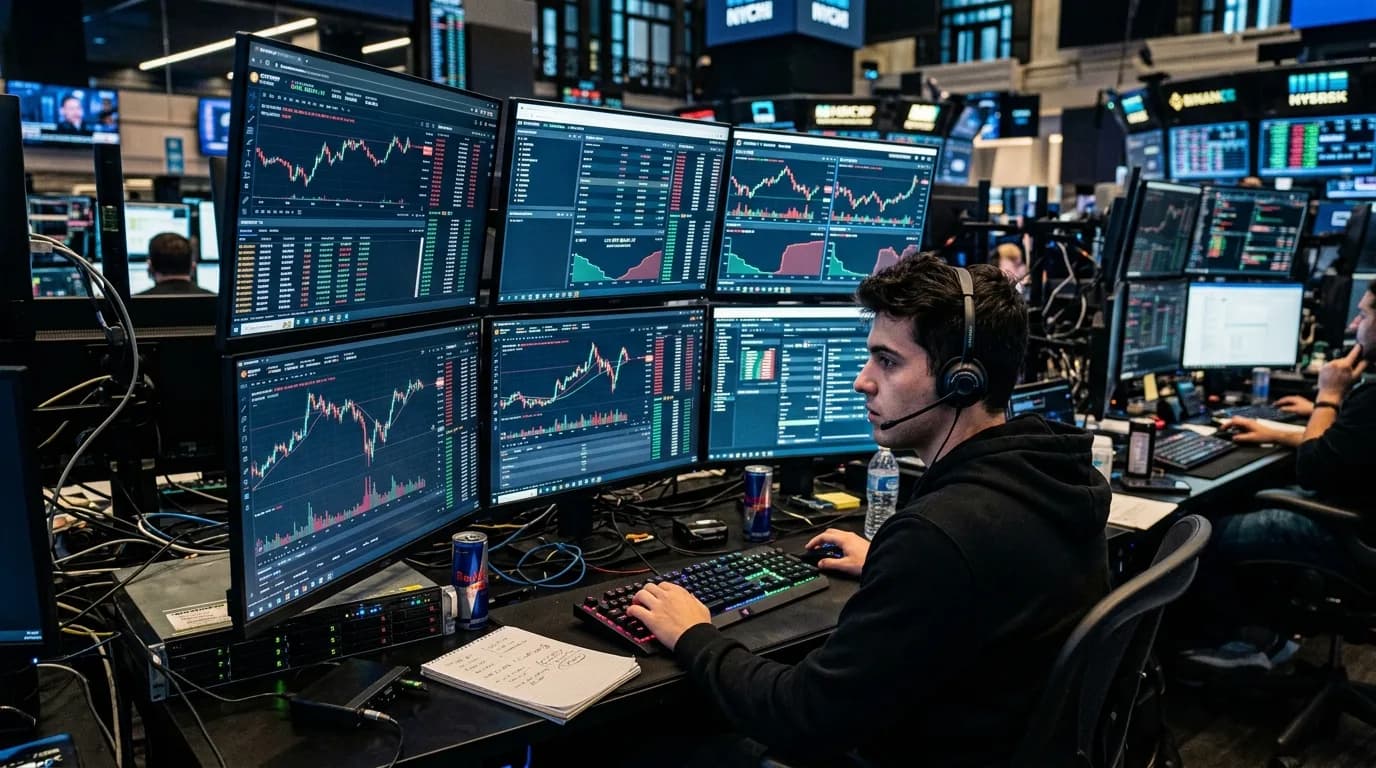
High-Frequency Trading (HFT) represents the extreme end of algorithmic trading, where strategies execute thousands to millions of orders per day with holding periods measured in microseconds to milliseconds. These systems exploit fleeting market inefficiencies that exist for fractions of a second, relying on ultra-low latency infrastructure, co-located servers, and sophisticated statistical models to generate consistent profits from razor-thin margins.
While HFT is often portrayed as a mysterious «black box» domain accessible only to billion-dollar hedge funds, understanding its core principles is valuable for any algorithmic trader. The concepts that drive HFT — latency optimization, market microstructure awareness, and statistical edge quantification — apply across all timeframes, from microsecond scalping to daily swing trading.
Core HFT Strategies
Most HFT activity falls into several well-defined categories, each exploiting different aspects of market structure:
| Strategy Type | Mechanism | Typical Holding Period | Edge Source |
|---|---|---|---|
| Market Making | Continuously posting bid/ask quotes, earning the spread | Seconds to minutes | Spread capture & rebates |
| Statistical Arbitrage | Exploiting temporary price divergences between correlated assets | Milliseconds to seconds | Mean reversion of spreads |
| Latency Arbitrage | Acting on price updates faster than competing venues can adjust | Microseconds | Speed advantage |
| Event-Driven | Parsing news feeds or data releases and reacting before humans | Milliseconds to minutes | Information processing speed |
| Order Flow Prediction | Detecting large institutional orders from pattern recognition | Milliseconds to seconds | Anticipating price impact |
The Technology Stack
HFT firms invest heavily in infrastructure to shave microseconds off execution times. The typical technology requirements include:
- Co-location: placing servers physically next to exchange matching engines to minimize network latency (typically under 50 microseconds)
- FPGA / ASIC hardware: field-programmable gate arrays that process market data in hardware rather than software, achieving sub-microsecond decision times
- Custom network stacks: bypassing the operating system’s TCP/IP stack with kernel-bypass technologies like DPDK or Solarflare OpenOnload
- Tick-to-trade pipeline: the entire path from receiving a market data update to sending an order, optimized to single-digit microseconds
The capital requirements for competitive HFT are substantial. Co-location fees at major exchanges range from $5,000 to $20,000 per month, custom hardware runs into hundreds of thousands of dollars, and the engineering talent to build and maintain these systems commands premium salaries.
HFT in Cryptocurrency Markets
Crypto markets present a unique environment for high-frequency strategies. Unlike traditional equities, crypto exchanges operate 24/7, offer direct market access without broker intermediaries, and feature significant cross-exchange price discrepancies. This creates opportunities that do not exist in more mature markets:
- Cross-exchange arbitrage: price differences between Binance, Bybit, and other venues can persist for seconds rather than microseconds, making them accessible to moderately fast systems
- Funding rate arbitrage: exploiting the basis between perpetual futures and spot prices, particularly during extreme funding periods
- DEX/CEX arbitrage: price discrepancies between decentralized and centralized exchanges, factoring in gas costs and slippage
- Liquidation cascades: front-running predictable liquidation events on leveraged positions
However, crypto HFT also faces unique challenges: exchange API rate limits, higher and more variable latency compared to traditional markets, and the risk of exchange downtime during volatile periods.
Key Performance Metrics for HFT
Evaluating HFT strategies requires different metrics than those used for longer-timeframe systems:
| Metric | What It Measures | Typical Target |
|---|---|---|
| Win Rate | Percentage of profitable trades | > 55% for market making |
| Profit per Trade | Average net profit including fees | $0.01 – $0.50 |
| Sharpe Ratio (daily) | Risk-adjusted return consistency | > 3.0 annualized |
| Maximum Drawdown | Worst peak-to-trough decline | < 5% of capital |
| Fill Rate | Percentage of posted orders that execute | Strategy-dependent |
| Latency (p99) | 99th percentile execution speed | < 1ms for crypto |
What Regular Traders Can Learn from HFT
Even if you never build an HFT system, several principles transfer directly to standard algorithmic trading. Execution quality matters — slippage and fees compound across hundreds of trades and can turn a profitable strategy into a losing one. Market microstructure awareness helps you understand why certain price levels hold or break. And the discipline of measuring every aspect of performance, from fill quality to latency, applies at any timeframe.
On StratBase.ai, while the platform focuses on backtesting strategies from 1-second to daily timeframes rather than microsecond HFT, the same analytical rigor applies. Every backtest accounts for realistic slippage modeling, exchange-specific fee structures, and precise entry/exit timing — the same factors that determine success or failure in high-frequency environments, just at a more accessible timescale.
Understanding HFT also helps retail traders recognize its market impact. The liquidity provided by HFT market makers narrows spreads and reduces trading costs for everyone. At the same time, being aware of latency arbitrage and order flow prediction helps you design strategies that are robust against these faster participants rather than vulnerable to them.
Further Reading
About the Author
Quantitative researcher with 8+ years in algorithmic trading and strategy backtesting. Specializes in technical indicator analysis and risk-adjusted performance metrics.
FAQ
What is high-frequency trading?▾
HFT uses extremely fast computers and algorithms to trade in microseconds (millionths of a second). Strategies include: latency arbitrage (exploiting tiny price differences between exchanges faster than competitors), market making (providing liquidity and earning the spread thousands of times per second), and statistical arbitrage at ultra-short timeframes. HFT accounts for 50-70% of US equity volume.
Can retail traders do HFT?▾
No. HFT requires: co-located servers ($10K-$50K/month rent next to exchange), custom hardware (FPGAs, ASICs), microsecond-level latency, and massive capital. The speed advantage is measured in nanoseconds — retail with a home internet connection is millions of times too slow. However, understanding HFT helps you understand market behavior and avoid being exploited by HFT strategies.
Further reading
Related articles
Comments (0)
Loading comments...